How to Build Your Own Generative AI Solution?
 By
Gillian Harper
|
Feb 23, 2026 |
Artificial Intelligence
By
Gillian Harper
|
Feb 23, 2026 |
Artificial Intelligence
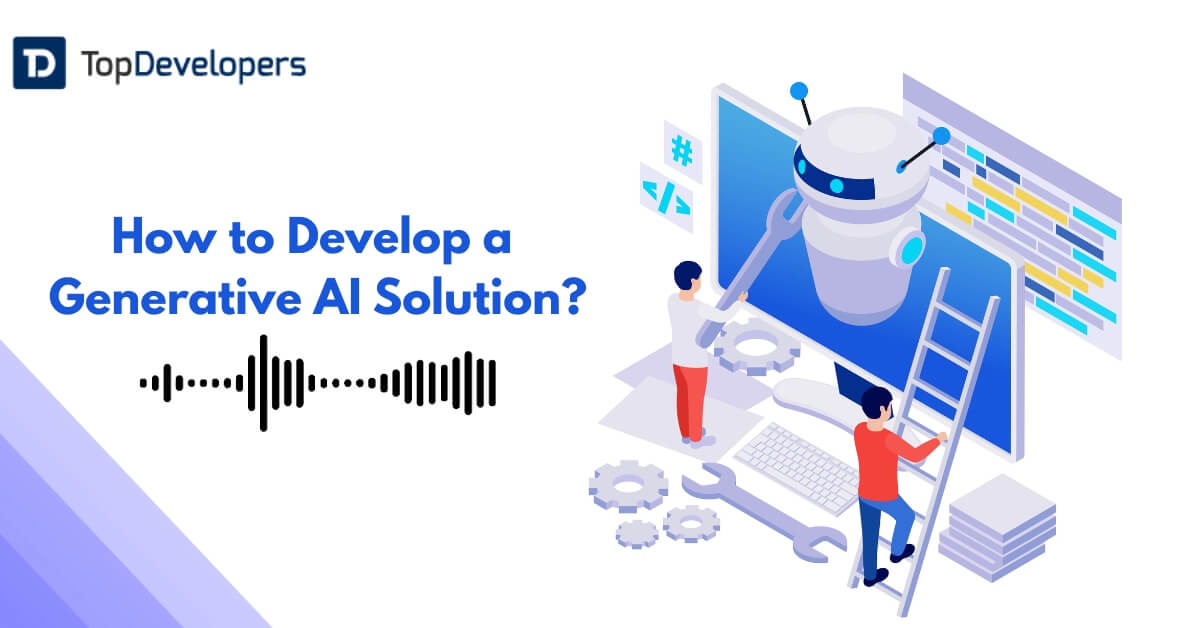
Building your own generative AI solution has become a strategic priority for organizations seeking to automate workflows, improve productivity, and gain competitive advantage through intelligent automation. A generative AI solution is a software system that uses trained AI models to generate human like text, code, summaries, images, or other outputs based on user input and enterprise data. Unlike traditional software, these systems can understand context, generate new information, and continuously improve performance based on data and usage patterns. Businesses are increasingly developing custom generative AI solutions to integrate intelligence directly into their applications, internal tools, and customer facing platforms.
The growing adoption of generative AI is driven by its measurable business impact and ability to enhance operational efficiency across functions such as customer support, software development, and enterprise search. According to McKinsey & Company, generative AI has the potential to generate between $2.6 trillion and $4.4 trillion annually in economic value by improving productivity and automating complex tasks across industries. At the same time, enterprise adoption is accelerating rapidly, with Gartner reporting that more than 80 percent of enterprises are expected to use generative AI APIs or deploy generative AI enabled applications in production environments by 2026. These trends highlight the increasing importance of building tailored generative AI solutions aligned with specific business requirements.
Developing your own generative AI solution provides greater control over data, customization, system integration, and long term scalability compared to using generic tools. Organizations can train models using proprietary data, integrate AI into internal systems, and design architectures optimized for performance and security. However, building such a system requires careful planning, including selecting the right model, designing scalable architecture, preparing quality data, and managing infrastructure. Understanding the complete development process is essential for building reliable, efficient, and production ready generative AI solutions that deliver real business value.
Table of Contents
Understanding Generative AI Solutions Before Development
Before you build your own generative AI solution, it is critical to understand what the system actually consists of at an implementation level. Many businesses approach generative AI as a standalone model or chatbot feature, but in reality it is a structured software system that integrates models, data pipelines, infrastructure, and application layers. A clear understanding of these components ensures that development decisions are aligned with long term scalability, security, and performance requirements.
What Is a Generative AI Solution in Practical Implementation Terms?
In practical terms, a generative AI solution is an integrated software system that uses trained AI models to produce new outputs such as text, code, summaries, images, or structured data based on user input and contextual information. It is not simply an API connection to a large language model. Instead, it combines model inference, enterprise data retrieval, application logic, and user interfaces into a unified architecture.
At the system level, a generative AI solution typically performs the following sequence:
- Accepts user input through an application interface
- Processes and enriches that input with relevant enterprise data
- Sends the processed context to a trained generative model
- Receives generated output
- Applies validation or formatting logic before delivering the response
For example, an enterprise generative AI chatbot does not just generate responses from a model. It retrieves internal documents, converts them into embeddings, queries a vector database for relevant context, and then produces grounded responses. This layered structure distinguishes a production grade generative AI system from simple experimental integrations.
Key Components That Make Up a Generative AI Solution
A functional generative AI solution consists of several core components working together. Understanding these elements is essential before beginning development.
1. AI Model Layer
This is the intelligence engine of the system. It may be a pretrained foundation model accessed via API, a fine tuned model trained on proprietary data, or a custom trained model. The model is responsible for generating outputs based on input prompts and contextual data.
2. Data Layer
Generative AI systems rely heavily on data. This includes structured databases, unstructured documents, knowledge bases, and external datasets. Data must be cleaned, organized, and often transformed into embeddings for retrieval.
3. Retrieval and Context Layer
In enterprise environments, models are frequently enhanced with retrieval mechanisms that fetch relevant information before generation. This improves factual accuracy and domain relevance.
4. Application Layer
This includes the user interface, backend logic, APIs, and integration points that allow users or other systems to interact with the AI. It connects the generative model to real business workflows.
5. Infrastructure Layer
This supports compute, storage, scaling, and deployment. Generative AI solutions require significant processing power, often supported by cloud platforms and GPU acceleration to handle inference efficiently.
A generative AI solution only becomes production ready when all these layers are properly designed and integrated.
Common Use Cases That Require Building Custom Generative AI Solutions
Organizations often build their own generative AI solutions when off the shelf tools do not meet their performance, security, or integration requirements. Custom development becomes necessary when proprietary data, domain specificity, or workflow integration is central to the business objective.
Enterprise Chatbots Trained on Internal Knowledge
Companies develop custom AI chatbots trained on internal documentation, policy manuals, product data, and support knowledge bases. Unlike generic chatbots, these systems provide context aware, organization specific responses while maintaining data privacy and compliance standards.
Automated Content Generation Systems
Marketing teams and ecommerce platforms build generative AI solutions to automatically generate product descriptions, reports, ad copy, and personalized communication. Custom systems allow alignment with brand voice, regulatory requirements, and integration with content management systems.
Internal AI Assistants for Employee Productivity
Businesses implement internal AI assistants that help employees draft emails, summarize meetings, generate reports, or retrieve internal information. These assistants are connected directly to enterprise data sources and productivity tools, enabling contextual and secure interactions.
AI Powered Document Processing and Summarization
Enterprises handling large volumes of contracts, compliance documents, research papers, or legal records build generative AI systems to extract insights and generate summaries. Custom solutions ensure accuracy, confidentiality, and compatibility with existing document management systems.
Understanding these use cases and system components provides clarity on what you are building. Only after defining the structure, purpose, and architecture of your generative AI solution should you move into detailed development planning.
Why Do You Need Your Own Generative AI Solution?
While off-the-shelf generative AI tools are powerful and accessible, they often fall short when it comes to addressing specific business requirements. Businesses that rely solely on public models may face limitations in accuracy, customization, data control, and long-term scalability. Building your own generative AI solution allows you to overcome these limitations and provides strategic advantages that can differentiate your business in the market.
Limitations of Off-the-Shelf Generative AI Models
Pre-trained public AI models like GPT, DALL·E, or MidJourney are designed for general-purpose use and trained on broad datasets. While they perform well for generic tasks, they may not meet the requirements of niche industries or specialized use cases. Some common limitations include:
- Lack of domain expertise: Generic models may produce outputs that are inaccurate or irrelevant for industry-specific tasks, such as legal document generation, medical reports, or scientific content.
- Limited customization: You cannot easily modify their behavior, tone, or style to match your brand or business objectives.
- Data privacy concerns: Using third-party APIs may expose sensitive business or customer data.
- Dependence on external providers: Model updates, pricing, and availability are outside your control, which can impact reliability and long-term strategy.
Benefits of Building a Custom Generative AI Solution
Developing your own generative AI system addresses the limitations of public models and provides numerous advantages for businesses:
- Domain specificity: Training on proprietary data ensures the AI understands your industry’s terminology, standards, and processes, producing highly accurate outputs.
- Data ownership and compliance: You maintain complete control over your data, enabling compliance with privacy regulations such as GDPR, HIPAA, or CCPA.
- Behavioral control: Customize the AI to align with your company’s tone, style, and ethical guidelines.
- Competitive differentiation: A unique, custom-built model can offer capabilities that competitors cannot replicate, providing a strategic edge.
- Cost efficiency at scale: Owning the model infrastructure and training process can reduce dependency on third-party APIs and lower costs as usage grows.
Evolving Client Expectations
Today’s clients expect personalized, context-aware, and high-quality experiences. Generic models often fall short in delivering the level of customization and precision required for enterprise-grade applications. Businesses that invest in custom generative AI solutions are better equipped to meet these evolving expectations, enhance customer satisfaction, and create long-term loyalty.
For example, a customer support AI trained specifically on a company’s historical interactions can provide more accurate, helpful, and contextually relevant responses than a general-purpose chatbot. Similarly, a retail recommendation engine powered by a custom generative model can deliver personalized product suggestions that increase conversion rates and drive revenue.
For additional insights on how generative AI is influencing client expectations and transforming software projects, you can refer to this resource: Generative AI changing client expectations.
Step by Step Process to Build Your Own Generative AI Solution
Building your own generative AI solution involves more than selecting a model and integrating it into an application. It requires a structured development approach that ensures the system delivers accurate outputs, scales efficiently, and aligns with business objectives. Each step plays a critical role in transforming generative AI from an experimental capability into a reliable production system. The following process outlines the essential stages involved in designing, developing, and deploying a generative AI solution.
Step 1: Define the Problem and Objective the AI Solution Will Solve
The foundation of any successful generative AI solution begins with clearly defining the problem it is intended to solve. Without a well defined objective, development efforts can become unfocused, resulting in a system that fails to deliver measurable value. Organizations must identify whether the goal is to automate customer support, generate content, assist employees, summarize documents, or enhance search capabilities.
This step involves understanding the end users, expected outputs, and success criteria. For example, a customer support assistant must generate accurate responses based on internal knowledge, while a content generation system must produce consistent, brand aligned content. Defining performance metrics such as response accuracy, generation speed, and user adoption helps guide architecture, model selection, and infrastructure planning. A clearly defined objective ensures that the generative AI solution is built to solve a specific operational or technical challenge rather than functioning as a generic AI integration.
Step 2: Identify and Prepare the Data Required for Training or Context
Data is one of the most critical components of a generative AI solution. The model’s ability to generate relevant and accurate outputs depends heavily on the quality, structure, and relevance of the data it uses. This step involves identifying data sources, collecting relevant information, and preparing it for use within the AI system.
Structured Data Sources Such as Databases
Structured data includes organized information stored in relational databases, spreadsheets, and enterprise systems such as CRM, ERP, or product management platforms. This data often contains customer records, product information, transaction history, or operational metrics. Structured data can be used to provide contextual information that improves the accuracy and usefulness of generated responses.
Unstructured Data Sources Such as Documents and Text
Unstructured data is one of the most valuable resources for generative AI systems. This includes documents, PDFs, emails, knowledge base articles, reports, contracts, and web content. These sources allow the AI system to understand organizational knowledge and generate responses based on real internal information. Most enterprise generative AI systems rely heavily on unstructured data to provide context aware outputs.
Data Preprocessing and Quality Improvement
Raw data cannot be used directly without preparation. Data preprocessing involves cleaning, formatting, removing duplicates, and organizing content to ensure consistency and usability. In many cases, unstructured data is converted into embeddings so that it can be efficiently retrieved during model inference. High quality, well structured data improves model accuracy, reduces incorrect outputs, and enhances overall system performance.
Step 3: Choose the Right Generative AI Model Based on Your Requirements
Selecting the appropriate model is a critical technical decision that affects system performance, cost, scalability, and customization capability. The model must align with the use case, accuracy requirements, and infrastructure constraints.
Using Pretrained Models Through APIs
Pretrained models accessed through APIs provide the fastest and most cost effective way to build generative AI solutions. These models are already trained on large datasets and can generate high quality outputs without requiring custom training. They are suitable for applications such as chatbots, content generation, and productivity assistants where general language understanding is sufficient.
Fine Tuning Existing Models With Custom Data
Fine tuning improves model performance by training it further on domain specific data. This approach is used when organizations require higher accuracy, industry specific knowledge, or specialized output formats. Fine tuning allows the model to better understand internal terminology, workflows, and content patterns.
Training Custom Models From Scratch
Training a model from scratch is the most complex and resource intensive approach. It requires large datasets, specialized expertise, and significant computational resources. This approach is typically used by organizations with highly specialized requirements, strict data privacy needs, or unique use cases that cannot be supported by pretrained models.
Step 4: Design the System Architecture for Your Generative AI Solution
System architecture defines how all components interact, including the model, data sources, infrastructure, and application interface. A well designed architecture ensures scalability, reliability, and efficient performance.
Model Integration Architecture
This defines how the application communicates with the AI model. It includes inference pipelines, request handling, and response processing. Proper integration ensures efficient communication between the application and the model.
Data Pipeline Architecture
The data pipeline manages data ingestion, preprocessing, storage, and retrieval. It ensures that relevant information is available to the model when needed. A well designed pipeline improves accuracy and reduces latency.
Application Integration Architecture
This layer connects the AI system to web applications, mobile apps, enterprise software, or internal tools. It ensures seamless interaction between users and the generative AI system.
Infrastructure Architecture
Infrastructure architecture defines how compute, storage, and networking resources support the AI system. This includes cloud platforms, GPU resources, containerization, and deployment environments. Proper infrastructure planning ensures the system can scale as usage increases.
Step 5: Develop and Integrate the Generative AI Model Into Your Application
Once architecture and models are selected, the next step is to develop and integrate the AI system into the application environment. This involves implementing backend logic, connecting data sources, and creating user interfaces.
Backend Integration
Backend integration involves connecting the AI model with data pipelines, APIs, and business logic. This ensures that user inputs are properly processed and relevant data is supplied to the model.
Frontend Integration
Frontend integration provides the user interface through which users interact with the generative AI system. This may include chat interfaces, dashboards, or embedded AI features within applications.
API Implementation
APIs allow applications to communicate with the AI model and enable integration with other systems. Proper API design ensures flexibility, scalability, and secure communication.
Step 6: Test the Generative AI System for Accuracy, Performance, and Reliability
Testing ensures that the system performs correctly under different conditions and generates accurate outputs. This step is essential before deploying the system in a production environment.
Functional Testing
Functional testing verifies that the system operates as expected and responds correctly to user inputs.
Accuracy Testing
Accuracy testing evaluates the quality and relevance of generated outputs. This helps identify incorrect or misleading responses and improve system performance.
Performance Testing
Performance testing measures system speed, latency, and scalability. This ensures the system can handle real user workloads without performance degradation.
Step 7: Deploy the Generative AI Solution to Production Environment
Deployment involves making the generative AI system available to users in a live environment. Deployment strategy depends on security, scalability, and infrastructure requirements.
Cloud Deployment
Cloud deployment provides scalability, flexibility, and access to GPU resources. It is the most common deployment approach for generative AI solutions.
On Premise Deployment
On premise deployment is used when businesses require full control over data and infrastructure. This approach is common in highly regulated industries.
Hybrid Deployment
Hybrid deployment combines cloud and on premise infrastructure. It allows organizations to balance scalability with data security and compliance requirements.
Step 8: Monitor, Maintain, and Continuously Improve the AI Solution
Building the solution is only the beginning. Continuous monitoring and improvement are essential to maintain performance and accuracy over time.
Performance Monitoring
Monitoring tools track system performance, response quality, and infrastructure utilization. This helps identify issues and optimize performance.
Model Updates and Retraining
Models must be periodically updated or retrained using new data to maintain accuracy and relevance as business needs evolve.
Infrastructure Optimization
Infrastructure must be optimized to ensure cost efficiency and scalability. This includes adjusting compute resources, improving system efficiency, and managing operational costs.
Following this structured development process ensures that your generative AI solution is reliable, scalable, and capable of delivering consistent value in real world applications.
Conclusion
Building your own generative AI solution is a strategic process that involves careful planning, the right technology selection, and a scalable system architecture. It is not limited to integrating a pretrained model into an application. A production ready generative AI system requires clearly defined objectives, high quality data preparation, appropriate model selection, robust infrastructure, and seamless integration with existing applications. Each stage of development, from defining the use case to deployment and continuous monitoring, directly impacts the system’s accuracy, performance, and long term reliability.
Organizations that successfully build generative AI solutions focus on aligning the system with real business needs rather than adopting AI without a clear purpose. Selecting the right model approach, whether using pretrained models, fine tuning, or custom training, depends on factors such as data availability, accuracy requirements, cost constraints, and scalability goals. Equally important is designing a flexible architecture that supports future growth, handles increasing workloads, and ensures secure access to enterprise data. In cases where internal expertise is limited, businesses often evaluate experienced generative AI development companies to understand implementation approaches, architecture patterns, and best practices before building their own solutions.
As generative AI continues to evolve, building custom solutions allows organizations to gain greater control, improve automation, and create intelligent systems tailored to their workflows. Businesses that invest in well designed generative AI architecture and implementation processes can improve productivity, enhance user experiences, and unlock new operational capabilities. By following a structured and technically sound development approach, organizations can successfully build generative AI solutions that deliver measurable value and remain scalable for future advancements.
Gillian Harper
| Feb 23, 2026
A professionally engaged blogger, an entertainer, dancer, tech critic, movie buff and a quick learner with an impressive personality! I work as a Senior Process Specialist at Topdevelopers.co as I can readily solve business problems by analyzing the overall process. I’m also good at building a better rapport with people!