Risk Management in Software Development Explained
 By
Avantika Shergil
|
Jan 12, 2026 |
Software Development
By
Avantika Shergil
|
Jan 12, 2026 |
Software Development
One-third of software development projects fail or are abandoned outright because of cost overruns, delays, and scope creep. The statistics determine that effective risk management during the software development process can reduce failure rates by preventing cost and schedule overruns, and proactively identifying the issues.
Businesses can stay assured of successful, high-quality delivery when risk management is considered a critical aspect of the software development procedure and not ignored at any cost. In this blog, we will dive deeper into the importance of software project risk management, the types of risk management, and how to manage the risk in a step-by-step way during the SDLC Process.
Table of Contents
What is Risk Management in SDLC?
Risk management in the Software Development Life Cycle (SDLC) is a systematic, proactive process of identifying, navigating, and mitigating potential risks that hinder a software project’s success. It involves analyzing uncertainties and potential challenges early on that may arise during different stages of the SDLC process and implementing strategies to address them effectively with continuous risk monitoring.
Top Software Development Risks (2026-Ready List) and Mitigations
Software development risks in 2026 are no longer limited to missed deadlines or budget overruns. Modern projects operate in fast-changing ecosystems shaped by cloud dependencies, AI adoption, distributed teams, cybersecurity threats, and constant scope evolution. Below is a practical, up-to-date list of the most common software development risks, along with proven mitigation strategies used by experienced delivery teams.
Unclear or Continuously Changing Requirements
Risk:
Vague requirements or uncontrolled scope changes lead to rework, delivery delays, and stakeholder dissatisfaction.
Mitigation:
- Conduct structured requirement discovery workshops early
- Maintain a prioritized backlog with clear acceptance criteria
- Introduce formal change-control or sprint-based scope evaluation
- Validate requirements with prototypes or wireframes before development
Technical Debt Accumulation
Risk:
Quick fixes, outdated frameworks, or rushed codebases create long-term maintenance and scalability problems.
Mitigation:
- Schedule technical debt reviews each sprint or release cycle
- Allocate fixed capacity (10–20%) for refactoring
- Enforce coding standards and automated code quality checks
- Track technical debt items as visible backlog tasks
Cybersecurity and Data Privacy Threats
Risk:
Security vulnerabilities, data breaches, and non-compliance with regulations (GDPR, HIPAA, etc.) can result in legal, financial, and reputational damage.
Mitigation:
- Integrate security reviews into every SDLC phase
- Perform regular vulnerability scans and penetration testing
- Apply secure coding practices and least-privilege access
- Conduct threat modeling for high-risk features
Dependency on Third-Party APIs, Vendors, or Open-Source Components
Risk:
External services may change pricing, deprecate features, experience downtime, or introduce security flaws.
Mitigation:
- Assess vendor risks during architecture planning
- Maintain fallback options or abstraction layers
- Monitor third-party SLAs and release notes
- Regularly audit open-source dependencies for vulnerabilities
Skill Gaps and Team Turnover
Risk:
Loss of key personnel or lack of expertise in modern technologies (cloud, AI, DevOps) slows delivery and increases errors.
Mitigation:
- Cross-train team members and document critical knowledge
- Maintain updated technical documentation
- Use pair programming and code reviews to reduce knowledge silos
- Plan onboarding buffers for critical roles
Inaccurate Time and Cost Estimation
Risk:
Optimistic estimates cause missed deadlines, budget overruns, and loss of stakeholder trust.
Mitigation:
- Break work into smaller, estimable tasks
- Use historical data for forecasting
- Apply buffer planning for high-uncertainty features
- Re-estimate regularly as new risks emerge
Poor Communication Across Distributed Teams
Risk:
Remote and globally distributed teams may experience delays, misunderstandings, and alignment issues.
Mitigation:
- Establish clear communication protocols and escalation paths
- Use documented decisions instead of verbal agreements
- Schedule regular sync-ups and sprint reviews
- Align on shared tools for tracking risks and progress
Inadequate Testing and Quality Assurance
Risk:
Insufficient testing increases production defects, rework, and customer churn.
Mitigation:
- Shift testing left (early in development)
- Automate regression and integration tests
- Define quality benchmarks before development starts
- Track defect trends to identify systemic risks
Performance and Scalability Failures
Risk:
Applications may fail under real-world load, leading to outages and poor user experience.
Mitigation:
- Conduct performance testing early, not post-launch
- Design scalable architectures from the start
- Monitor production performance metrics continuously
- Use load testing before major releases
Lack of Ongoing Risk Monitoring
Risk:
Risks identified early become outdated or ignored as the project evolves.
Mitigation:
- Maintain a living risk register
- Review risks during sprint planning or release checkpoints
- Assign clear ownership to every high-impact risk
- Track risk trends instead of treating risks as one-time items
Different Types of Risks that Occur During SDLC Phases
Knowing the different types of risks that occur during SDLC is important because it needs a unique strategy and approach to resolve them.
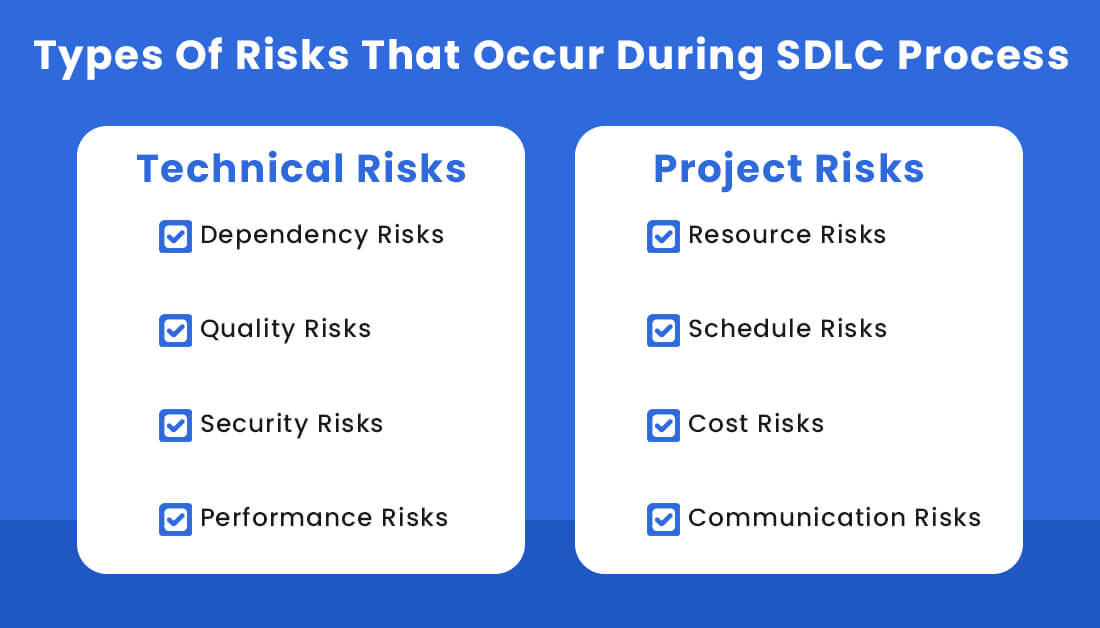
Take a quick look at different risks that are categorized into several broad types.
Technical Risks
These risks are related to the technology and tools used in the software development process. Examples include compatibility issues, performance bottlenecks, security vulnerabilities, or challenges with integrating new technologies.
Dependency Risks: Dependency risks refer to the reliance on external parties or components, such as third-party APIs, vendors, or other systems. Failures or issues with these dependencies can affect the project’s progress and functionality.
Quality Risks: Quality risks relate to the potential for defects, bugs, or usability issues in the software product. Inadequate testing, poor code quality, or ineffective quality assurance processes contribute to quality risks.
Security Risks: Security risks involve vulnerabilities and threats that could compromise the security of the software application. These risks may include data breaches, unauthorized access, or lack of proper encryption measures.
Performance risks: This risk highlights when the software fails to meet the performance expectations such as high loading time, downtime, and crashes.
Project Risks
The project risks include all the issues that arise due to uncertainties or ambiguities in project management. This may lead to scope creep, incomplete specifications, or changes in user needs that impact the project’s timeline, cost, and deliverables.
Resource Risks: Resource risks pertain to challenges related to the availability and allocation of human resources, equipment, and other necessary assets. These risks may result in delays, inadequate expertise, or resource shortages.
Schedule Risks: Schedule risks are associated with project timelines and deadlines. Unforeseen complexities, dependencies on external factors, or delays in deliverables can impact the software project’s schedule.
Cost Risks: Cost risks involve potential deviations from the project budget. These risks may arise due to underestimating expenses, cost overruns, changes in requirements, or external economic factors.
Communication Risks: Communication risks involve breakdowns in communication among project stakeholders, team members, or external parties. Misunderstandings and lack of clear communication can impact decision-making and lead to misalignment.
The Importance of Risk Management During SDLC
Risk management helps identify, assess, and mitigate potential risks that could impact software project development.
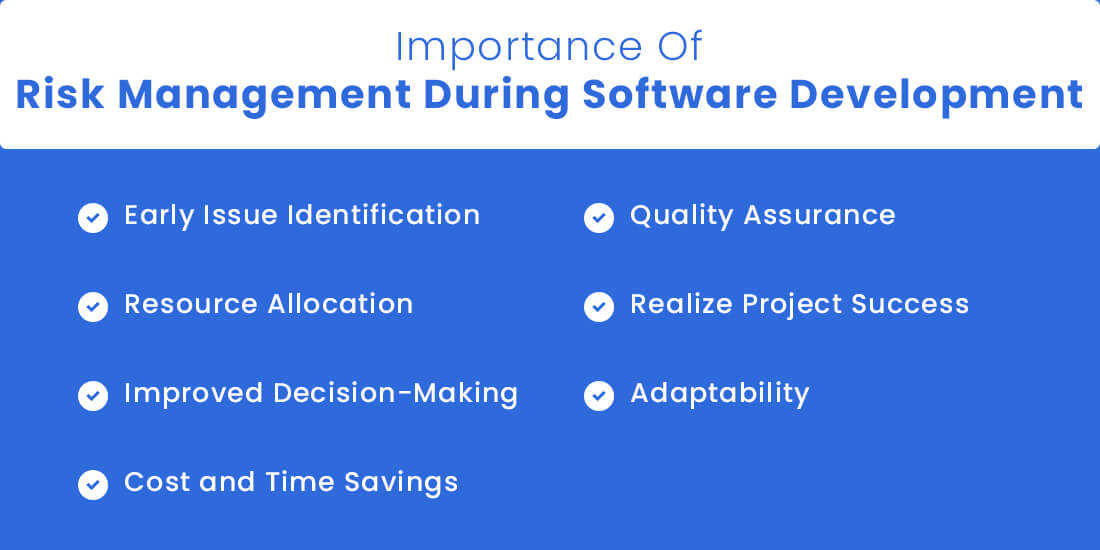
Here’s why risk management is important in SDLC:
Early Issue Identification
Risk management allows software development teams to identify potential issues and challenges early in the project. By proactively addressing risks, dedicated teams can avoid costly and time-consuming problems later in the software development process.
Resource Allocation
Assessing risks helps in allocating resources appropriately. By understanding potential risks, project managers can allocate time, budget, and manpower effectively, ensuring a smoother development process of software.
Improved Decision-Making
Risk management enables informed decision-making. When project stakeholders are aware of potential risks and their impact, they can make well-informed decisions to mitigate or accept risks based on their potential consequences.
Cost and Time Savings
Addressing risks early on prevents rework and costly fixes later in the project. This results in optimal cost and time savings during the software development process.
Quality Assurance
Effective risk management ensures that potential quality issues are identified and addressed, leading to a higher-quality end product.
Realize Project Success
Properly managed risks increase the chances of project success. By addressing potential challenges, the project team-building software can stay on track and meet project goals effectively.
Adaptability
In an ever-changing technological landscape, risk management allows teams to adapt to unexpected challenges and uncertainties effectively that may occur during the different SDLC stages.
How to Identify Risks During Software Development?
Identifying risks during the development of software is a vital step in the risk management process. By using a combination of these methods, software development teams can comprehensively identify risks and develop appropriate risk mitigation strategies.
Here are some effective methods to identify risks during software development:
- SWOT analysis
- Prototyping
- Feedback from users through surveys
- Brainstorming sessions
- Expert consultation
How to Manage Risk During the Software Development Life Cycle?
The 7 stages of the software development life cycle are important to software success. Similarly, risk management is vital for quality software product delivery.
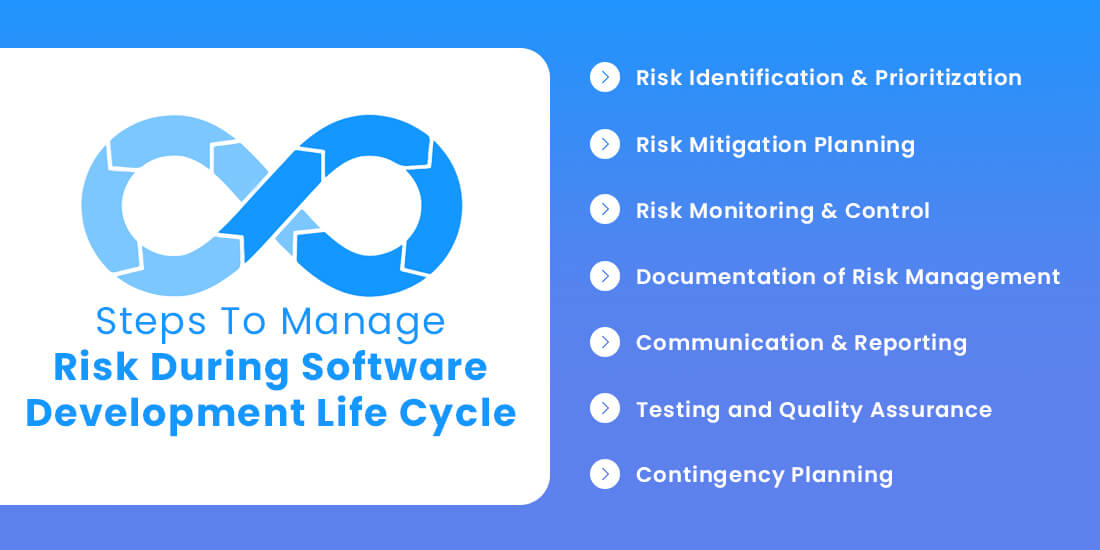
Here we will learn in a step-by-step guide on how to manage risk during the SDLC process:
Risk Identification and Prioritization
Firstly, identify potential risks of software development by involving stakeholders, development team members, and subject matter experts. Create a risk register to document identified risks and their descriptions. Thereafter, evaluate the impact and likelihood of each identified risk using qualitative and quantitative methods. It further helps in prioritizing risks based on their severity and potential impact on the software project, so that the risk adversity on the project is reduced.
Risk Mitigation Planning
Create strategies to mitigate high-priority risks. These strategies can include prevention, mitigation, assessment, acceptance, contingency plans, or risk transfer. When software development is outsourced and a team is hired, the responsibilities are assigned for each risk to specific team members to ensure accountability.
Risk Monitoring and Control
It’s necessary to continuously monitor the identified risks throughout the process of SDLC. Regularly monitor and update the risk register with the latest information that helps know how risk management strategies are working. Later, review and adjust risk mitigation strategies as the project progresses and new risks pops-up to ensure the impact of risk is diminished.
Documentation of Risk Management
Maintaining detailed documentation of software development risk management activities, including risk assessments, mitigation plans, and their outcomes is quite helpful. The lessons learned from past projects help in improving risk management practices in future projects.
Communication and Reporting
Maintaining open communication with all stakeholders about the identified risks and their status ensures that everyone is on the same page. So, provide regular risk reports to project sponsors, management, and other stakeholders, highlighting progress on software development risk mitigation efforts.
Testing and Quality Assurance
Comprehensive testing is conducted to identify and address software defects early, reducing the risk of critical issues during the later stages of software development life cycle. Implementing robust quality assurance practices ensures that software meets the required standards and specifications.
Contingency Planning
Developing contingency plans for high-impact software development risks that may occur despite mitigation efforts is all-important. It’s good to identify alternative approaches to be taken if certain risks materialize.
KPIs to Prove Your Risk Management in Software Development Works
Risk management in software development only creates value when it leads to measurable improvements in delivery stability, quality, and predictability. Simply maintaining a risk register is not enough. Teams must be able to demonstrate that identified risks are being reduced and that fewer surprises are reaching production.
The following key performance indicators are widely used by experienced engineering leaders, delivery managers, and product teams to evaluate whether risk management practices are working throughout the software development lifecycle.
Risk exposure score trend
This KPI metric represents the combined level of active risks at any point in time. It is usually calculated by multiplying the probability and impact score for each risk and then aggregating the values.
Tracking the trend of risk exposure over time is more important than focusing on individual scores. When risk management in software development is effective, the overall exposure gradually declines even as new risks are identified. Sudden spikes indicate new threats, dependency changes, or missed early warning signals that require immediate attention.
Risk identification rate
Risk identification rate measures how frequently new risks are being surfaced during planning sessions, sprint reviews, design discussions, or retrospectives.
A very low identification rate often signals a lack of visibility rather than a lack of risk. Experienced software developers treat continuous risk identification as a healthy behavior. As projects evolve, new technical, security, and operational risks naturally emerge, and capturing them early reduces downstream impact.
Risk resolution rate
This KPI tracks the percentage of identified risks that are mitigated, transferred, accepted, or closed within a defined period.
A strong risk resolution rate shows that software development companies are actively addressing uncertainty instead of allowing risks to linger unresolved. When this KPI metric remains low, it often points to unclear ownership, delayed decision making, or insufficient prioritization of preventive work.
High severity risk aging
High severity risk aging measures how long critical or high impact risks remain open without effective risk mitigation.
Long development periods for severe risks increase the likelihood of production incidents, delivery delays, or security breaches. Monitoring this metric helps businesses identify decision bottlenecks and escalate risks in software development before they become unavoidable issues.
Defect escape rate
Defect escape rate reflects the number of defects discovered in production compared to those identified earlier in software development or testing phases.
From a software development risk management perspective, production defects represent realized quality risks. A declining defect escape rate indicates that risks related to design flaws, incomplete requirements, or insufficient testing are being addressed earlier in the lifecycle.
Change failure rate
Change failure rate measures the percentage of releases that result in service degradation, rollbacks, or emergency fixes.
This KPI directly connects risk management to release stability. High change failure rates often indicate unmitigated dependency risks, insufficient testing coverage, or rushed deployment decisions. Reducing this metric demonstrates stronger release risk assessment and better operational resilience.
Unplanned work ratio
Unplanned work ratio shows how much team capacity is consumed by reactive tasks such as emergency fixes, hotfixes, or incident recovery.
When this ratio remains high, it typically signals unmanaged technical debt, security gaps, or architectural weaknesses. Effective risk management shifts effort away from firefighting and toward planned delivery.
Schedule variance caused by risk events
This risk management KPI metric isolates delivery delays that occur specifically due to realized risks such as late requirement changes, vendor failures, performance issues, or rework.
Tracking schedule variance caused by risk events helps software development agencies understand which categories of risk have the greatest impact on predictability. Over time, this insight supports better mitigation planning and more realistic delivery commitments.
Incident recurrence rate
Incident recurrence rate measures how often similar production incidents happen due to the same underlying cause.
Repeated incidents indicate that risks are being temporarily patched rather than fully resolved. Monitoring recurrence encourages software companies to focus on root cause elimination and long term risk reduction rather than short term fixes.
Risk burndown rate
Risk burndown rate shows how quickly overall risk exposure decreases across sprints or project milestones.
Visualizing risk burndown alongside delivery metrics provides a clear picture of whether uncertainty is being reduced as development progresses. Consistent improvement in this metric signals disciplined and proactive risk management.
Stakeholder confidence indicator
This qualitative KPI metric captures feedback from stakeholders on delivery predictability, transparency, and confidence in the development process.
While subjective, stakeholder confidence often reflects the real world impact of risk management in software development more accurately than numbers alone. When stakeholders feel informed and confident, it usually means risks are being communicated and managed effectively.
Using KPIs responsibly in software risk management
Effective teams avoid metric overload. Instead of tracking every possible KPI, they focus on trends, relationships between metrics, and how insights inform decisions. Leading indicators such as risk exposure and identification rates should be reviewed alongside outcome metrics like defects, incidents, and delivery delays.
When used consistently, these KPIs help organizations move from reactive problem solving to proactive risk control. This shift is what ultimately makes risk management a competitive advantage rather than an administrative exercise.
Conclusion
Risk management is a part and parcel of the software development life cycle that when taken seriously, businesses could save themselves from the challenges that occur after launching software. The blog has fairly explained the importance of risk management if you are not convinced with the same followed by methods to identify the risks and an 7-step process for risk management in software development.
Consider a proactive and systematic approach to risk management to minimize uncertainties, enhance project success rates, and deliver software on time and within budget. Overcome all the challenges with risk management in the life cycle of software development.
Avantika Shergil
| Jan 12, 2026


Avantika Shergil is a technology enthusiast and thought leader with deep expertise in software development and web technologies. With over 8 years of experience analyzing and evaluating cutting-edge digital solutions, Avantika has a knack for demystifying complex tech trends. Her insights into modern programming frameworks, system architecture, and web innovation have empowered businesses to make informed decisions in the ever-evolving tech landscape. Avantika is passionate about bridging the gap between technology and business strategy, helping businesses build customized software and website, and understand about different tools to leverage effectively for their ventures. Explore her work for a unique perspective on the future of digital innovation.