Top Types of AI Agents in 2026
 By
Avantika Shergil
|
Mar 2, 2026 |
AI agents AI Tools Artificial Intelligence
By
Avantika Shergil
|
Mar 2, 2026 |
AI agents AI Tools Artificial Intelligence
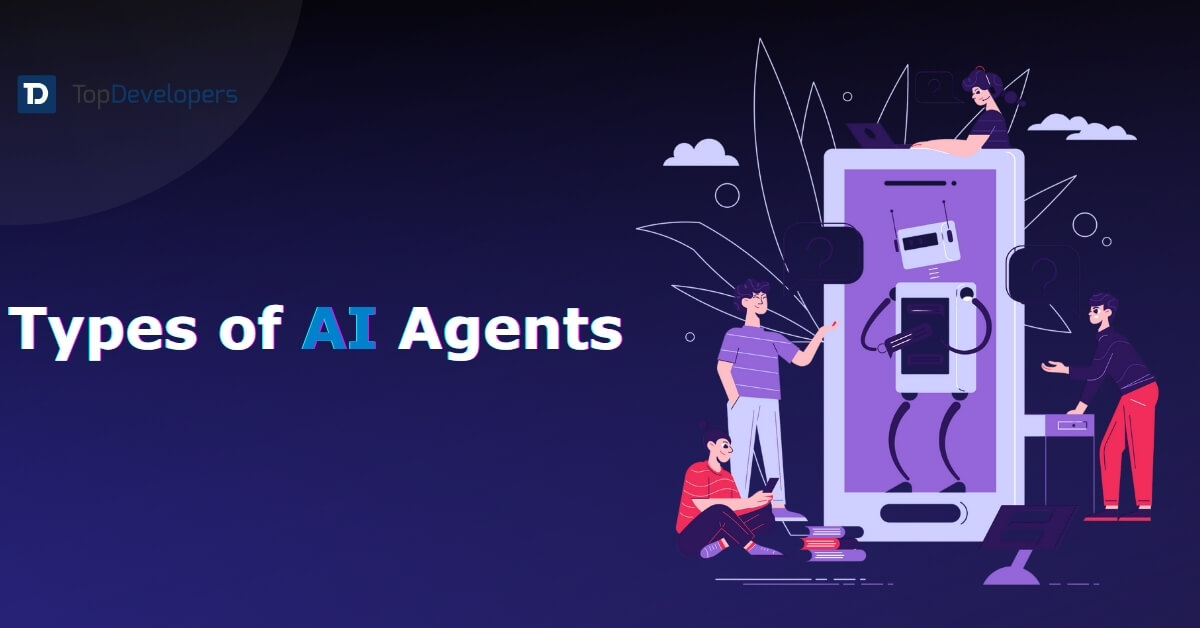
AI has progressed from rule driven automation to intelligent systems capable of independent reasoning and action. At the center of this shift are AI agents, structured software entities that perceive data from their environment, process it through defined logic or learning models, and execute decisions aligned with specific objectives. Unlike conventional applications that rely solely on preprogrammed instructions, an AI agent can respond dynamically to changing inputs and operational conditions.
For businesses exploring automation, analytics, and intelligent process optimization, understanding the types of AI agents is not optional. Different agents in AI are built for different levels of complexity. Some operate on predefined condition based logic, while others evaluate multiple scenarios, optimize decisions using utility functions, or continuously evolve through learning mechanisms. The architecture selected directly influences scalability, accuracy, and long term adaptability.
The market momentum around intelligent systems reflects this growing importance. According to Grand View Research, the global artificial intelligence market size was valued at USD 196.63 billion in 2023 and is projected to grow at a compound annual growth rate of 36.6 percent from 2024 to 2030. This growth signals accelerating enterprise reliance on advanced AI agents to automate workflows, enhance decision making, and create competitive differentiation.
Table of Contents
Top Types of AI Agents
Artificial intelligence systems are not built on a single architectural model. Instead, AI agents are categorized based on how they perceive information, process inputs, and make decisions. This classification helps businesses and technology leaders understand the operational depth of each AI agent and determine its suitability for specific applications. From rule driven automation to adaptive learning systems, the structure of an agent defines its intelligence capacity and autonomy.
The types of AI agents are primarily distinguished by three factors: decision logic, intelligence level, and learning capability. Decision logic determines whether the agent reacts instantly to conditions or evaluates multiple future possibilities. Intelligence level defines how deeply the agent understands its environment. Learning capability differentiates static rule based systems from adaptive agents that improve over time. These distinctions form the foundation for formal categorization in artificial intelligence and play a critical role in guiding strategic AI agent development initiatives.
There is also a natural progression across agents in AI. Basic agents operate using predefined rules with no contextual awareness. More advanced models incorporate environmental memory, goal evaluation, utility optimization, and learning mechanisms. Understanding this progression enables organizations to move beyond simple automation toward intelligent systems that can reason, adapt, and optimize outcomes.
Simple Reflex AI Agents
Simple reflex AI agents represent the most foundational category of agents in AI. These agents operate purely on condition action rules, meaning they respond directly to the current state of the environment without considering past experiences or future consequences. They are designed for environments where inputs are predictable and rules can be clearly defined.
Because they do not maintain internal memory or environmental models, simple reflex agents are efficient and fast. However, their functionality is limited to predefined scenarios. They are best suited for straightforward automation tasks where variability is minimal and outcomes are deterministic.
How Simple Reflex AI Agents Work
Simple reflex agents function using a direct mapping between perception and action. The workflow can be summarized in three steps:
- The Artificial Intelligence agent perceives the current state of the environment through inputs or sensors.
- It matches the perceived state against a predefined condition rule.
- It executes the corresponding action immediately.
There is no historical data retention, internal state modeling, or learning mechanism involved. Every decision is based solely on the present input. If the condition is met, the action is triggered. If it is not, no action occurs.
This approach makes simple reflex AI agents computationally lightweight and easy to implement, but inherently limited in adaptability.
Simple Reflex AI Agents Examples
Common AI agent examples of Model Based AI Agents include:
- Basic rule based chat systems that respond to keyword triggers
- Automated email filters that sort messages based on defined criteria
- Intrusion detection alerts that activate when specific thresholds are crossed
- Smart thermostats operating on fixed temperature conditions
These systems illustrate how simple reflex agents operate effectively in controlled and predictable environments.
Key Characteristics of Simple Reflex AI Agents
Simple reflex AI agents exhibit several defining traits:
- Operate using predefined condition action rules
- No memory of past states or interactions
- No learning capability
- Fast response time
- Suitable for static or fully observable environments
While they represent the simplest category among the top types of AI agents, they remain valuable for structured automation tasks where complexity is low and predictability is high.
Model Based AI Agents
Model based AI agents represent an evolution beyond simple reflex systems. Unlike rule driven agents that respond only to current inputs, model based agents maintain an internal representation of the environment. This internal model allows them to track changes over time, interpret partially observable conditions, and make more informed decisions. As a result, they are better suited for real world business environments where data may be incomplete or dynamic.
Among the top types of AI agents, model based systems introduce contextual reasoning. They do not rely solely on immediate perception. Instead, they combine current inputs with stored environmental knowledge to determine appropriate actions. This added layer of intelligence significantly improves reliability in complex operational scenarios.
How Model Based AI Agents Work
Model based AI agents function by maintaining an internal state that reflects aspects of the external environment. Their workflow generally includes:
- Perceiving the current environment through data inputs or sensors.
- Updating an internal state model that represents known aspects of the environment.
- Using this type of AI model to determine the most appropriate action based on predefined logic.
The internal AI model acts as memory. It helps the agent infer missing information, predict outcomes, and operate effectively even when the environment is only partially observable. This makes model based agents more robust compared to simple reflex agents.
For example, if certain environmental variables are not directly visible, the agent can infer them based on previously stored states. This ability enhances decision accuracy in dynamic systems.
Model Based AI Agents Examples
Common AI agent examples in Model Based AI Agents include:
- Inventory management systems that track stock levels and update records in real time
- Intelligent monitoring systems that maintain equipment state history
- Workflow automation engines that adjust processes based on contextual data
- Traffic management systems that adapt to evolving road conditions
These agents in AI demonstrate how internal modeling enables more sophisticated behavior in enterprise applications.
Core Capabilities of Model Based AI Agents
Model based AI agents possess distinct strengths:
- Maintain internal representation of the environment
- Operate effectively in partially observable conditions
- Provide improved decision accuracy over simple reflex agents
- Enable contextual awareness within automation systems
However, they still rely on predefined logic rather than self learning mechanisms. While more intelligent than basic AI agents, they do not independently improve performance unless combined with learning components.
Goal Based AI Agents
Goal based AI agents introduce a higher level of intelligence by focusing on achieving specific objectives rather than merely reacting to environmental conditions. Unlike simple reflex or model based agents that operate on predefined rules or internal state representations, goal based agents evaluate potential actions based on whether they help accomplish a defined target. This shift from reactive logic to objective driven reasoning marks a significant advancement among the top types of AI agents.
These agents are particularly useful in business environments where outcomes matter more than immediate responses. Instead of executing a fixed rule, a goal based AI agent analyzes possible action paths and selects the one most likely to achieve the desired result. This makes them suitable for planning, optimization, and strategic automation tasks.
How Goal Based AI Agents Operate
Goal based AI agents function through structured evaluation and planning. Their process typically involves:
- Defining a clear goal or desired outcome.
- Analyzing the current state of the environment.
- Generating possible action sequences that could achieve the goal.
- Selecting the most appropriate action based on feasibility and expected success.
These type of AI agents often use search algorithms, decision trees, or planning frameworks to determine optimal paths. Unlike reflex agents, they do not respond instantly without evaluation. Instead, they reason about future consequences before acting.
For example, if an AI agent is designed to minimize delivery time, it may evaluate multiple route options and choose the one that best satisfies the goal under current traffic conditions.
Goal Based AI Agents Examples
Common AI agent examples in Model Based AI Agents include:
- Route optimization systems in logistics and transportation
- Task scheduling engines in enterprise project management platforms
- Automated planning systems in manufacturing operations
- Robotic systems programmed to complete defined objectives
These agents in AI demonstrate how structured goal evaluation enhances operational efficiency and strategic performance.
Strengths and Limitations of Goal Based AI Agents
Goal based AI agents offer several advantages:
- Ability to evaluate multiple possible actions
- Strong planning and strategic reasoning capabilities
- Suitable for dynamic and goal driven environments
- Improved adaptability compared to purely rule based agents
However, Goal-based AI agents can be computationally intensive because evaluating multiple scenarios requires processing power. Additionally, they depend on clearly defined goals. If objectives are ambiguous or poorly structured, performance may decline.
Goal based AI agents represent a meaningful progression in AI agent intelligence, bridging the gap between contextual awareness and outcome optimization.
Utility Based AI Agents
Utility based AI agents extend the logic of goal based systems by introducing measurable value assessment into decision making. While goal based agents determine whether an action achieves a defined objective, utility based agents evaluate how well different actions satisfy that objective. This distinction is critical in complex environments where multiple outcomes are possible and trade offs must be considered.
Among the top types of AI agents, utility based systems are designed for scenarios where achieving a goal is not sufficient on its own. Instead, the agent must choose the most desirable outcome based on defined performance metrics such as cost efficiency, risk minimization, time optimization, or customer satisfaction. This makes them particularly relevant in enterprise decision intelligence systems.
Utility Function in AI Agents
At the core of a utility based AI agent is a utility function. This function assigns numerical values to possible outcomes, representing the relative desirability of each result. The decision process typically follows these steps:
- Identify all possible actions available in the current state.
- Predict potential outcomes associated with each action.
- Assign a utility score to each outcome using predefined evaluation criteria.
- Select the action that maximizes overall utility.
Unlike simple reflex or goal based agents, utility based agents quantify decision quality. This allows them to handle uncertainty, balance competing objectives, and optimize across multiple variables simultaneously.
For example, in a supply chain scenario, an AI agent may need to balance delivery speed, transportation cost, and inventory availability. The selected decision is the one that produces the highest combined utility score rather than simply meeting a single target.
Utility Based AI Agents Examples
Common Utility Based AI Agents examples in this category include:
- Dynamic pricing systems that adjust prices based on demand, competition, and profit margins
- Recommendation engines that rank content based on user engagement probability
- Risk assessment platforms in finance that balance return potential and exposure levels
- Resource allocation systems that optimize cost efficiency and performance metrics
These agents in AI demonstrate how utility measurement enhances intelligent decision making across industries.
Business Relevance of Utility Based AI Agents
Utility based AI agents provide several strategic advantages:
- Optimize decisions under uncertainty
- Balance multiple competing objectives
- Support data driven strategic planning
- Improve measurable performance outcomes
Because they rely on structured evaluation frameworks, these agents are highly suitable for complex business environments where decisions must account for several influencing factors simultaneously. However, defining accurate utility functions requires domain expertise and careful modeling to ensure reliable performance.
Utility based systems represent a significant step toward advanced intelligent automation, bridging structured planning with quantitative optimization.
Learning AI Agents
Learning AI agents represent a major advancement in the evolution of AI agents. Unlike reflex, model based, goal based, or utility based systems that rely primarily on predefined logic, learning agents improve their performance over time through experience. Their defining characteristic is adaptability. They refine decision making based on feedback, historical data, and environmental interaction.
Among the top types of AI agents, learning agents are the most dynamic. They are designed for environments where patterns evolve, user behavior shifts, and static rules become insufficient. Instead of depending entirely on programmed instructions, these agents adjust their internal models and strategies based on outcomes. This makes them highly valuable in data driven business ecosystems.
Architecture of Learning Agents
A learning AI agent typically consists of four core components:
Performance element: This component selects actions based on the current knowledge and environment.
Learning element: It improves the agent’s knowledge or decision policy using new data and experience.
Critic or feedback mechanism: This component evaluates the agent’s actions by comparing outcomes against expected results.
Problem generator: It suggests exploratory actions to acquire new knowledge and improve future decisions.
The continuous interaction between these components enables the agent to evolve. Over time, performance improves without manual reprogramming, making learning agents highly scalable in dynamic systems.
Types of Learning Used
Learning AI agents can be built using different machine learning paradigms:
Supervised Learning: The AI agent learns from labeled datasets where correct outcomes are known. This approach is commonly used in classification and prediction systems.
Unsupervised Learning: The AI agent identifies patterns or structures in unlabeled data. This is useful for clustering, anomaly detection, and behavior segmentation.
Reinforcement Learning: The agent learns by interacting with an environment and receiving rewards or penalties. It gradually optimizes its strategy to maximize cumulative reward over time.
Each learning type influences how the AI agent adapts and improves in real world conditions.
Learning AI Agent Examples
Common AI agent examples in this category include:
- Fraud detection systems that continuously refine risk models based on transaction data
- Personalized recommendation engines that adapt to evolving user preferences
- Predictive maintenance platforms that improve failure forecasting accuracy
- Conversational AI systems that enhance response quality through usage data
These agents in AI illustrate how adaptive intelligence creates long term business value.
Key Strengths of Learning AI Agents
Learning AI agents offer several advantages:
- Continuous improvement without manual rule updates
- High adaptability in dynamic environments
- Data driven performance optimization
- Strong scalability across evolving operational conditions
However, their effectiveness depends heavily on data quality, training strategy, and monitoring mechanisms. Without structured governance, learning agents may inherit bias or produce unintended outcomes.
Learning systems represent one of the most powerful categories among the types of AI agents, enabling organizations to move beyond static automation toward truly adaptive intelligence.
Multi Agent Systems
Multi Agent Systems represent a distributed approach within the broader landscape of AI agents. Instead of relying on a single AI agent to solve a problem, this model involves multiple autonomous agents interacting within a shared environment. Each agent operates independently but coordinates, collaborates, or competes with others to achieve system level objectives.
Among the top types of AI agents, Multi Agent Systems are designed for high complexity scenarios where tasks are too large, dynamic, or decentralized for a single agent to manage effectively. This structure reflects real world environments where decision making is distributed across multiple entities rather than centralized in one unit.
How Multi Agent Systems Work
A Multi Agent System typically functions through structured interaction mechanisms. The process includes:
- Multiple agents perceive their local environment or specific data segments.
- Each agent makes decisions based on its internal logic, goals, or learning model.
- Agents communicate or coordinate with other agents when required.
- Collective behavior emerges from the interaction of all participating agents.
These systems may operate under cooperative models where agents work toward a shared objective, or competitive models where agents optimize individual goals within a shared ecosystem.
For example, in a logistics network, different AI agents may manage inventory, routing, demand forecasting, and supplier coordination. Together, they optimize the entire supply chain rather than functioning in isolation.
Multi Agent System Examples
Common AI agent examples within Multi Agent Systems include:
- Smart grid systems where distributed agents balance energy production and consumption
- Autonomous vehicle fleets coordinating navigation and traffic flow
- Supply chain optimization platforms with agents managing procurement, warehousing, and delivery
- Financial trading ecosystems where multiple algorithmic agents operate simultaneously
These agents in AI demonstrate how distributed intelligence enhances scalability and resilience in enterprise systems.
Strategic Advantages of Multi Agent Systems
Multi Agent Systems provide several important strengths:
- Scalability across large and distributed environments
- Parallel decision making and faster processing
- Increased fault tolerance through decentralized operation
- Enhanced problem solving for complex and dynamic systems
However, coordination complexity increases as the number of agents grows. Communication protocols, synchronization mechanisms, and conflict resolution strategies must be carefully designed to ensure system stability.
Multi Agent Systems represent one of the most advanced implementations among the types of AI agents. They enable organizations to build intelligent ecosystems capable of managing large scale operations with distributed autonomy and coordinated decision making.
Conclusion
Understanding the top types of AI agents provides a structured foundation for evaluating artificial intelligence systems beyond surface level automation. From simple reflex AI agents that operate on predefined rules to model based and goal based systems that introduce contextual reasoning and planning, each category represents a progressive increase in intelligence capability. Utility based agents add quantitative optimization, learning AI agents enable adaptive improvement, and Multi Agent Systems deliver distributed intelligence across complex environments.
The classification of agents in AI is not theoretical. It directly influences how systems perform in real world business scenarios. Organizations that clearly distinguish between these types of AI agents can align technical architecture with operational requirements, ensuring the selected AI agent matches the desired level of autonomy, scalability, and decision sophistication.
As enterprises continue integrating intelligent technologies into core workflows, selecting the appropriate AI agent model becomes a strategic decision rather than a technical one. A clear understanding of AI agent examples and architectural progression enables businesses to move from basic automation toward resilient, adaptive, and value driven AI ecosystems, often in collaboration with experienced AI Agent development companies that specialize in building scalable and intelligent solutions.
FAQ on Types of AI Agents
What are the main types of AI agents?
The main types of AI agents are categorized based on their decision making logic, environmental awareness, and learning capability. The core categories include Simple Reflex AI Agents, Model Based AI Agents, Goal Based AI Agents, Utility Based AI Agents, Learning AI Agents, and Multi Agent Systems.
Simple reflex agents operate on predefined condition action rules without memory. Model based agents maintain an internal representation of the environment to make contextual decisions. Goal based and utility based agents focus on achieving objectives and optimizing outcomes, while learning agents improve performance over time through data driven adaptation. Multi Agent Systems involve multiple interacting AI agents that collaboratively solve complex problems across distributed environments.
Which type of AI agent is used in chatbots?
The type of AI agent used in chatbots depends on the chatbot’s complexity and intended functionality.
Basic rule based chatbots operate as Simple Reflex AI Agents, where responses are triggered by predefined keywords or condition action rules. These systems do not retain context or learn from past interactions.
More advanced conversational systems function as Learning AI Agents. They use natural language processing and machine learning models to understand intent, maintain conversational context, and improve response accuracy over time.
In enterprise grade deployments, AI chatbots often combine model based reasoning with learning mechanisms, effectively operating as hybrid AI agents to deliver contextual, adaptive, and scalable interactions.
How do learning agents improve over time?
Learning AI agents improve over time by continuously updating their decision models based on data, feedback, and environmental interaction. Unlike static agents that rely only on predefined rules, learning agents adjust their internal parameters whenever new information becomes available.
The improvement process typically follows a feedback loop. The agent performs an action, observes the outcome, evaluates whether the result aligns with expected performance, and modifies its strategy accordingly. This adjustment may involve refining prediction weights, updating probability distributions, or altering decision policies depending on the learning approach used.
For example, in supervised learning, the agent improves by minimizing prediction errors against labeled datasets. In reinforcement learning, it improves by maximizing cumulative rewards through trial and error interactions. Over time, this continuous optimization enhances accuracy, adaptability, and overall performance in dynamic environments.
What is a multi-agent system (MAS)?
A multi-agent system (MAS) is an artificial intelligence framework in which multiple autonomous AI agents operate within a shared environment and interact with one another to achieve individual or collective objectives. Each agent functions independently, perceiving its own inputs, making decisions, and executing actions based on its internal logic.
In a MAS, agents may collaborate, coordinate, or compete depending on the system design. Communication mechanisms allow agents to share information, negotiate actions, or resolve conflicts, enabling the system to address complex problems that are difficult for a single AI agent to manage alone.
Multi-agent systems are commonly used in large scale and dynamic environments such as supply chain optimization, smart grids, autonomous vehicle coordination, and distributed simulations, where decentralized decision making improves scalability, resilience, and overall system performance.
What are agents in AI?
Agents in AI are autonomous software entities that perceive their environment, make decisions, and take actions to achieve defined objectives. They operate using structured logic, models, or learning algorithms depending on their architecture. Unlike traditional programs, AI agents can respond dynamically to changing inputs and, in advanced cases, improve performance over time.
Are AI agents the same as AI models?
No, AI agents and AI models are not the same. An AI model is a mathematical or machine learning component used for tasks such as prediction or classification. An AI agent, however, is a broader system that may use one or more AI models to perceive, reason, decide, and act within an environment.
Which type of AI agent is best for business automation?
The best type of AI agent depends on operational complexity. Simple reflex agents are suitable for structured, rule based automation tasks. Learning AI agents or utility based agents are more appropriate for dynamic environments that require adaptation, optimization, and data driven decision making.
What industries use AI agents the most?
AI agents are widely used in industries such as finance, healthcare, retail, manufacturing, logistics, and customer service. Applications include fraud detection, predictive maintenance, recommendation engines, automated support systems, and intelligent supply chain management.
Avantika Shergil
| Mar 2, 2026


Avantika Shergil is a technology enthusiast and thought leader with deep expertise in software development and web technologies. With over 8 years of experience analyzing and evaluating cutting-edge digital solutions, Avantika has a knack for demystifying complex tech trends. Her insights into modern programming frameworks, system architecture, and web innovation have empowered businesses to make informed decisions in the ever-evolving tech landscape. Avantika is passionate about bridging the gap between technology and business strategy, helping businesses build customized software and website, and understand about different tools to leverage effectively for their ventures. Explore her work for a unique perspective on the future of digital innovation.