The Role of AI in Enhancing Customer Acquisition
 By
Derek Cohen
|
Apr 15, 2026 |
Artificial Intelligence
By
Derek Cohen
|
Apr 15, 2026 |
Artificial Intelligence
Do you know how AI in customer acquisition helps businesses impress customers? The customer is king, and businesses thrive in this modest market only if they acquire new ones and retain the old ones. Any organization failing to impress customers or users will have to face a defeat in the long run. Thankfully, today, customer experience is soaring with artificial intelligence technology and tools.
Intelligent chatbots guide and assist customers 24/7 and recommendation engines have curated the best products customized to customers. The role of AI for customer acquisition and success is the thing in 2024 and beyond. CMSWire reports that for data designing, collecting, and summarizing 75% of organizations use AI platforms whereas AI-enabled chatbots have automated more than 83% of businesses for improving their knowledge management.
In this short guide, we will learn how AI has transformed the way customers are attracted, engaged, and retained for a specific business service or product. It is high time that you must think of having an AI solution to increase your customer base and ensure customer satisfaction to expand your brand visibility and value.
Table of Contents
10 Excellent Ways AI Will Improve Customer Experience
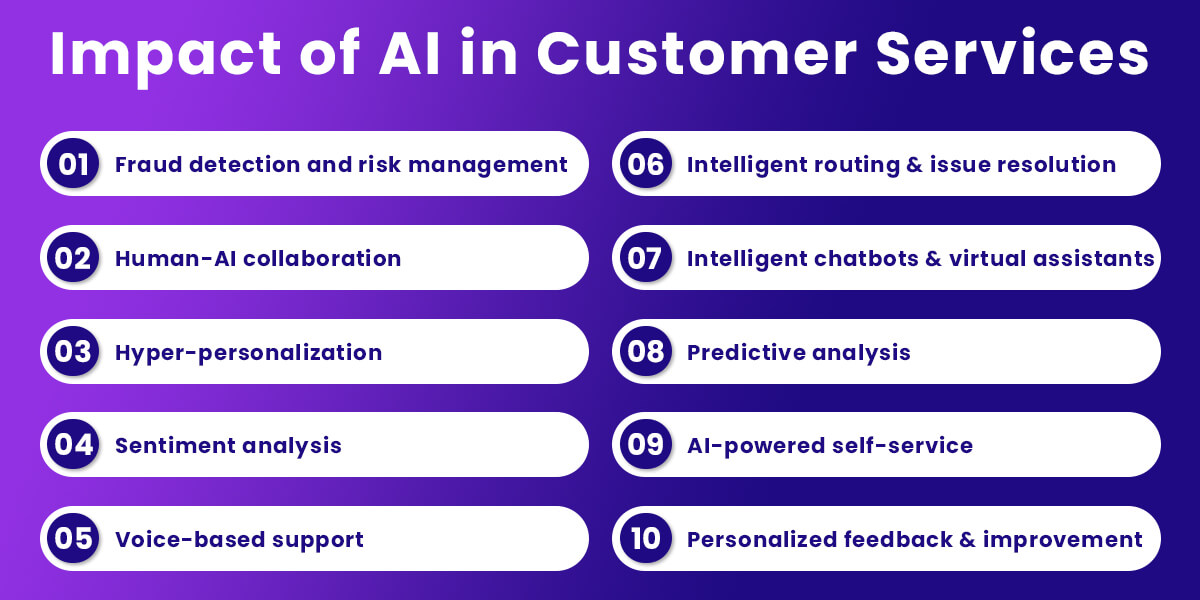
The rise of artificial intelligence trends in improving business operations, ensuring customer acquisition, and satisfying them with automated services have helped organizations win trust. You can deploy trained AI algorithms and models to any department, process, or operation in your business workflow directly or indirectly.
Here are the top 10 segments where you can have AI-powered tools or software solutions that can get you new customers while retaining old ones with loyalty.
Fraud detection and risk management
One of the AI trends that is rising all over the world is its integration into the system to detect any malicious activities. AI tools act as a tireless sentinel that can accurately analyze huge amounts of data from customers in real-time. Following this trend, organizations use AI to identify suspicious activities and flag potential fraudulent patterns and transactions even before they occur. Such early detection leads to a proactive approach to safeguard businesses from financial losses and protect customers from identity theft.
The AI impact on customers: AI creates a secure environment that wins the trust of customers and encourages others to confidently choose your business.
Human-AI collaboration
By having AI at your side, you can build a strong partnership wherein it empowers your esteemed customer service teams to achieve goals and mission. AI can automate repetitive tasks such as data entry and general troubleshooting so that customers can perform self-diagnosis and correct the flaws. This can free up a remarkable amount of time for the human workforce. In addition, Artificial Intelligence can also equip your workforce with real-time data and personalized recommendations based on customer behavior and choices. This saves time to research on customers and your staff can better focus on high-value tasks.
The AI impact on customers: The human workforce focuses on building relationships with customers and as a result, customers feel privileged and turn into loyal clients.
Hyper-personalization
Personalization is an old thing today. Powerful AI tools can break the notion of one-solution-fits-all in marketing. AI tools customized to your business can strategically design the customer journey at every touchpoint. The tools can analyze past behavior, preferences, choices, and purchases to recommend future products and services that clients are more likely to be interested. The outreach of AI systems when customized to your business logic resonates with customers with specific interests and allures them with a perfect sales pitch.
The AI impact on customers: Such laser focus on individual preferences can lead to a better conversion ratio and improve customer engagement making them loyal to your brand.
Sentiment analysis
The role of AI in customer acquisition and retention is also noteworthy due to its capability of sentiment analysis. AI tools just go beyond processing what customers opine because these tools listen to what customers feel. The algorithms and models of AI and ML in sales can be trained to improve customer journeys as such tools can analyze social media posts, support interactions, and online reviews. These tools can be further tailored to detect the emotional undercurrent. Businesses can proactively take steps before the escalation goes beyond control. For instance, AI tools can identify negative feedback about the company and immediately trigger notifications to concerned departments to solve that ASAP.
The AI impact on customers: By getting their concerns solved earliest, the customers have the impression of being cared for by companies and thus the trust is gained back.
Voice-based support
The future of premium customer service is voice-based assistants. AI-powered virtual assistants and smart speakers have provided seamless customer support. Customers can get answers quickly and can perform several other general tasks such as booking an appointment, tracking orders, or just having a natural conversation for any queries. A growing tech-savvy customer base can be satiated for their all needs by voice-based support powered by AI.
The AI impact on customers: The wait time is drastically reduced which results in enhanced customer satisfaction and brand perception.
Intelligent routing and issue resolution
The AI-powered tools can redirect queries to the most qualified agents who can answer instantly with accuracy and untiringly. Customized AI solutions for your business can study customer data and the nature of their concerns to intelligently route them to the best resources. Artificial Intelligence can also assist human agents with relevant subject knowledge through potential articles and guidelines.
The AI impact on customers: This can eliminate the frustration of navigating complex phone menus and reaching the right executive ultimately resulting in maximizing customer satisfaction and success.
Intelligent chatbots and virtual assistants
More and more investment is put into making virtual assistants and AI-enabled chatbots more human-like. The intelligent chatbots are now enhanced and augmented by the next generation of natural language processing that can initiate meaningful conversations and answer customers with their queries precisely. They are trained to troubleshoot general to moderate issues around the clock without human intervention. AI can further customize the answers according to customers’ specific interests.
The AI impact on customers: Quick turnaround and human-like solutions will delight customers and save them time. Such enhanced experience will make them stick to your brand.
Predictive analysis
As experts say, artificial intelligence does not react to a customer’s behavior, it rather predicts it and nails it with its amazing accuracy and pitch-perfect responses. Advanced analytics can anticipate customer requirements and thinking. Many enterprises recommend products that customers might be interested in before they even know that they need them. Amazon is the best example of the AI to attract, engage, and retain customers. Furthermore, AI can also flag suspicious actions so that businesses can prevent damages. Plus, it can help in marketing campaigns and setting roadmaps for future growth by analyzing customers’ choices and preferences.
The AI impact on customers: Customers are delighted by seeing the recommendations by businesses as they always needed them. This improves the conversion ratio.
AI-powered self-service
Businesses can empower their customers to get what they need in the shortest possible time. AI-backed self-service portals can provide customers with round-the-clock access to a wealth of services and resources. A powerful knowledge base backed by AI can offer precise and clear answers to FAQs. Customers can troubleshoot issues by themselves without any human assistance such as tracking orders and resetting passwords.
The AI impact on customers: This offers convenience and efficient solutions to customers and hence reduces the overall customer care and call center burden. The customers feel a sense of control and satisfaction as a result.
Personalized feedback and improvement
Any AI solution would listen to your customers and help you understand them better by analyzing customer interactions throughout multiple channels such as chats, emails, messages, and even voice calls. The AI systems can identify areas that you need to improve; additionally, the tools can also mark or pinpoint subjects and topics that have created issues or confusion among customers. Businesses can work on such things and can improve their services.
The AI impact on customers: When companies listen to their customers and implement their feedback into action, customers feel delighted and privileged. They feel that they contribute to the company’s growth.
The Future of Customer Satisfaction With AI
The future of AI looks promising especially when we consider the high penetration of this technology in almost every sector today. Likewise, in customer acquisition success, the future of AI is fruitful because it is likely to expand in making business processes and operations more streamlined, personalized, and available. While the AI-powered chatbots will be more humanized and intelligent, predictive analysis, machine algorithms and models, and other essential AI models will take on almost all business processes and departments to automatize and improve customer relationships.
High Time to Adopt AI for Customer Acquisition and Success
While technologies keep on evolving, customer satisfaction and experience remain at the center of any business success. Nevertheless, more and more technologies and tools are now available to ensure that the number of satisfied customers increases and retains. It is high time that you overcome traditional ways to engage and retain customers. Build your own AI solutions to acquire new clients while retaining the old loyal ones. Find top AI development companies and discuss your business operations and strategies to automate and enhance your customer base.
AI in Customer Acquisition: What you should know
How can AI help in customer acquisition?
Artificial Intelligence plays a transformative role in modern customer acquisition by enabling businesses to move beyond traditional guesswork and adopt data-driven strategies. It helps organizations identify potential customers, understand their behavior, and engage them with highly relevant messaging. Instead of relying on broad targeting, AI allows precision targeting and automation at scale. As a result, businesses can attract, convert, and retain customers more efficiently while reducing wasted effort.
Here are the key ways AI helps in customer acquisition:
- Smarter audience targeting: AI analyzes large datasets to identify high-intent prospects and ensures marketing efforts are directed toward users who are more likely to convert.
- Predictive lead scoring: AI evaluates user behavior and engagement patterns to prioritize leads that have the highest probability of becoming customers.
- Personalized marketing campaigns: AI delivers tailored content, offers, and recommendations based on individual customer preferences and past interactions.
- Automated engagement tools: AI-powered chatbots and assistants provide real-time responses, guiding users through the conversion funnel effectively.
- Campaign optimization: AI continuously monitors campaign performance and automatically adjusts strategies to maximize ROI.
What is the use of AI in customer acquisition?
AI is primarily used in customer acquisition to enhance decision-making, improve targeting accuracy, and automate repetitive marketing processes. It enables businesses to analyze vast amounts of customer data in real time and extract actionable insights that were previously difficult to obtain. This allows companies to engage the right audience with the right message at the right time. Ultimately, AI shifts customer acquisition from a reactive process to a predictive and proactive one.
Core uses of AI in customer acquisition:
- Data-driven decision making: AI processes and analyzes large volumes of structured and unstructured data, enabling marketers to make informed decisions based on actual customer behavior rather than assumptions.
- Real-time personalization: AI dynamically adjusts messaging, recommendations, and offers according to user preferences, increasing engagement and conversion rates.
- Marketing automation: AI automates repetitive tasks such as email campaigns, ad placements, and customer segmentation, reducing manual effort and improving efficiency.
- Predictive analytics: AI forecasts customer behavior, helping businesses anticipate needs and design proactive acquisition strategies.
Is AI going to replace customer service?
AI is significantly reshaping customer service, but it is not expected to completely replace human involvement. While AI can handle repetitive queries, automate workflows, and provide instant responses, human agents are still essential for complex, emotional, and nuanced interactions. Businesses are increasingly adopting a hybrid model where AI supports human teams rather than replacing them. This balanced approach ensures efficiency without compromising the human touch.
To better understand AI replacing customer service, consider the following points:
- AI handles routine tasks: AI can efficiently manage FAQs, basic troubleshooting, and order tracking, reducing workload for human agents.
- Humans handle complex issues: Emotional intelligence, empathy, and critical thinking remain areas where human agents outperform AI.
- Improved collaboration: AI provides real-time insights and recommendations to support human agents during interactions.
- Enhanced efficiency: Businesses can deliver faster and more consistent support by combining AI automation with human expertise.
Recent insights also highlight that AI is most effective when used alongside human agents rather than as a replacement, ensuring both efficiency and customer satisfaction.
What is conversational AI for customer service?
Conversational AI refers to technologies that enable machines to interact with users in a natural, human-like manner through text or voice interfaces. It is widely used in customer service to automate conversations, provide instant support, and enhance user experience. By leveraging natural language processing (NLP) and machine learning, conversational AI can understand user intent and respond intelligently. This makes it a critical component of modern customer acquisition and engagement strategies.
Key components of conversational AI:
- Chatbots: These are text-based AI systems that interact with users on websites, apps, and messaging platforms.
- Voice assistants: These systems allow users to communicate through voice commands for tasks like inquiries or bookings.
- Natural Language Processing (NLP): NLP enables AI to understand and interpret human language accurately.
- Machine learning models: ML models improve responses over time based on past interactions and data.
Benefits in customer acquisition:
- It ensures 24/7 customer engagement, improving accessibility and response time.
- It delivers consistent and accurate responses, enhancing trust and satisfaction.
- It supports lead generation and qualification, guiding users toward conversion.
What are top best practices for using AI in customer acquisition?
Implementing AI in customer acquisition requires a strategic and well-structured approach to achieve optimal results. Simply adopting AI tools without proper planning can lead to inefficiencies or poor outcomes. Businesses must align AI capabilities with their goals, data infrastructure, and customer expectations. A thoughtful implementation ensures that AI enhances both performance and customer experience.
Best practices for using AI in customer acquisition:
- Start with clear objectives: Define what you want to achieve, such as improving lead quality, reducing acquisition costs, or increasing conversion rates.
- Use high-quality data: AI systems rely heavily on data, so ensure that your data is clean, accurate, and well-organized.
- Focus on personalization: Leverage AI to deliver tailored experiences rather than generic messaging.
- Integrate AI across channels: Use AI consistently across websites, social media, email, and CRM systems for a unified customer experience.
- Maintain human oversight: Ensure that human teams monitor AI outputs to maintain accuracy, relevance, and ethical standards.
How can businesses overcome the challenges of AI in customer acquisition?
While AI offers numerous benefits, it also presents challenges such as data privacy concerns, implementation complexity, and potential biases in algorithms. Businesses must proactively address these challenges to fully leverage AI’s potential. A structured approach involving technology, governance, and human oversight is essential for successful implementation. Overcoming these barriers ensures sustainable and ethical AI adoption.
Here are practical ways to overcome challenges of AI in customer acquisition:
- Ensure data privacy and compliance: Businesses must follow regulations and protect customer data to build trust.
- Invest in skilled talent: Hiring or training professionals who understand AI technologies is crucial for effective implementation.
- Monitor and reduce bias: Regular audits of AI models help ensure fairness and accuracy in decision-making.
- Adopt a phased implementation: Start small with pilot projects before scaling AI across operations.
- Focus on human-AI collaboration: Combining human expertise with AI capabilities leads to better outcomes.
What is the future of AI in customer acquisition?
The future of AI in customer acquisition is highly promising, with continuous advancements in machine learning, automation, and data analytics. AI is expected to become more intelligent, adaptive, and capable of delivering hyper-personalized experiences. Businesses will increasingly rely on AI to automate complex processes and improve customer engagement at scale. As technology evolves, AI will play a central role in shaping customer acquisition strategies.
Future trends of AI in customer acquisition to watch:
- Hyper-personalization at scale: AI will deliver highly individualized experiences across all customer touchpoints.
- Predictive and proactive engagement: AI will anticipate customer needs before they arise.
- Increased automation: More stages of the acquisition funnel will be automated, reducing manual intervention.
- Integration with emerging technologies: AI will work alongside technologies like voice search and augmented reality.
- Improved ROI and efficiency: Businesses will achieve better results with lower acquisition costs.
How will AI-driven customer acquisition evolve with changing customer behavior?
Customer behavior is constantly evolving, driven by technological advancements and changing expectations. AI-driven customer acquisition will adapt by becoming more responsive, personalized, and data-centric. Businesses will need to leverage AI to stay aligned with customer preferences and deliver seamless experiences. This evolution will redefine how brands interact with and acquire customers.
Key evolution patterns:
- Real-time adaptability: AI will continuously adjust strategies based on live customer data and behavior.
- Omnichannel experiences: Customers will expect consistent interactions across multiple platforms.
- Greater emphasis on experience: Acquisition will focus more on delivering value and experience rather than just conversions.
- AI-human synergy: Businesses will combine AI efficiency with human creativity and empathy for better outcomes.
- Ethical AI usage: Transparency and responsible AI practices will become critical for maintaining customer trust.
How does AI improve lead generation in customer acquisition?
AI significantly enhances lead generation by making the process more targeted, efficient, and data-driven. Traditional lead generation methods often rely on broad assumptions, which can result in low-quality leads and wasted resources. In contrast, AI uses advanced algorithms to analyze customer data, identify patterns, and predict which users are most likely to convert. This enables businesses to focus their efforts on high-potential prospects and improve overall acquisition performance.
Key ways AI improves lead generation:
- Advanced audience segmentation: AI divides audiences into highly specific segments based on behavior, demographics, and interests, allowing businesses to target the right users with precision.
- Predictive lead scoring: AI evaluates multiple data points such as browsing behavior, engagement levels, and past interactions to rank leads based on their likelihood to convert.
- Automated lead capture: AI-powered tools such as chatbots and smart forms automatically capture and qualify leads in real time without manual intervention.
- Intent-based targeting: AI identifies users who show strong purchase intent and enables businesses to engage them at the right moment with relevant messaging.
What are the key metrics to measure AI success in customer acquisition?
Measuring the effectiveness of AI in customer acquisition is essential to ensure that investments are delivering tangible business outcomes. Without proper metrics, it becomes difficult to evaluate performance or optimize strategies. AI-driven campaigns generate a large volume of data, which can be used to track efficiency, engagement, and conversion outcomes. By focusing on the right key performance indicators (KPIs), businesses can continuously refine their customer acquisition strategies.
Here are the most important metrics to track AI success in customer acquisition:
- Customer Acquisition Cost (CAC): This metric measures the total cost of acquiring a new customer and helps assess the efficiency of AI-driven campaigns.
- Conversion rate: This indicates the percentage of leads that turn into paying customers, reflecting the effectiveness of targeting and engagement strategies.
- Lead-to-customer ratio: This metric evaluates the quality of leads generated through AI systems.
- Customer Lifetime Value (CLV): This measures the total revenue a business can expect from a customer over time, helping determine long-term ROI.
- Engagement rate: This includes metrics such as click-through rates, time spent, and interactions, which indicate how well AI-driven content resonates with users.
- Return on Investment (ROI): This provides an overall view of how profitable AI-driven customer acquisition efforts are.
Derek Cohen
| Apr 15, 2026
Analyzing business activities and data to formulate the best business development ideas is where I earn appreciations and remunerations. I’m an ardent reader, business adviser, gadget aficionado and an amateur yet an avid writer. My urge for innovative writing evokes every time I come across new gadgets, neo technology and novel technical events.