Documents in Software Development Outsourcing Explained in Detail
 By
Avantika Shergil
|
Jan 16, 2026 |
Outsourcing Software Development
By
Avantika Shergil
|
Jan 16, 2026 |
Outsourcing Software Development

Outsourcing software development to an offshore software development company is fraught with several concerns that soon may turn into your nightmare if not paid serious attention. Not only do you need to be assured of falling into safe hands but also skillful.
From choosing the right technology partner to selecting the most suitable hiring model, and from checking on regular milestones to getting trustworthy after-sales support – all of this piles up into a complex process that requires solid documentation.
Table of Contents
Why Documentation Is Critical in Software Development Outsourcing?
Software development outsourcing offers clear benefits such as cost efficiency, faster scaling, and access to global talent. At the same time, it introduces challenges including time zone differences, limited real time collaboration, and reduced visibility into daily development activities. In this context, documentation becomes one of the most critical success factors.
In outsourced projects, documentation is not a secondary activity. It acts as the primary communication channel between the client and the external development team. When expectations, requirements, and responsibilities are not clearly documented, even experienced vendors may deliver results that do not align with business objectives.
Documentation as a Risk Mitigation Tool
Many outsourcing challenges arise due to unclear or incomplete documentation. Common issues include ambiguous requirements, poorly defined project scope, unclear ownership of intellectual property, and misaligned expectations around timelines and quality standards.
Well structured documentation helps reduce these risks by creating a shared understanding among all stakeholders. It provides a consistent reference point for decision making and minimizes reliance on verbal explanations or assumptions.
Why Documentation Matters More in Outsourcing Than In House Development
Unlike internal teams, outsourced software developers do not have immediate access to business context or informal communication channels. They rely heavily on written instructions and references to understand project goals, constraints, and expectations.
Because outsourced software development team teams often work across different locations and time zones, every assumption must be clearly documented. Proper software development documentation ensures continuity even when team members change and allows software development to progress without constant clarification.
A Foundation for Successful Collaboration
Effective documentation for software development supports smoother collaboration throughout the outsourcing lifecycle. It enables faster onboarding of external teams, improves estimation accuracy, helps control scope changes, and ensures smoother handovers after project completion.
From legal agreements to technical specifications, documentation establishes trust, accountability, and transparency in software development outsourcing. Strong documentation does not slow projects down. Instead, it prevents costly rework, delays, and misunderstandings later.
What Is Software Development Documentation in Outsourcing?
Software development documentation in outsourcing refers to the complete set of written materials that define how an outsourced project is planned, executed, managed, and delivered. These documents for software development act as a shared reference between the client and the outsourcing partner, ensuring that both sides have a clear and consistent understanding of the project.
In an outsourced environment, software documentation replaces much of the informal communication that typically happens within in house teams. It provides clarity on business goals, technical requirements, legal obligations, and operational processes, making it possible for external teams to work independently and efficiently.
Purpose of Documentation in Outsourced Projects
The primary purpose of documentation in software development outsourcing is to eliminate ambiguity. Clear documentation ensures that expectations are understood before development begins and remain consistent throughout the project lifecycle.
Key objectives of outsourcing documentation include:
- Defining project scope, deliverables, and timelines
- Establishing roles, responsibilities, and communication protocols
- Protecting intellectual property and confidential information
- Providing technical guidance for development, testing, and deployment
- Supporting long term maintenance and knowledge transfer
How Outsourcing Documentation Differs from In House Documentation?
In house documentation is often lighter because software development team members share organizational knowledge and can clarify details quickly. Outsourcing documentation, on the other hand, must be more detailed and explicit.
Outsourced software companies require documentation that clearly explains business context, user expectations, technical standards, and decision making processes. Without this level of detail, even well defined requirements can be misinterpreted, leading to delays and rework.
Documentation as a Single Source of Truth
In software development outsourcing, documentation serves as a single source of truth for all stakeholders. It ensures consistency across distributed teams and provides a reliable reference when questions or disagreements arise.
When software development documentation is well maintained and easily accessible, it improves collaboration, accountability, and overall project outcomes. It also creates a strong foundation for scaling the project or transitioning it to another vendor or internal team in the future.
Categories of Documentation in Software Development Outsourcing
In outsourced projects, documentation serves as the foundation for legal clarity, project alignment, and technical accuracy. The right documents in software development outsourcing help clients and vendors operate with a shared understanding throughout the project lifecycle.
Each software development document plays a specific role in planning, execution, quality control, and long term ownership. Collectively, these documents in software development reduce risk, prevent misunderstandings, and support successful outsourcing outcomes.
Legal and Contractual Documents in Software Development Outsourcing
Legal and contractual documentation establishes the formal relationship between the client and the outsourcing vendor. These are essential documents in software development outsourcing that must be finalized before development begins.
Common legal software development documents include:
- Non Disclosure Agreement NDA
- Master Service Agreement MSA
- Statement of Work SOW
- Data Processing Agreement DPA
- Intellectual Property Assignment Agreement
These software development documents define confidentiality obligations, project scope, timelines, payment terms, compliance requirements, and ownership of intellectual property. Well drafted legal documentation protects both parties and minimizes contractual risks in software development outsourcing.
Project Management Documents for Outsourced Software Development
Project management documentation defines how the outsourced software project will be planned, monitored, and controlled. These documents in software development ensure structured execution across distributed teams.
Key project management software development documents include:
- Request for Proposal RFP
- Project Charter
- Project Plan
- Communication Management Plan
- Risk Management Plan
- Change Request Document
By clearly documenting roles, milestones, reporting structures, and escalation processes, these documents help keep outsourced software development aligned with business goals and timelines.
Requirements and Technical Software Development Documents
Requirements and technical documentation explain what the software must do and how it should be built. These are among the most critical documents in software development outsourcing.
Essential technical software development documents include:
- Software Requirements Specification SRS
- Functional Requirements Document FRD
- Technical Design Document TDD
- System Architecture Document
- API Documentation
- Database Design Document
These documents provide outsourced development teams with clear functional and technical guidance. High quality technical documentation reduces rework, improves code consistency, and supports scalability.
Quality Assurance and Testing Documents in Software Development
Quality assurance documentation defines how software quality will be measured and validated during outsourced development. These documents in software development ensure that delivery meets agreed standards.
Common QA and testing software development documents include:
- Test Plan
- Test Case Specification
- Acceptance Criteria Document
- Defect Report
- User Acceptance Testing UAT Document
Clear testing documentation enables early defect detection and helps outsourced teams deliver reliable and stable software.
User Documentation and Knowledge Transfer Documents
User documentation and knowledge transfer materials support long term software usage, maintenance, and ownership. These documents in software development outsourcing are critical after project delivery.
Typical user and handover software development documents include:
- User Manual
- Administrator Guide
- Operations Manual
- Knowledge Transfer Document
- Maintenance and Support Guide
- Release Notes
These documents reduce dependency on the outsourcing vendor and enable internal teams to manage and evolve the software independently.
Why These Documents Matter in Software Development Outsourcing
Well structured and clearly defined documents in software development create transparency, accountability, and continuity across outsourced projects. They improve collaboration, simplify onboarding, and ensure smoother transitions between vendors or internal teams.
Strong software development documentation is not just a formality. It is a critical success factor that directly impacts delivery quality, cost control, and long term project sustainability.
Best Practices for Creating Documents in Software Development Outsourcing
Creating effective documents in software development outsourcing requires more than listing requirements or legal terms. These software development documents must be clear, detailed, and structured to support collaboration between geographically distributed teams.
Following proven best practices ensures that documentation adds real value and reduces delivery risks in outsourced software development projects.
Write Software Development Documents With Clear Business Context
Outsourced teams do not share internal business knowledge. Every software development document should clearly explain the business objectives behind the project.
Best practices include:
- Clearly defining the problem the software is solving
- Explaining end users and expected outcomes
- Documenting assumptions and constraints
Providing context helps outsourced teams make better technical decisions and reduces misinterpretation.
Maintain Clarity and Consistency Across All Documents
Consistency is essential when managing multiple documents in software development. Conflicting information across documents can lead to delays and rework.
Recommended practices:
- Use consistent terminology across all software development documents
- Maintain uniform formatting and naming conventions
- Avoid ambiguous language
Clear and consistent documentation improves understanding and trust between clients and vendors.
Keep Software Development Documentation Structured and Accessible
Well structured software development documentation is easier to use and maintain. Outsourced teams rely heavily on written references, so accessibility is critical.
Effective practices include:
- Organizing documents by category and purpose
- Using headings, tables, and diagrams where appropriate
- Storing documents in a centralized and accessible repository
This approach ensures that outsourced teams can quickly find the information they need.
Update Documents Throughout the Outsourcing Lifecycle
Software development outsourcing is dynamic. Requirements evolve, and documentation must reflect those changes.
Key practices include:
- Updating documents after scope or requirement changes
- Version controlling all software development documents
- Clearly marking outdated or superseded documents
Up to date documentation prevents confusion and ensures alignment throughout the project.
Assign Ownership for Each Software Development Document
Every software development document should have a clear owner responsible for its accuracy and updates.
Recommended ownership practices:
- Assign document owners from both client and vendor sides
- Define review and approval responsibilities
- Schedule periodic documentation reviews
Clear ownership ensures accountability and long term documentation quality.
Align Documentation With Legal and Contractual Agreements
Technical and project documentation should always align with legal documents in software development outsourcing such as the Statement of Work and Master Service Agreement.
Best practices include:
- Ensuring requirements match contractual scope
- Aligning acceptance criteria with delivery milestones
- Documenting change requests formally
This alignment reduces disputes and supports smoother project execution.
Why Best Practices Matter in Software Development Outsourcing
Following best practices for software development documentation improves communication, reduces risk, and increases delivery predictability. Well maintained documents in software development outsourcing help outsourced teams work independently while remaining aligned with business goals.
Strong documentation practices directly contribute to higher quality outcomes, lower costs, and long term project success.
Tools Commonly Used for Software Development Documentation in Outsourcing
In software development outsourcing, the effectiveness of documentation depends not only on what is written but also on where and how it is maintained. The right tools help teams create, manage, update, and share software development documents efficiently across locations and time zones.
Below are the most commonly used tools for managing documents in software development outsourcing, grouped by purpose.
Documentation and Knowledge Management Tools
These tools are used to create and maintain core software development documentation such as requirements, technical specifications, and knowledge bases.
Commonly used tools include:
- Confluence
- Notion
- Google Docs
- Microsoft SharePoint
- Wiki based documentation systems
These platforms allow multiple stakeholders to collaborate on software development documents, track updates, and maintain a centralized source of truth for outsourced teams.
Requirements and Technical Documentation Tools
Requirements and technical tools are used to document functional and technical details that outsourced teams rely on during development.
Frequently used tools include:
- Jira for requirements and issue tracking
- Azure DevOps for requirement and backlog documentation
- Markdown based documentation repositories
- Diagramming tools for architecture and system design
These tools help structure documents in software development such as Software Requirements Specification, Technical Design Documents, and architecture diagrams.
Version Control and Source Documentation Tools
Version control systems play a critical role in managing technical software development documents that evolve alongside the codebase.
Common tools include:
- Git based repositories
- GitHub or GitLab documentation repositories
- README and in repository documentation
Using version control ensures that technical documentation remains aligned with the source code and supports traceability in software development outsourcing.
Quality Assurance and Testing Documentation Tools
Testing tools support the creation and management of quality related documents in software development.
Widely used tools include:
- Test management systems
- Bug and defect tracking tools
- Test case documentation platforms
These tools help manage Test Plans, Test Cases, Defect Reports, and User Acceptance Testing documentation in outsourced projects.
Collaboration and Communication Tools Supporting Documentation
While not documentation tools by design, collaboration platforms support documentation workflows in software development outsourcing.
Common tools include:
- Project management platforms
- Team communication tools
- File sharing systems
These tools help distribute software development documents, support reviews, and ensure that documentation updates are communicated effectively to outsourced teams.
What are the Benefits of documents in outsourcing software development?
Software development documentation helps you streamline software development project outsourcing by all accounts. On the other hand, for a software development outsourcing company, documentation shall build their profile as a reputed and professional firm. Here are a few straightforward benefits of documents in software development outsourcing.
Surety
The first document sent to a software development outsourcing service providing company is the Request for Proposal/RFP with a set of features, specifications, and other important business objectives. Both, the software vendor (service provider) and the client perform reviews and carry out the scope with its feasibility. Negotiations and changes may happen as a part of project understanding before it finally kick-starts.
Assured budget limits
It is observed that many entrepreneurs, in the race of launching their products, often overlook documentation. As a result, the project’s scope and priorities go vague and feeble affecting the overall software development cost estimated. There are also fair chances of conflict on including features and scopes later which may ultimately affect the budget.
The surety on whereabouts
Documentation of software project outsourcing puts an end to your helplessness to trace or search the progress of the project in development procedure. With proper documents in place, you have an eye on the software development process and you know every milestone achieved or to be achieved.
Accelerated development
Delay in software development projects costs you an arm and a leg. That said, if the top software development outsourcing company kick-starts the project without any documents, it is likely to face several issues in streamlining the software development life cycle. Proper documentation speeds up the project and results in a quicker time to market.
Clarity
Outsourcing project involves risks when it goes undocumented. Clarity is key as it helps reduce the chances of misunderstanding, the major cause of project development failure. While fixing a contract with leading custom software development company, you are to deal with remote software developers with whom you are not in constant touch for clarification on business objectives and your business’ goals.
Documents for developers
Software developers aim to have a simple development plan with clearly defined milestones and timelines. Proper documentation also helps them keep a record of codes and methods used to build a software product; in addition, if the project is to undergo any knowledge shift or if you change software development team, clear documentation shall reduce the time the new talent acquisition takes to understand the progress so far.
Key Documents in Software Development
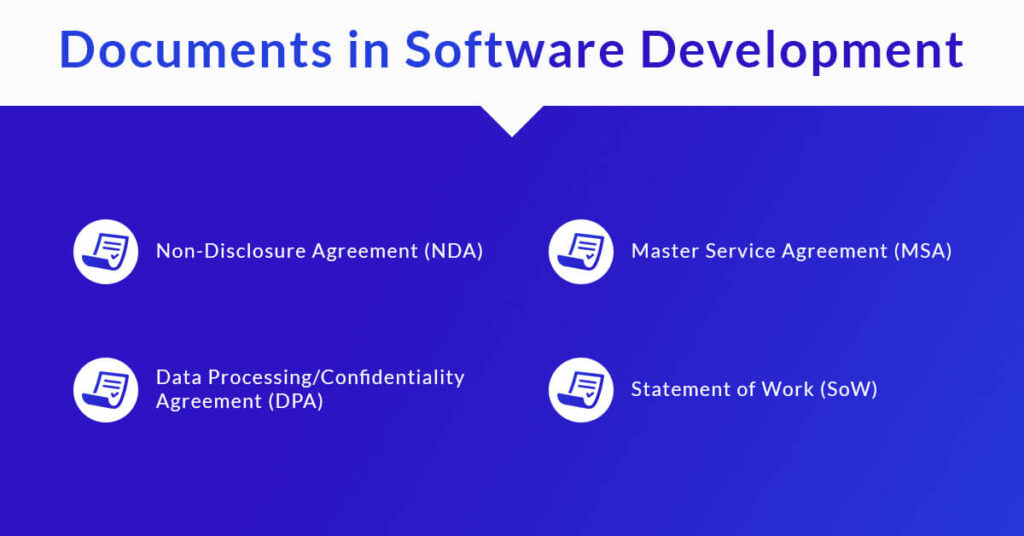
This guide to documents in software development outsourcing you absolutely should know is a comprehensive list of the required legal paperwork to help you have a fair business deal that is secure.
Non-Disclosure Agreement (NDA)
The non-disclosure agreement document tops the list of the required documents in the business deal of outsourcing software development. This document possesses all the necessary clauses that secure every bit of information about the software project. The exchange of information from both sides is classified as confidential and the software development firm is bound to keep it secured with no sharing with any third party whatsoever.
The agreement seals the deal securely and both parties sign the documents. It is also important for you to check out the list that defines and includes data or information as confidential for your project. Here is the list you can work upon for NDA–
- All digital procedures
- Software development processes
- Passwords
- Database (local and/or cloud)
- Source codes (make this sure)
- Strategies
- Architectures
- Any pilot projects
- Software Prototypes
Some enterprises, before outsourcing their software development projects to any remote development company, like to include a time frame till the information shall be kept confidential. Ideally, the period should be long enough that business should not get affected and stay secure from peers in the market. On the other hand, the period is kept short and practical so that the dedicated software development company shouldn’t feel trapped.
Opposite to NDA is the disclosure clause that many enterprises prefer to clarify before they kick off the project. While some classified information is crucial and kept secret, other information better goes public, which is beneficial for businesses. The parties that are likely to be considered for disclosure clauses include freelancers, employees, and business partners.
Master Service Agreement (MSA)
The Master Service Agreement (MSA) is a legal contract between a professional software development consultant and a client that defines clauses for project outlines, responsibilities, terms and conditions, and other crucial service agreements. The primary difference between NDA and MSA is the latter is more useful when the software development firm and the client are likely to work regularly in the future.
The MSA saves costs and hassles of negotiations between parties to facilitate a fair deal that works every time they seal the deal. Though documentation of MSA is highly complex, once drafted with consensus, it shall be used as a template/format for subsequent deals.
The document is beneficial to both parties the software development agency and client as they can avoid contractual clashes in the form of legal actions on the project’s goal, objectives, and even time frame. Such documentation, moreover, can fix the roles and responsibilities on both sides for any change in cost, time frame, or even technical requirements.
The legal teams at both parties define the provision of services with the acceptance of payments (including taxes, fees, time frames, and charges of all kinds). The teams then carefully define how long the document shall be valid.
Data Processing/Confidentiality Agreement (DPA)
As the name suggests, Data Processing Agreement (DPA) or Confidentiality Agreement addresses all the concerns of data processing performed by all the parties involved in the software development project. The DPA also regulates and defines the roles and responsibilities of both parties for data processing and controlling (confidentiality).
At times, in outsourced software development projects, data are shared with different parties and vendors in order to use it for building the software product or for customizing it. When such service providers or third parties are covered in DPA, strict norms are followed for data storing, processing, fetching, and even using.
Under the data processing agreement, any unwanted or unexpected event of data breaching would be considered a heinous act, and the responsible party would have to bear stringent legal consequences.
Statement of Work (SoW)
The Statement of Work -SoW, as the name suggests, is the complete statement of all the work that is predefined and in the scope. The document specifies deliverables of any kind for which the buyer has contacted the software development specialist or service provider; therefore, it is easier for both parties to keep track of the milestones and timeline. Industry experts look at this documentation as a moral responsibility and contractual obligation to fulfill the tasks.
Any change in the project for its scope shall require the responsible party to request a change in a formal way. Though SoW doesn’t possess stringent legal consequences but the documentation, in a way, introduces errands to the concerned company or entity. The dedicated software development teams then plan their workforce and task allocation to meet the business objectives stated by the buyers.
Here are some documents related to software development outsourcing:
- Source code document
- API Documentation
- Release notes
- Architecture design documentation
Clauses of Software Development Outsourcing Contracts You Should Pay Attention to
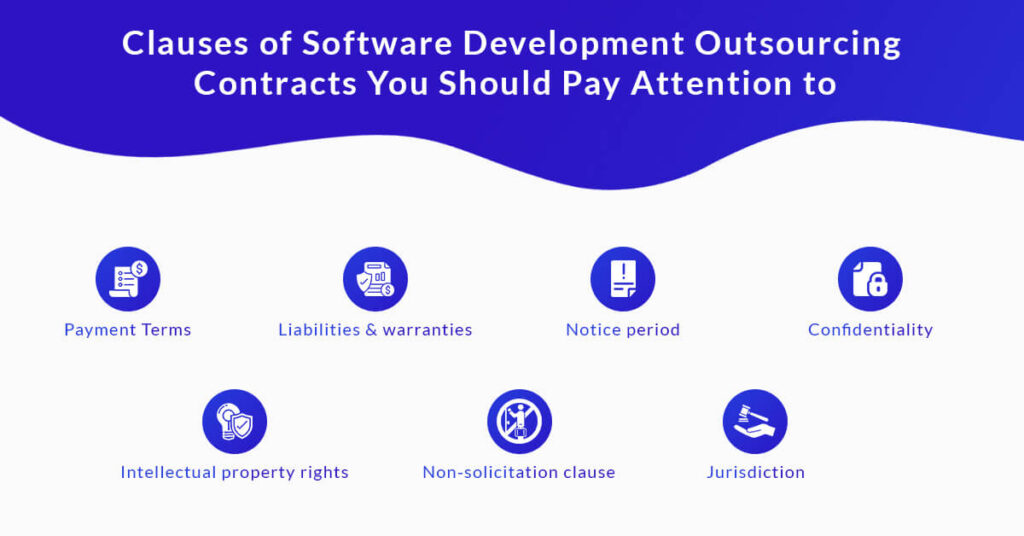
Outsourcing software development requirements can have great benefits to entrepreneurs but then the deal comes with a few cautions that may add bitterness to your relationship with the service provider. As a result, the entire software development project gets shadowed. Here we present to you, from our experience, the clauses of software development outsourcing contracts you should pay attention to.
Payment Terms
From negotiation to the way payment proceeds to the software development service provider, everything should be noted down and fixed before the project kick-starts. Both parties should mutually agree to the terms and conditions drafted in payment terms which may include the parts of payments to be released along with the deliverables, partially or completely.
Liabilities and warranties
Again, with mutual understanding, both parties agree to fix the liabilities (minimum to maximum) according to their roles and responsibilities. The liability cap is set to have control over financial exposure. On the other hand, a warranty aims at setting up a fixed time limit within which the software development solution provider is liable to build and deliver a predefined product or product.
Notice period
The notice period defines the timeline within which all the required changes or software solutions to escalations are defined. That said, notice periods assure the buyers to get things done within a timeframe.
Notice periods can be further classified into resizing the team wherein scaling the software development team (to increase or decrease the software development team members) is specified. Generally, such a notice period varies from one to three months. Furthermore, the second notice period includes the termination of the software development outsourcing contract between two parties which may vary from five months to one year, depending on the size and type of project or product.
Confidentiality
Protecting data has been of paramount importance to any enterprise. Hence, data protection should be one of the major concerns of buyers regarding what clauses are fixed between parties. Setting up the rules for data protection assures the buyers that their outsourced project is in safe hands. On the other hand, a security breach of any kind would give power to the buyers to sue and recover the damage from the service-providing companies.
Intellectual property rights
From owning the code to ids and passwords, the contract of software development outsourcing solution mentions the clauses of maintaining privacy and ownership for all the intellectual properties. While the buyer has an upper hand in this clause, the software development vendors too have the authority to act superior if the payment is not proceeded as per the other clauses.
Non-solicitation clause
Many projects require domain expertise and if the buyer or offshore software development service-providing company is keen to hire one, the non-solicitation clause comes into the picture. The collaboration with any other third party happens with strict clauses and norms agreed by both the concerned parties.
Jurisdiction
For any business deal to happen, the vicinity of jurisdiction is fixed before the project kick starts or the deal is finalized. Outsourcing software development services to an offshore company should have clear jurisdiction (location) so that any unwanted event should be addressed keeping the region’s laws in mind.
Overall, all the documents in software development outsourcing have their own importance and values; hence, while you contract any offshore company with a proper guide to hire the best software developers, make sure that you stay clear with the above-mentioned paperwork to protect your product.
Conclusion
Well structured documents in software development outsourcing play a critical role in ensuring clarity, accountability, and successful collaboration between clients and external development teams. From legal agreements and project management documentation to technical specifications and user guides, every software development document helps reduce risk, improve communication, and maintain alignment throughout the outsourcing lifecycle. This is why leading software development companies place strong emphasis on creating and maintaining comprehensive documentation as part of their delivery standards.
Investing in high quality software development documentation enables smoother onboarding, better decision making, and long term software sustainability. When supported by the right tools and best practices, these documents in software development become strategic assets rather than administrative tasks. Businesses that follow the documentation practices used by top software development companies are better positioned to achieve predictable delivery, control costs, and build successful long term outsourcing partnerships.
Avantika Shergil
| Jan 16, 2026


Avantika Shergil is a technology enthusiast and thought leader with deep expertise in software development and web technologies. With over 8 years of experience analyzing and evaluating cutting-edge digital solutions, Avantika has a knack for demystifying complex tech trends. Her insights into modern programming frameworks, system architecture, and web innovation have empowered businesses to make informed decisions in the ever-evolving tech landscape. Avantika is passionate about bridging the gap between technology and business strategy, helping businesses build customized software and website, and understand about different tools to leverage effectively for their ventures. Explore her work for a unique perspective on the future of digital innovation.