Changing a Software Development Team: A Complete Guide
 By
Gillian Harper
|
Jun 29, 2026 |
Software Development
By
Gillian Harper
|
Jun 29, 2026 |
Software Development

Most buyers or product owners have less or no technical knowledge and, therefore, find it challenging to change software development teams or a company, especially when the project is in the middle of its development phase. So, most buyers hunt for an answer to when and how to change the development team or company.
However, it will be required to have a brief knowledge of the software development life cycle so that you can minimize the gap in development and have better clarity on the best remote software development team.
Common signs signal when to change your software development teams or an offshore IT company. Lack of clarity and management can lead to many impediments, such as prolonged time, frustration, an increase in budget, hindered progress, and the like. With our business and technology consultants’ two cents, we shall help buyers overcome the hassle.
Table of Contents
What Does Changing a Software Development Team Mean?
Changing a software development team means replacing all or part of the professionals responsible for designing, developing, testing, and maintaining your software application while the project is still in progress. This transition may involve switching to a new software development company, replacing individual developers, onboarding a new technical partner, or restructuring the existing team with specialists who better align with your project requirements. Businesses often consider changing a software development team when the current team can no longer meet technical expectations, delivery timelines, communication standards, or long-term business objectives.
A software development team change does not necessarily mean your project has failed. In many cases, it is a strategic business decision made to improve software quality, accelerate development, reduce operational risks, or gain access to specialized expertise. Whether you are a startup building an MVP or an enterprise managing a large-scale digital transformation, switching a software development team can help realign the project with changing market demands, customer expectations, and organizational goals. The key is to ensure the transition is carefully planned so that development continues with minimal disruption.
Before changing a software development partner, it is important to assess whether the issues stem from the team’s performance, project management processes, unclear business requirements, or evolving business priorities. Sometimes, extending the existing team or introducing additional specialists may resolve the problem without requiring a complete replacement. However, when recurring issues continue to affect project quality, delivery, security, or collaboration, deciding to change your current development team may be the most effective way to protect your investment and improve the likelihood of project success.
Top Signs It’s Time to Change Your Current Development Team
Every software project encounters occasional setbacks, but persistent issues often indicate deeper problems that can jeopardize timelines, budgets, and product quality. Recognizing these warning signs early allows businesses to take corrective action before delays and technical challenges become difficult or expensive to resolve. If your current software development team consistently struggles in multiple areas, it may be time to evaluate whether changing a software development team is the best path forward.
Repeated Missed Deadlines and Project Delays
Occasional schedule adjustments are common in software development, especially when project requirements evolve. However, consistently missing sprint goals, milestone deadlines, or release dates suggests that your software development team may be facing planning, resource, or execution challenges. When delays become routine, they can affect product launches, customer satisfaction, investor confidence, and overall business growth.
Several factors can contribute to repeated project delays, including poor project estimation, inadequate technical expertise, unclear development priorities, or inefficient sprint planning. In some cases, developers spend more time fixing existing issues than building new features, resulting in an ongoing cycle of postponed deliveries.
Consider changing your software development team if you notice:
- Sprint commitments are rarely completed on time.
- Release dates are repeatedly postponed without valid justification.
- Development velocity continues to decline over multiple iterations.
- Critical features remain unfinished despite extended timelines.
- Project roadmaps frequently change because of avoidable delays.
When deadlines consistently slip without measurable improvement, switching your software development team may be necessary to restore project momentum.
Poor Code Quality and Increasing Technical Debt
A successful software product depends on clean, maintainable, and scalable code. If developers prioritize speed over quality, the result is often increasing technical debt—shortcuts in development that create larger maintenance challenges in the future. While technical debt is inevitable to some extent, allowing it to accumulate unchecked makes future development slower, more expensive, and riskier.
Poor code quality often reveals itself through frequent bugs, unstable releases, duplicated code, inadequate documentation, and inconsistent coding practices. Over time, these issues reduce development efficiency because every new feature requires additional effort to work around existing problems rather than building on a stable foundation.
Common indicators include:
- Frequent production bugs after every release.
- High bug-fix effort compared to new feature development.
- Difficult-to-maintain or poorly documented code.
- Lack of coding standards or peer code reviews.
- Developers hesitate to modify existing modules because of hidden dependencies.
If your project is becoming increasingly difficult to maintain despite continuous development efforts, replacing your development team with experienced engineers who follow modern development practices may significantly improve long-term product stability.
Lack of Communication and Transparency
Effective communication is one of the most important characteristics of a high-performing software development team. Even technically skilled developers cannot deliver successful projects if business stakeholders remain uninformed about progress, risks, or changing priorities. Communication gaps often lead to misunderstandings, incorrect feature implementation, and delayed decision-making.
Transparency should extend beyond regular status meetings. Your development partner should provide visibility into sprint progress, blockers, resource allocation, project risks, and delivery timelines. Businesses should never feel uncertain about what the development team is working on or when deliverables will be completed.
Warning signs include:
- Long response times from developers or project managers.
- Infrequent or inconsistent project updates.
- Unclear explanations for missed deadlines.
- Limited visibility into sprint progress.
- Difficulty scheduling meetings or obtaining technical clarification.
If communication problems continue despite repeated discussions, changing a software development partner may be necessary to establish stronger collaboration and improve project governance.
Budget Overruns Without Measurable Progress
Software development budgets often change when project scope expands or business requirements evolve. However, consistently increasing costs without corresponding progress indicate inefficient resource utilization or poor project management. Businesses should clearly understand how development hours translate into completed functionality and measurable outcomes.
Budget overruns may result from inaccurate effort estimation, excessive rework, inefficient workflows, frequent requirement misunderstandings, or prolonged debugging caused by poor development practices. Without proper cost tracking, businesses can spend significantly more while receiving fewer completed deliverables.
You should investigate further if:
- Monthly development costs continue increasing without proportional feature delivery.
- Developers spend excessive time fixing previously completed work.
- Sprint outputs decrease despite maintaining the same team size.
- Project estimates frequently change after development begins.
- ROI becomes increasingly difficult to justify.
When rising costs are accompanied by declining productivity, switching software development teams may help improve delivery efficiency and optimize your technology investment.
The Team No Longer Matches Your Business Goals
Business priorities evolve as products mature. A startup may initially require rapid MVP development but later need scalability, cloud optimization, AI integration, cybersecurity expertise, or enterprise-grade architecture. If your existing software development team lacks the necessary skills to support these new objectives, project growth may stall despite everyone’s best efforts.
A mismatch between business strategy and technical capability often becomes apparent during expansion, digital transformation initiatives, or market changes. Rather than forcing the current team to learn unfamiliar technologies while critical deadlines approach, many organizations choose to upgrade their development team or transition to specialists with relevant experience.
Signs of misalignment include:
- Limited expertise in the technologies required for future development.
- Difficulty scaling the application for growing user demand.
- Inability to implement modern architectural practices.
- Lack of experience with industry-specific compliance requirements.
- Resistance to adopting newer development tools or methodologies.
In these situations, changing a software development team is often a strategic decision that enables faster innovation and supports long-term business growth.
Security, Compliance, or Intellectual Property Concerns
Security should remain a priority throughout the software development lifecycle. Weak development practices, poor access management, or inadequate documentation can expose businesses to cybersecurity threats, regulatory violations, and intellectual property disputes. These risks become even more significant for organizations handling financial transactions, healthcare data, or sensitive customer information.
A reliable software development team follows secure coding standards, implements regular security testing, documents development processes, and ensures that source code ownership, credentials, and project assets remain under the client’s control. Failure to maintain these standards can create serious legal, financial, and operational risks.
Warning signs include:
- Lack of secure coding practices or security testing.
- Unclear ownership of source code or project assets.
- Missing documentation for infrastructure and deployment.
- Poor compliance with regulations or industry standards.
- Restricted access to repositories, cloud environments, or production systems.
If your current team cannot adequately protect your software, customer data, or intellectual property, changing your software development team may be the safest course of action to safeguard your business and ensure long-term project success.
Common Reasons to Change Software Developers
As it may happen, even with the best software developers, product owners can think of changing their software development team for several compelling reasons. The most common factor that causes buyers to take this step is dissatisfaction. Delays in milestones and miscommunications are also reported to be the primary reasons for buyers who outsource IT solutions to software development companies.
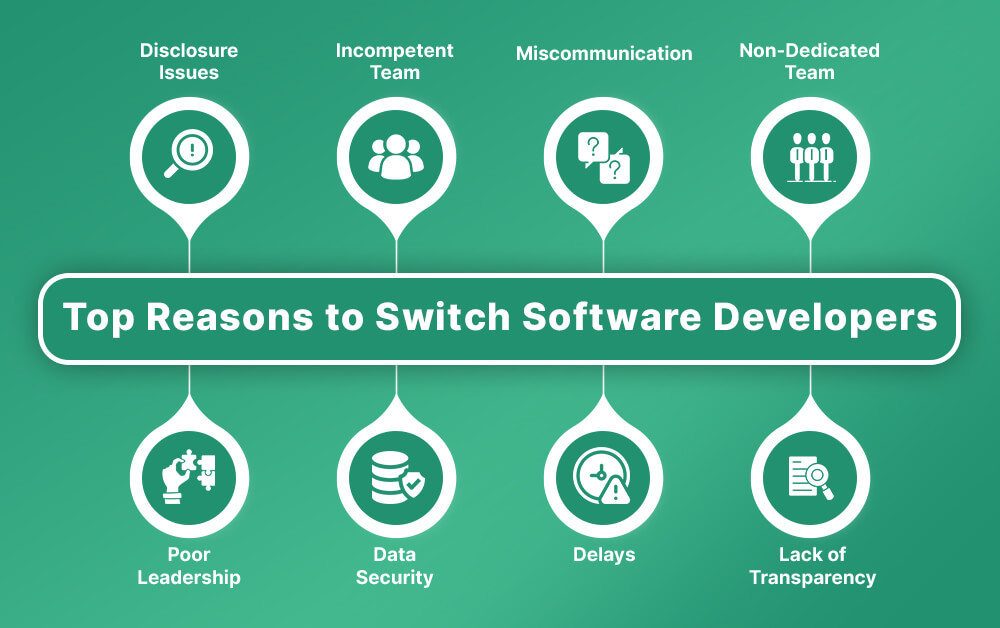
Here are a few more factors –
Disclosure Issues
While most offshore software development companies sign NDAs, buyers sometimes need to pay more attention to compliance and give their projects to remote software developers who avoid indulging in legal documents. Such deals are half-baked and can create a hassle for buyers. The data and project idea may be revealed to peers or competitors in the market.
Less Competent Team
Sometimes, project owners’ expectations must be met due to incompetent software development teams. Novice and immature software programmers take longer to understand the product and work sluggishly. Humdrum routine work could be rare but cannot be ruled out due to a lack of interest in the project. On the other hand, to save money, many buyers compromise with their projects and opt for something other than experienced software developers, thus risking their products.
Miscommunication
Whether a language barrier or apathy to update the project owners, miscommunication could be a significant factor for anyone considering changing the software development team. It is the common reason software development companies lose big projects. Clients need to learn about the software development project’s progress when they are regularly updated with milestones.
Non-Dedicated Team
It is common for mediocre IT companies to deploy their software, mobile, and web developers on multiple projects. It gives fewer priorities to a particular project because the team is occupied with the new acquisition. Ultimately, procrastination in meeting deadlines and inferior quality products is evident.
Lack of Leadership
Poor project management due to inexperienced team leaders and project managers is another factor that could be improved when developing a software product. While client involvement is necessary for project management, micromanagement is needed among hired dedicated software developers. Adherence to defined objectives or loose supervision can lead to endless escalations.
Data Security
Most software development teams debut using standard development practices, leverage encryption techniques, and employ security measures. However, when checked by the business clients, the software developed in phases found severe security issues; this led to the switch of the software development teams.
Potential Delays
When the software development team fails to release the software on time, businesses start reconsidering software development team selection for time-critical projects. When a software project to be developed in parts fails to hit pre-defined milestones, the business asks the team to complete the allocated work. If the team fails or won’t provide a satisfactory answer, delays are non-negotiable, and businesses move to another team.
No Transparency
Transparency stays at the heart of communication, ensuring business stakeholders and teams sail the same boat. When the company pushes clients to buy third-party APIs or plugins while hiding required documents, that leads to cost overruns. Such uncontrolled development leads to inefficient investment and makes businesses change the software development team.
Change in Software Development Team Amidst Ongoing Project
The change may happen for any reason stated above, and therefore, switching the hired software developers or the entire development team from one to the other requires foolproof planning and homework from a buyer. The following are a few areas to help anyone transition smoothly.
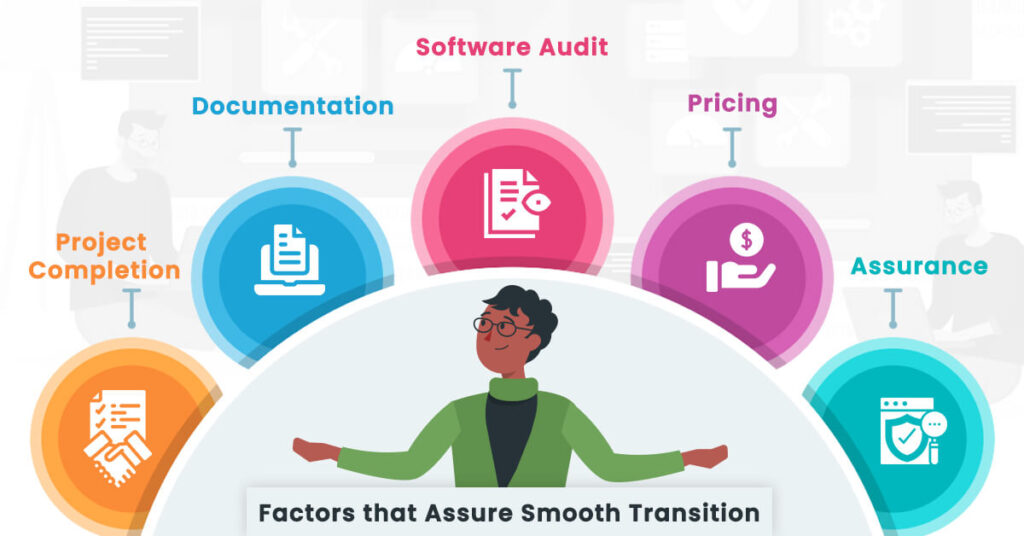
Whether the entire development team is a colossal prick or has a couple of underperformers to achieve the quality, once you decide to switch or change resources for your software development project, you need to consider several factors mentioned here in your account.
Project Completion
According to tech consultants and experts, if the project is almost done (say, more than 79%), there is a thin chance that switching would help. Here, communicating with hired software developers or higher authorities and pressuring them for quality performance may help. It is worth noting that you shouldn’t trust the numbers (here, the percent). Check the software product yourself –how much it is completed and how much it is remaining.
Documentation
Documentation helps you keep the development of software applications on track and makes major sense in legal actions. Check the documents yourself, or hire a tech consultant to evaluate the progress. Termination or shifting of the contract should be done legally with necessary digital signs and approvals from both sides.
Software Audit
The audit of software products gives you a clear idea about the development done to date and what is left for completion. If you have the new resources ready, you can use their help to evaluate the project development milestones that have yet to be achieved. You may also hire freelance domain experts to get the job done.
Pricing
If the project is kept on hold, you must settle the accounts before changing the entire software development company. Nevertheless, any current payment shall also be put on hold if you are to change just the development team within the same agency. With the mutual agreement and understanding, the software development project can be started with the new team, and payment for the milestone (or installment) can be released.
Assurance
The new dedicated software development team or company should assure you of the completion of the project while maintaining the quality you are looking for. The business objectives should be made clear to the team and project managers. The clients should make the new team quite clear about the factors that led them to change the development team or software development firm.
History should not be repeated, and mistakes of all kinds should be avoided. It is also essential to sign papers of agreement about the rest of the software development with every milestone described. Personal meetings with the new software programmers and project managers to determine the project’s current status can help them know their whereabouts.
Key Benefits of Switching to a Better-Suited Software Development Team
Changing the software development team is a good idea to nullify the risks associated with existing partners in some cases. Here are some of the factors that would showcase how it’s beneficial.
- Help you get rid of the underperforming software development team.
- Switching to a team with the right expertise ensures your project benefits from the latest technologies and best practices.
- Changing teams will increase flexibility. A well-matched team can adapt to changing project needs and scale up or down as required.
- A more efficient and effective team can reduce overall project costs by avoiding rework and minimizing development time.
- Changing team members with experienced and skilled one are more likely to produce high-quality software that meets your requirements.
- Allow you to fix communicational issues which will improve trust and project efficiency.
- Ensure timely delivery with reduced risk
- Increased transparency allows you to know about the project at every step of development
- Enhance project efficiency and quality of work with better team members
What Team is the Best Software Development Team?
No businessperson wants any hiccups in their business software development, and therefore, you need to understand the core criteria of selecting the best software development company. Here are a few factors you need to check as they make the best software development team to hire.
- Hire software developers who understand your business objectives and remember the end goal of the product.
- Build a top software development team that comprises domain experts and technology veterans in specific software languages and platforms.
- Technical expertise makes a big difference in achieving milestones without any glitches. Hire experienced software developers.
- Deal with leading software development teams with precise records and excellent portfolios. Make sure that they are not just good but also regular in communications.
- Some software experts also mention that developers with various questions are good learners. Hence, the team that challenges you with their enthusiasm could be the best bet for your software project.
- Another essential characteristic you should look for in your software development team is scalability. Depending on the business objectives defined and the market demands, you may need to scale (up or down) the software developers and the dedicated software development team.
A few measures can help entrepreneurs or businesses hire the best software development team. The chances of escalations and miscommunications can be curbed to save time and money; otherwise, changing the teams in the middle of the projects would be costly.
How to Change a Software Development Team Without Disrupting Your Project
Changing a software development team during an active project requires careful planning to avoid delays, unexpected costs, and loss of valuable project knowledge. A structured transition helps maintain development continuity while enabling the new team to quickly understand the product, architecture, and business objectives. By following a systematic approach, businesses can minimize risks and ensure a smooth handover.
The goal is not simply to replace developers but to preserve project momentum. Before changing a software development partner, ensure that all technical assets, documentation, and communication channels are organized so the incoming team can begin contributing with minimal disruption.
Evaluate the Current Project Status
Start by performing a complete assessment of your software development project. Review completed features, pending tasks, technical debt, known issues, sprint progress, and upcoming milestones. This evaluation provides a clear understanding of the project’s current health and helps identify areas that require immediate attention during the transition.
Document the technology stack, system architecture, development workflow, testing process, and deployment practices. A well-defined project assessment enables the new software development team to estimate timelines accurately and prioritize development work from day one.
Secure Source Code, Documentation, and Project Assets
Before switching software development teams, confirm that your business has complete ownership and access to all project assets. This includes source code repositories, design files, technical documentation, cloud environments, databases, CI/CD pipelines, testing environments, and production servers.
Ensure administrator access is transferred where necessary, passwords are updated, and backup copies are securely stored. Maintaining uninterrupted access to these assets prevents operational disruptions and protects your software investment throughout the transition.
Review Contracts, NDAs, and Intellectual Property Ownership
Carefully review existing contracts before ending your relationship with the current development partner. Verify clauses related to project termination, notice periods, ongoing support obligations, intellectual property ownership, source code rights, confidentiality agreements, and payment settlements.
Confirm that all deliverables legally belong to your organization and that there are no restrictions preventing the new team from continuing development. Addressing legal and contractual matters early reduces the risk of disputes during the transition.
Prepare a Structured Knowledge Transfer Plan
A successful transition to a new development team depends on effective knowledge sharing. Arrange structured handover sessions where the existing developers explain the system architecture, application workflows, coding standards, unresolved issues, third-party integrations, deployment process, and future development roadmap.
Create centralized documentation that includes API references, infrastructure details, database schemas, coding conventions, and troubleshooting guides. Well-organized knowledge transfer significantly reduces onboarding time and minimizes dependency on the outgoing team.
Run an Overlap Period Between Both Teams
Whenever possible, allow the outgoing and incoming software development teams to work together for a short transition period. This overlap enables the new developers to ask questions, validate assumptions, review the codebase, and understand business requirements directly from the existing team.
Even a brief collaboration period can reduce misunderstandings, accelerate onboarding, and improve development continuity. If a full overlap is not feasible, schedule dedicated technical workshops and Q&A sessions before the transition is completed.
Monitor the Transition with Clear Milestones
After onboarding the new software development team, establish measurable milestones to track transition progress. Monitor code quality, sprint velocity, issue resolution, deployment frequency, communication efficiency, and overall project stability during the first few development cycles.
Regular review meetings with project stakeholders help identify potential issues early and allow corrective actions before they affect delivery timelines. Tracking key performance indicators ensures the new team is successfully adapting while maintaining project momentum.
Essential Checklist Before Replacing Your Development Team
Before replacing your development team, verify that every critical technical, operational, and legal asset has been transferred to your organization. Missing credentials, incomplete documentation, or unresolved ownership issues can delay development and increase project risks after the transition.
A comprehensive checklist ensures nothing is overlooked during the handover process. Completing these items before onboarding a new software development team helps maintain business continuity, protects intellectual property, and enables developers to begin work without unnecessary delays.
Use the following checklist before making the final transition:
- Source Code Repository Access – Verify full administrative access to Git repositories, branches, commit history, and version control platforms.
- Cloud Infrastructure Credentials – Collect credentials for cloud providers, servers, databases, storage services, DNS management, and hosting environments.
- Project Documentation – Obtain architecture diagrams, API documentation, technical specifications, coding standards, user stories, and system workflows.
- API Keys and Third-Party Services – Secure access to payment gateways, authentication providers, analytics tools, messaging platforms, external APIs, and software licenses.
- Product Backlog and Sprint History – Export product roadmaps, sprint boards, completed user stories, pending tasks, issue trackers, and project management records.
- Testing and Deployment Pipelines – Ensure access to CI/CD pipelines, automated testing frameworks, deployment scripts, staging environments, monitoring tools, and production release processes.
Steps to Successfully Switch Your Software Development Team
Seamless transition between software development teams is essential for ensuring the best delivery. The following steps allow the new software development team to execute the project correctly.
- Create a business document that defines the product description, how to set up the environment, and the CI/CD pipeline.
- Create a roadmap that briefly overviews the software solution and what needs to be built.
- Determine that you will be the owner of the source code post-development while signing the contract.
- Get access to third-party services leveraged initially before leaving the previous vendor so that the new vendor can access them effortlessly.
- Check the code status to know what’s deployed and left so the new software development team can quickly see the project’s stage.
- Be clear with development speed and quality issues with the new service provider so that the software aligns with expectations.
- Define KPIs to measure project progress with the next team, ensuring software developmental goals are achieved.
Conclusion
Revenue in the Software development market is projected to reach $704.10 billion in 2024 and grow at a CAGR of 5.01% between 2024 and 2029, resulting in a market volume of $898.90 billion by 2029. It signals that the best software positively impacts business growth and ROI. When the existing software development team is not meeting expectations, scaling or switching the software development team is a good option.
The blog lets you know why and when to change the software development team and how to change the team to enjoy a myriad of benefits. To help you hire a team capable of seeing you through every development phase, here’s a list of the top software development companies vetted after thorough research on various criteria.
Final Thoughts
Changing a software development team in the middle of a project can seem challenging, but it is often the right decision when ongoing issues begin affecting project quality, delivery timelines, security, or business outcomes. Rather than viewing the transition as a setback, businesses should approach it as an opportunity to improve development processes, strengthen technical expertise, and realign the project with long-term objectives. A carefully planned transition allows the new team to continue development while minimizing disruption and protecting valuable project assets.
Whether you are changing a software development partner, switching software development teams, or simply upgrading your development team, success depends on proper planning, complete documentation, secure asset transfer, and effective knowledge sharing. By recognizing the warning signs early and following a structured transition process, businesses can reduce project risks, improve collaboration, and create a stronger foundation for future growth.
If you are evaluating potential technology partners, reviewing experienced software development teams with proven expertise, transparent development practices, and successful project delivery records can help you make a more informed decision before replacing your current team.
Frequently Asked Questions (FAQs)
Can you change a software development team in the middle of a project?
Yes. Businesses can change a software development team at any stage of a project. While the transition requires careful planning, securing project assets, and transferring technical knowledge, it can be completed successfully without major disruption. Many organizations choose to switch teams when recurring delivery, quality, communication, or security issues begin affecting business objectives.
What are the common reasons for businesses to change their software development team?
Businesses may consider changing a software development team for several reasons, including:
- Repeatedly missed project deadlines and delayed releases.
- Poor code quality and growing technical debt.
- Lack of communication and project transparency.
- Increasing development costs without measurable progress.
- Insufficient expertise in required technologies.
- Security, compliance, or intellectual property concerns.
- Changing business goals that require different technical capabilities.
If multiple issues persist despite corrective efforts, replacing your current development team may be the best long-term decision.
How do you ensure a smooth transition to a new software development team?
To ensure a successful transition to a new development team, businesses should:
- Evaluate the current project’s technical and business status.
- Secure access to source code, infrastructure, and project assets.
- Review contracts, NDAs, and intellectual property ownership.
- Prepare complete technical and functional documentation.
- Conduct structured knowledge transfer sessions.
- Allow an overlap period between the outgoing and incoming teams whenever possible.
- Track the transition using clearly defined milestones and KPIs.
Following these steps minimizes disruption and enables the new software development team to become productive more quickly.
What should you collect before changing a software development partner?
Before changing a software development partner, make sure you have collected:
- Complete source code repositories and version history.
- Technical and project documentation.
- Cloud infrastructure and hosting credentials.
- Database backups and configuration files.
- API keys and third-party service accounts.
- CI/CD pipelines and deployment scripts.
- Product backlog, sprint history, and issue tracker data.
- Design assets, architecture diagrams, and test cases.
- Legal documents related to IP ownership and NDAs.
Collecting these assets before the transition helps prevent delays and ensures uninterrupted software development.
Can changing a software development team improve project quality?
Yes. Replacing your software development team can improve project quality when the new team brings stronger technical expertise and better development practices. Potential improvements include:
- Higher code quality and maintainability.
- Reduced technical debt.
- Faster feature development and release cycles.
- Improved communication and project transparency.
- Better security and compliance practices.
- More accurate project planning and estimation.
- Greater alignment with long-term business goals.
However, these benefits depend on selecting an experienced software development partner and executing the transition carefully.
Is changing a software development partner the right decision?
Changing a software development partner is the right decision if your current team consistently fails to meet business or technical expectations. Consider making the switch when:
- Project deadlines are repeatedly missed.
- Software quality continues to decline.
- Communication has become inconsistent or unclear.
- Development costs keep increasing without visible progress.
- The team lacks expertise in the technologies your project requires.
- Security, compliance, or intellectual property concerns remain unresolved.
If these issues persist despite multiple improvement efforts, changing your software development partner can help improve project outcomes.
Is switching software development teams risky?
Like any business decision, switching software development teams carries some risks. However, most risks can be minimized through careful planning. Potential challenges include:
- Temporary slowdown during onboarding.
- Knowledge transfer gaps.
- Incomplete or outdated documentation.
- Short-term productivity loss.
- Potential compatibility issues with the existing codebase.
Preparing documentation, securing project assets, and conducting a structured handover significantly reduce these risks.
When should you upgrade your software development team instead?
Instead of replacing your entire software development team, upgrading the existing team may be sufficient when:
- Your current developers perform well but need additional specialists.
- The project is expanding into AI, cloud, DevOps, or cybersecurity.
- Development capacity needs to increase for faster delivery.
- The existing team understands the product well but lacks niche expertise.
- Your business is scaling rapidly and requires additional technical leadership.
Upgrading your development team preserves existing knowledge while strengthening technical capabilities.
When should you extend your software development team instead?
Extending your software development team is often a better option than replacing it when:
- The existing team consistently delivers quality work.
- Development timelines need to be accelerated.
- Temporary resource shortages are delaying delivery.
- You require additional developers for a specific project phase.
- The workload has increased because of business growth.
Team extension allows businesses to increase development capacity without disrupting ongoing project workflows.
When should you replace your software development team instead?
A complete replacement becomes necessary when the existing team can no longer support your project’s success. Common situations include:
- Persistent delivery failures.
- Consistently poor software quality.
- Breakdowns in communication and collaboration.
- Serious security or compliance issues.
- Lack of ownership or accountability.
- Business goals have evolved beyond the team’s capabilities.
Replacing your development team may seem challenging, but it often results in improved productivity and long-term project stability.
What mistakes do businesses make when changing software developers?
Businesses often encounter unnecessary delays and complications because of avoidable mistakes during the transition. The most common mistakes include:
- Rushing the transition without proper planning.
- Failing to secure source code and project assets.
- Ignoring documentation and knowledge transfer.
- Choosing a new partner based only on cost.
- Not reviewing contracts and intellectual property ownership.
- Skipping a technical audit of the existing codebase.
A structured transition plan helps businesses avoid operational risks and ensures a smoother handover to the new software development team.
How do you measure success after changing your software development team?
The success of a new software development team should be measured using clear business and technical performance indicators, such as:
- Improved sprint completion rates.
- Higher code quality and fewer production bugs.
- Faster feature delivery.
- Better communication with stakeholders.
- Reduced technical debt.
- Improved adherence to project timelines and budgets.
Monitoring these metrics over several development cycles helps determine whether the transition has achieved the expected business outcomes.
How long does it take to transition to a new software development team?
The transition timeline depends on the project’s size, complexity, documentation quality, and knowledge transfer process. In general:
- Small projects typically require 1–2 weeks.
- Medium-sized applications usually take 2–6 weeks.
- Large enterprise software projects may require several months.
Well-maintained documentation and effective collaboration between the outgoing and incoming teams can significantly shorten the transition period.
Will changing software developers delay a software development project?
Some short-term delays are possible, but they can usually be minimized with proper planning. The overall impact depends on factors such as:
- The complexity of the software project.
- The quality of the existing documentation.
- The completeness of the knowledge transfer.
- The experience of the incoming software development team.
- Whether both teams collaborate during the transition period.
Although there may be a brief slowdown, businesses often recover quickly and benefit from improved long-term productivity.
Can a new software development team continue working with the existing codebase?
Yes. An experienced software development team can continue working with an existing codebase after conducting a thorough technical assessment. The new team typically:
- Performs a technical audit.
- Reviews the application architecture.
- Evaluates code quality and technical debt.
- Validates documentation and deployment processes.
- Identifies opportunities for optimization and future enhancements.
This evaluation enables the new team to understand the project quickly and continue development with minimal disruption.
What happens to the source code when changing software development companies?
If your contracts clearly establish intellectual property ownership, the source code should remain the property of your business when changing software development companies. Before completing the transition, ensure you receive:
- Complete source code repositories with version history.
- Administrative access to Git or other version control platforms.
- Database backups and configuration files.
- Deployment scripts and CI/CD pipeline configurations.
- Technical documentation and architecture diagrams.
- All credentials associated with the development environment.
Verifying ownership and access before ending the engagement helps prevent development interruptions and protects your software investment.
How do you protect intellectual property when switching software development partners?
Protecting intellectual property is one of the most important steps when switching software development partners. Businesses should:
- Review contracts to confirm IP ownership.
- Verify that all confidentiality agreements (NDAs) remain enforceable.
- Transfer ownership of source code repositories and cloud resources.
- Change passwords and administrator credentials.
- Revoke unnecessary access for former developers.
- Secure copies of all documentation, designs, and project assets.
Taking these precautions helps safeguard proprietary software, business data, and customer information throughout the transition.
How do you choose the best software development team after replacing your current one?
Choosing the right software development team requires evaluating both technical expertise and business compatibility. Before making a decision, consider whether the new team:
- Has experience with your required technologies and industry.
- Can demonstrate successful case studies and client references.
- Follows transparent project management and communication practices.
- Implements secure coding standards and quality assurance processes.
- Provides realistic project estimates and delivery timelines.
- Offers long-term support and scalability for future development.
Selecting a development partner based on experience, reliability, and technical capability rather than price alone increases the likelihood of long-term project success.
What are the costs involved in changing a software development team?
The total cost of changing a software development team depends on your project’s complexity and the transition process. Common cost factors include:
- Knowledge transfer and onboarding activities.
- Technical audits and code reviews.
- Project documentation updates.
- Temporary productivity loss during onboarding.
- Infrastructure migration or access management.
- Legal or contractual obligations with the previous development partner.
Although there may be short-term transition expenses, businesses often recover these costs through improved productivity, better software quality, and reduced maintenance efforts.
Can changing a software development team improve project quality?
Yes. Replacing your software development team can significantly improve project quality when the new team follows proven engineering practices. Potential benefits include:
- Higher code quality and maintainability.
- Reduced technical debt.
- Fewer software defects and production issues.
- Improved software architecture and scalability.
- Better communication and project transparency.
- More predictable delivery timelines.
These improvements are most likely when the new development partner has relevant technical expertise and follows well-defined development processes.
How can startups safely switch software development service providers?
Startups can safely switch software development service providers by preparing for the transition before ending the current engagement. Recommended steps include:
- Secure ownership of the source code and intellectual property.
- Collect complete project documentation and design assets.
- Perform a technical audit of the existing application.
- Select a development partner with startup experience.
- Plan a structured knowledge transfer process.
- Prioritize critical features during the transition period.
A carefully planned transition reduces operational risks while allowing startups to continue product development with minimal disruption.
Does changing a software development team affect product security or compliance?
Changing a software development team can affect security and compliance if the transition is poorly managed. To maintain security, businesses should:
- Transfer administrator access securely.
- Rotate passwords and API keys.
- Review user permissions across all systems.
- Verify compliance with industry regulations.
- Document security policies and deployment procedures.
- Conduct security testing after the transition.
Following these practices helps ensure the software remains secure and compliant throughout the transition process.
How do you perform a technical audit before changing software developers?
A technical audit helps the incoming software development team understand the application’s current condition before taking over development. A comprehensive audit should include:
- Reviewing source code quality and maintainability.
- Identifying technical debt and architectural issues.
- Evaluating security vulnerabilities.
- Assessing application performance and scalability.
- Reviewing documentation and deployment workflows.
- Analyzing testing coverage and CI/CD processes.
Completing a technical audit before the transition enables the new development team to estimate effort accurately, prioritize improvements, and reduce implementation risks.
Gillian Harper
| Jun 29, 2026
A professionally engaged blogger, an entertainer, dancer, tech critic, movie buff and a quick learner with an impressive personality! I work as a Senior Process Specialist at Topdevelopers.co as I can readily solve business problems by analyzing the overall process. I’m also good at building a better rapport with people!