What is the Development Phase in SDLC Process?
 By
Avantika Shergil
|
Feb 18, 2026 |
Software Development
By
Avantika Shergil
|
Feb 18, 2026 |
Software Development
SDLC is an acronym for System or Software Development Life Cycle, and it is the backbone of any digital product, Software, Website, or Mobile app) building. The phase is not just important for software engineers, software developers, and designers, but also for product owners i.e., businesspeople who will finally receive a customized product.
The development phase is the point in the Software Development Life Cycle where abstract designs are transformed into a functional system. It is no longer about what the system should do, but how it will operate in real environments. Every architectural decision, coding practice, and technical choice made during this phase directly affects the software’s reliability, performance, security, and long term scalability.
Unlike earlier SDLC stages that focus on documentation and planning, the development phase produces working components. The quality of this output determines how smoothly the project transitions into testing, deployment, and maintenance. A weak development phase leads to unstable releases, inflated testing cycles, and long term technical debt.
Just like the Request for Proposal documents, it is important for all stakeholders to have some knowledge of the SDLC development phase also so that they can get an assurance of the digital product’s quality.
Table of Contents
What is the development phase of SDLC?
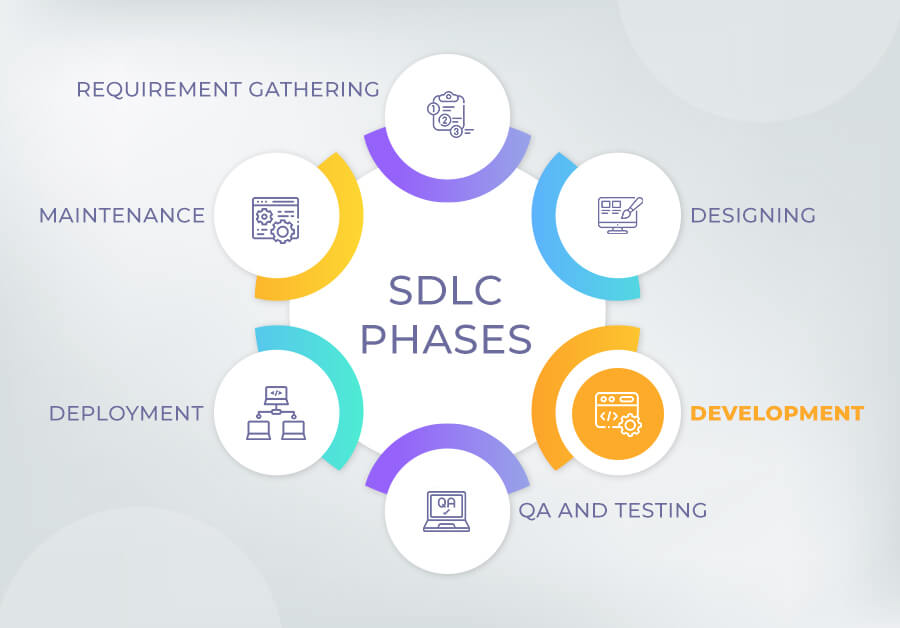
The entire software development (a digital product) can be divided into several phases that start with requirement gathering and ends with deployment and maintenance of the software product built. For each stage, the documentation of software development is assured so that the product is aligned with business objectives. Here are the six main phases of SDLC –
Requirement gathering: In this phase of SDLC, all the requirements of software development are gathered and they are mapped with business objectives. A blueprint (that talks about how the software product will be) is created and documented.
Designing: In the designing phase, the design of the software product is crafted. UI/UX Designers focus on building the best UI/UX to make the product engaging and easy to use.
Development: This is the core of the entire software development life cycle. The tech stack is assured and all necessary resources are kept in place for this crucial software development phase. We are going to discuss this phase in detail later.
QA and testing: After the software product is built, quality assurance is achieved by a thorough investigation of coding practices. Vigorous tools are applied for testing the efficacy and usability of the software.
Deployment: The final stage of software development ends with the deployment of the product on a particular platform or predefined environment. The product is officially released and ready to be used by stakeholders or specific users.
Maintenance: This is an extension of the SDLC process where maintenance is assured to keep the product up and running. Maintenance would also include regular updates and bug fixing if any.
What Happens During the Development Phase of SDLC?
The development phase is not a single activity of writing code. It is a structured workflow where tools, processes, collaboration, and validation work together to convert system designs into a stable and functional product. Each activity inside this phase has a direct impact on software quality, delivery speed, and long term maintainability.
Instead of treating development as a linear task, modern SDLC practices divide this phase into controlled technical operations that reduce risk, improve transparency, and ensure alignment with system requirements.
Setting Up the Development Environment and Toolchain
Before writing the first line of code, developers prepare a controlled environment where the application can be built, tested, and refined. This includes configuring integrated development environments, selecting programming frameworks, installing required libraries, and setting up local or cloud based workspaces.
A well structured environment eliminates inconsistencies between developer machines and reduces integration failures later. It also ensures that every software development team member works with the same dependencies, runtime configurations, and coding standards.
Writing Modular and Maintainable Source Code
Once the environment is ready, developers begin implementing features based on technical design documents and functional specifications. Code is written in small, independent modules that can be tested, updated, and reused without affecting the entire system.
This modular approach improves clarity, simplifies debugging, and supports scalability. Instead of building one large codebase, software developers create logical components that can evolve independently while still working together as a unified application.
Managing Code with Version Control Systems
Version control allows multiple developers to work on the same project without overwriting each other’s changes. Every code update is tracked, reviewed, and stored in a shared repository.
Branching strategies, controlled merges, and commit tracking make it possible to trace changes, restore earlier versions, and collaborate efficiently across software development teams. This prevents code conflicts and maintains a reliable history of development activity.
Performing Unit Testing and Early Validation
Developers test individual components as soon as they are written to verify functionality and logic. These tests validate that each unit behaves as expected before it is combined with other parts of the system.
Early software testing reduces the cost of fixing defects and improves overall code quality. It also ensures that issues are identified before they reach later SDLC stages where corrections become more complex and expensive.
Integrating Continuous Builds and Code Checks
Modern development integrates automated build and verification processes that run whenever new code is added. These systems compile the application, run basic tests, and check for errors or vulnerabilities.
This continuous validation helps software companies detect problems immediately and maintain consistent quality throughout software development. It transforms the software development phase into a dynamic and controlled process rather than a risky, end loaded activity.
The development phase of SDLC
As mentioned earlier, the core part or the pillar of the entire software development is the development phase wherein standard coding practices are followed by software developers and engineers. The development phase is actual software program writing and following SDLC guidelines, one can track changes in the code even in the future. This phase is crucial to achieving the goal and business objective of the digital product.
What are the objectives of the development phase of SDLC?
The software development team follows standard coding practices and documentation. The team would appraise and support perfect documentation of the development phase because it helps them understand the product and its programming. It is a primary source for any software developer (now or in the future) to go through the following procedure of software product design and development and sync in. Here are the purposes of the SDLC development phase –
- To build a flawless system
- To integrate and test units into larger components
- Providing a seamless technical environment
- Assurance of quality achievement to go into the testing phase
The primary goal of the development phase in SDLC is to achieve an optimum level of software development architecture. This is done by transforming the system design into a working environment without losing the objectives and scope of the product. It is like adding a soul to a beautiful body and making it function or work flawlessly. At the end of the SDLC development phase, all the documents shall be used for the testing phase.
What are the duties of software developers during the SDLC development phase?
Passing through the most crucial stage of SDLC requires a dedicated approach by software developers. During the documentation development, the software programmers’ team should perform specific jobs listed below –
- Refer to previous documents for references for similar coding standards and fetch the benefits of saving time and effort.
- Draft the documents that are unambiguous yet comprehensive to include the details of the process followed in the development phase.
- Build organized document repositories that include critical information about the development stage. The ultimate aim of this is to provide easy access and reference to the phase to all team members.
- Check software development documents for any flaws or indistinctness that may confuse readers.
- Assure that sample deliverables are available to present to owners. Such deliverables may have scope to expand or limit depending on the feedback received from stakeholders and other users.
When the software development teams perform their duties properly, the documentation of this phase shall produce a foolproof roadmap to the success of the product in the coming SDLC stages.
The RACI key
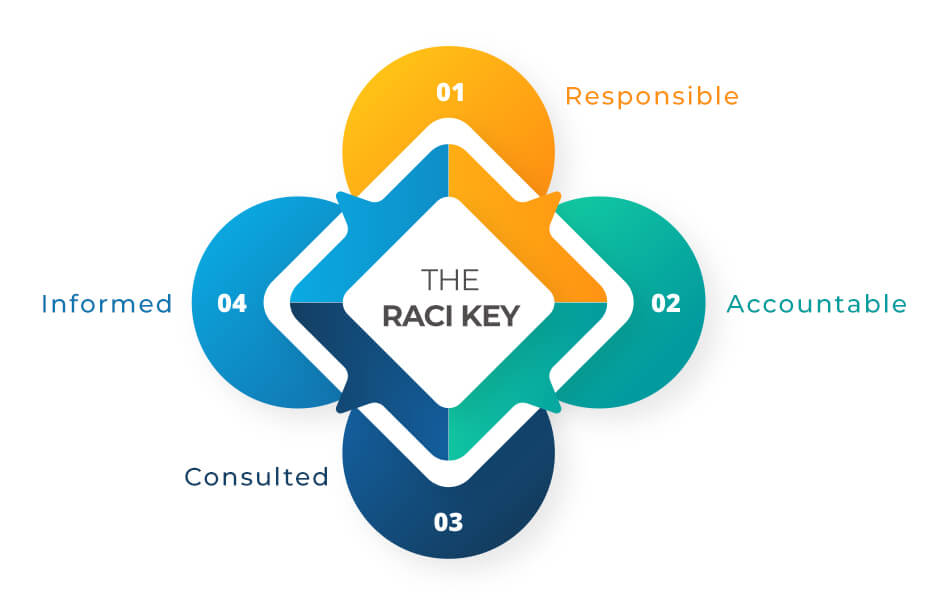
Experts in software development at the Department of Information Technology (DoIT) Maryland suggest following the RACI key to assure that the development phase in SDLC follows standard practices. The RACI key would set everybody’s roles and responsibilities.
Responsible
It describes the role of software development team members who shall execute several actions to achieve the overall goal of the software product.
Accountable
In this, accountability and ownership of several tasks and activities that lead to the final development phase deliverables are defined and fixed.
Consulted
It describes the roles of subject experts or domain experts for their valuable inputs in the development phase. Their inputs help software developers execute the stage flawlessly.
Informed
This part describes the roles of people who receive information and convey it to concerned stakeholders.
What tasks are finished after the development stage?
The software development team completes some crucial tasks at the end of the development stage of SDLC process.
- Documentation for the system design
- Documentation for system security
- Disaster recovery backing plan
- Drafts of the unit and integration testing
- Draft of conversation plan
- Draft of data retention and implementation plan
- Drafts of operations, maintenance, and training plans
How can development phase deliverables improve the SDLC process?
Successfully achieved development phase for SDLC assures that the product is clearly defined, strategically planned, and well communicated. It is the development stage where the product would grow its control, features, and facilities that will be tactfully handled by the building team of the software product.
The SDLC’s development period shall give a clear idea and structure to developers and associates who shall now perform testing on the product. Here are the benefits of final products built at the end of this stage –
- Creates ubiquitous understandings so that all developers are on the same board
- Facilitates further action as the project gets more complex
- Provides in-depth insight to seniors about possible risks or impediments
- Encourages developers to master coding for future references of the similar components programming
- Provides a professional environment through the documentation for knowledge transfer in case there is a change in software developers. Also, it helps get budgetary ideas or assessment activities for young coders
The software development stage, known as the coding or implementation stage, divides tasks into modules or units, and the roles of developers are defined. This longest stage follows standard practices to assure a superlative software development team management that renders quality pare excellence while customizing the product as per the business logic applied.
Key Deliverables Produced in the Development Phase
The development phase does not only produce application features. It also generates technical assets that support testing, deployment, maintenance, and future enhancements. These deliverables provide traceability, stability, and continuity across the remaining SDLC stages.
Each output from this phase plays a specific role in ensuring that the software can be validated, scaled, and supported after release.
Source Code and Versioned Repositories
The primary deliverable is the complete, version controlled source code. Every feature, bug fix, and improvement is stored in a shared repository that tracks change history, authorship, and revisions.
This repository becomes the single source of truth for the project and supports collaboration, rollback, and auditability.
Unit Test Reports and Build Artifacts
Alongside the code, developers generate unit test results that verify the behavior of individual components. These reports confirm that core functions work correctly before the system moves to broader testing stages.
Build artifacts such as compiled binaries, libraries, and packages are also produced. These artifacts are used in testing, staging, and deployment environments.
Technical Documentation and Configuration Files
The development phase updates system documentation that explains how the software is structured, how modules interact, and how the system should be maintained.
Configuration files define environment settings, dependencies, and runtime parameters. Together, documentation and configuration ensure consistency, reduce onboarding time, and support long term system stability.
Coding Standards and Quality Control Practices for SDLC Development Step
The reliability of a software product depends heavily on how consistently and clearly the code is written. During the development phase, coding standards and quality controls ensure that every contributor follows the same structure, naming conventions, and logic patterns. This consistency reduces errors, improves readability, and makes long term maintenance more efficient.
Without defined standards, development teams face fragmented codebases that are difficult to scale, test, or enhance. Quality governance transforms individual coding efforts into a cohesive system.
Enforcing Clean Code and Style Guidelines
Clean code principles focus on clarity, simplicity, and reusability. Developers follow naming conventions, formatting rules, and documentation practices that make the code easy to understand for both current and future team members.
Style guides define how variables, functions, and classes should be written and organized. These guidelines eliminate ambiguity and ensure uniformity across modules, regardless of who writes the code.
Peer Reviews and Static Code Analysis
Before code is merged into the main system, it is reviewed by other developers to identify errors, inefficiencies, and security risks. Peer reviews encourage knowledge sharing and enforce accountability across the software development company.
Static analysis tools automatically scan code to detect syntax errors, performance issues, and vulnerabilities. These checks provide continuous feedback and prevent defects from moving deeper into the SDLC pipeline.
Embedding Security and Compliance into the Development Process
Security is no longer a final step performed after coding is complete. In modern SDLC frameworks, protection and compliance are built directly into the development phase to reduce risk and prevent costly vulnerabilities later in the lifecycle.
When software development partners apply security practices while writing code, they eliminate many threats before the software ever reaches testing or production. This approach protects sensitive data, preserves system integrity, and supports regulatory compliance.
Secure Coding and Vulnerability Prevention
Software development companies follow secure coding principles that protect applications from common threats such as data exposure, injection attacks, and unauthorized access. This includes validating inputs, managing authentication securely, and protecting sensitive configuration details.
By identifying potential weaknesses during development, teams reduce the likelihood of security flaws becoming embedded in the system architecture.
DevSecOps Practices During Code Implementation
DevSecOps integrates automated security checks into the development workflow. Every code change is scanned for vulnerabilities and compliance issues before it is approved.
This ensures that security is continuously monitored rather than treated as a one time activity. It also enables faster development without sacrificing protection, allowing teams to release reliable software with confidence.
How the Development Phase Differs Across SDLC Models?
The activities performed during the development phase remain technically similar across projects, but the way they are planned, executed, and validated changes significantly based on the SDLC model being used. Each model defines how code is written, reviewed, tested, and delivered throughout the lifecycle.
Understanding these differences helps organizations select the right development approach for their project complexity, timeline, and risk tolerance.
Development Execution in the Waterfall Model
In the Waterfall model, development begins only after requirements and design are fully finalized. Developers work through the entire scope in a single structured sequence.
Testing occurs after the coding phase is completed, which means issues discovered later may require significant rework. This approach works best for stable projects with clearly defined requirements.
Development Cycles in Agile Methodologies
Agile development divides work into short iterations where features are built, tested, and refined continuously. Developers collaborate closely with stakeholders and adapt to feedback in real time.
This iterative approach allows teams to respond quickly to changes and deliver functional components early and often.
Continuous Development in DevOps Environments
DevOps focuses on continuous integration and continuous delivery. Code is written, tested, and deployed through automated pipelines.
This model reduces deployment risks and accelerates release cycles by maintaining a constant flow from development to production.
Validation Driven Development in the V Model
The V Model pairs each development activity with a corresponding testing phase. Code validation happens alongside development, not after it.
This structured alignment improves traceability and ensures that every feature is verified against its original requirements.
Tools Commonly Used During the Development Phase
The development phase relies on a combination of tools that support coding, collaboration, testing, and automation. These tools help teams work efficiently, maintain consistency, and reduce technical risks throughout the SDLC process.
Selecting the right toolset ensures that developers can focus on building reliable software rather than managing manual processes.
Code Editors, Frameworks, and Build Tools
Software developers use integrated development environments and code editors to write, debug, and manage application logic. Frameworks provide reusable components that speed up development and enforce architectural consistency.
Build tools automate the compilation, packaging, and dependency resolution processes, ensuring that the application is assembled correctly every time.
Version Control and Collaboration Platforms
Version control systems manage code changes and enable team collaboration. These platforms store code history, manage branches, and track contributions, making it easier to merge work from multiple developers without conflicts.
They also provide transparency and accountability across the software development process.
Automated Testing and CI/CD Solutions
Testing frameworks validate functionality at different stages of software development, while continuous integration and delivery tools automate build, test, and deployment workflows.
This automation reduces errors, shortens feedback cycles, and maintains a steady flow of verified code through the SDLC pipeline.
Common Challenges Faced During the Development Phase
Even with structured processes, the development phase presents technical and operational challenges that can affect timelines, quality, and system stability. Identifying these risks early and addressing them systematically is essential for maintaining project momentum.
Code Conflicts and Integration Failures
When multiple developers work on the same codebase, conflicting changes can occur. These conflicts may delay releases and introduce errors if not resolved properly.
Using clear branching strategies, frequent merges, and automated integration checks helps teams manage conflicts efficiently.
Architecture Drift and Performance Issues
As new features are added, systems may slowly move away from their original design, creating inconsistencies and inefficiencies. This architecture drift can lead to performance bottlenecks and maintenance difficulties.
Regular design reviews and refactoring ensure that the system remains aligned with its original structure and performance goals.
Security Risks and Dependency Management
Third party libraries and frameworks introduce external dependencies that may contain vulnerabilities. Without proper tracking and updates, these risks can compromise the entire system.
Automated dependency scanning and version control practices help maintain secure and stable environments.
Modern Enhancements Shaping the Development Phase Today
The development phase has evolved significantly with the introduction of automation, cloud technologies, and intelligent development tools. These advancements have transformed traditional coding practices into faster, more adaptive, and highly efficient workflows.
Modern development environments focus on continuous improvement, real time validation, and rapid delivery without compromising quality.
DevOps Automation and Continuous Integration
Automation enables developers to integrate code frequently and validate it immediately. Continuous integration pipelines automatically build, test, and verify every change, reducing errors and accelerating feedback cycles.
This approach allows teams to release updates quickly while maintaining system stability.
AI Assisted Development and Cloud Native Practices
Artificial Intelligence tools support developers by suggesting code, detecting errors, and improving efficiency. Cloud native development enables scalable infrastructure, on demand resources, and flexible deployment models.
Together, these technologies reduce software development time and increase reliability across distributed systems.
Measuring the Success of the Development Phase
The success of the development phase cannot be judged by code completion alone. Writing code does not automatically mean the product is reliable, secure, or scalable. This phase must be measured using technical, operational, and business aligned indicators that show whether the development process is producing high quality and sustainable software.
When teams track meaningful metrics, they gain visibility into performance bottlenecks, code quality gaps, delivery inefficiencies, and long term system risks. These insights allow organizations to improve processes, reduce rework, and strengthen collaboration between development, testing, and operations teams.
Code Quality and Defect Metrics
Code quality metrics help determine how stable and maintainable the system is. These measurements reveal whether the codebase is growing in a healthy way or becoming fragile and difficult to manage.
Common indicators include code complexity levels, test coverage percentages, defect density, and code duplication rates. High complexity often leads to increased bugs and slower development cycles. Low test coverage increases the risk of undetected failures. Monitoring these factors ensures that new features do not compromise system reliability.
Static analysis results, vulnerability counts, and code review feedback also play an important role. Together, these metrics help teams understand where technical debt is accumulating and where corrective action is required.
Productivity and Delivery Performance Indicators
Productivity metrics measure how efficiently development work moves from planning to deployment. These indicators show whether teams are delivering value consistently or struggling with delays and rework.
Key performance indicators (KPIs) include build success rates, release frequency, cycle time, lead time for changes, and deployment success rates. A high build failure rate often signals unstable code or incomplete testing. Long cycle times may indicate workflow inefficiencies or resource constraints.
Tracking these metrics helps organizations identify bottlenecks, improve collaboration, and align development efforts with business objectives. When performance indicators are monitored regularly, teams can make data driven decisions that improve speed without sacrificing quality.
Key Takeaways from the Development Phase of SDLC!
In almost all software development models, the backbone of the SDLC procedure is the development stage and at the end of this phase, software developers get a complete working information system created in a functional environment. The product after this stage seeks approval from authorities to get into the testing phase. If the product enters the testing phase, it indicates that the SDLC process’ development stage has been achieved successfully and documented quite well.
Strategic Importance of the Development Phase in Software Projects
The development phase is the structural backbone of the Software Development Life Cycle. It is the stage where strategic planning, technical design, and business objectives converge to form a real, functional system. Every decision made during this phase influences performance, scalability, security, and long term maintenance costs.
When development is executed with disciplined practices, automated validation, and collaborative workflows, it reduces project risk and accelerates time to market. Businesses gain the ability to respond to change, release updates confidently, and scale their systems without compromising stability.
This development phase also defines the future flexibility of the product. Well written, modular, and secure code allows software development companies to enhance features, integrate new technologies, and adapt to evolving business needs. Poor development, on the other hand, increases technical debt, raises operational costs, and limits growth.
By treating the development phase of SDLC process as a strategic investment rather than a technical task, businesses build resilient software products that deliver long term value, customer satisfaction, and competitive advantage.
Avantika Shergil
| Feb 18, 2026


Avantika Shergil is a technology enthusiast and thought leader with deep expertise in software development and web technologies. With over 8 years of experience analyzing and evaluating cutting-edge digital solutions, Avantika has a knack for demystifying complex tech trends. Her insights into modern programming frameworks, system architecture, and web innovation have empowered businesses to make informed decisions in the ever-evolving tech landscape. Avantika is passionate about bridging the gap between technology and business strategy, helping businesses build customized software and website, and understand about different tools to leverage effectively for their ventures. Explore her work for a unique perspective on the future of digital innovation.