NDA for Software Development Explained
 By
Avantika Shergil
|
Jan 7, 2026 |
Software Development
By
Avantika Shergil
|
Jan 7, 2026 |
Software Development
Software development is a complex process where clear documentation is essential. There are many types of documents in software development that not only define the project scope but also legally bind both parties with certain roles and responsibilities along with access, distribution, and disclosure of data or information. In all documents, NDA stands for Non-Disclosure Agreement (NDA), a vital process or documentation in software development.
The document serves as a legal safeguard to protect proprietary information when a buyer or client contacts a software development company and fixes the deal to build a software product for a business. NDAs ensure that essential information like trade secrets, business strategies, and technical approaches are not leaked out and remain confidential.
The importance of NDA increases manifold when companies outsource software development services to an offshore company. Because here, in this case, the client’s innovative ideas could be potentially misused or stolen. Hence, a number of software development agreements along with an NDA are executed to define the scope of confidentiality and the consequences of breaches. This legally binds the parties and promotes fair business deals.
In this guide, we will understand the types and essentials of NDA for software development.
Table of Contents
What is a Non-Disclosure Agreement (NDA)?
As stated by PennState University, a Non-Disclosure Agreement (NDA), also known as a proprietary information agreement, secrecy agreement, or confidentiality agreement, is a legal agreement wherein information is defined that parties wish to protect from dissemination and outlines restrictions on use.
NDA when applied to a technology industry i.e., IT industry, it means that a buyer and software development company they have hired are bound by an agreement that the information or data on the project will be confidential and will never be disclosed to a third party of any kind without permission.
What are the Different Types of NDA?
There are different Non-disclosure agreements depending on the project type and deal between two parties: the buyer and the software development company or service provider in concern. There could be one-way agreements, two-way agreements, or multifaceted agreements that include several clauses. For complex software development projects with multiple entities involved, multi-party NDAs are sought after.
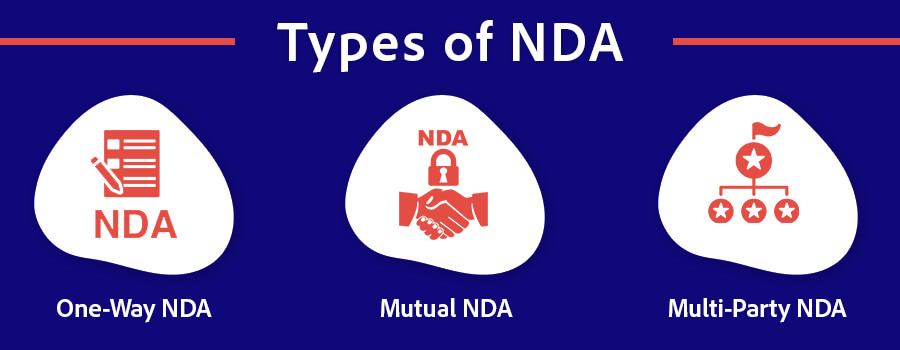
Here are some of the popular types of NDA for software development:
One-Way NDA
One-way NDA, also known as unilateral NDA, is an agreement that protects the confidential information of one party – generally the company that discloses the information. Here, unilateral NDA could include source codes, documents of designs, and even patented or registered business ideas. The receiving party such as a contractor or software development partner, will agree to keep this agreement secret and commit not to use it for their own benefit. It is a one-way street that ensures that sensitive data remains secret.
Mutual NDA
Mutual NDA is also called bilateral NDA wherein opposite to the previous type, both parties are held together for commitment. Here, a two-way flow of confidential information is established and both the parties involved in the software development project will agree to keep each other’s information safe. Such agreements are common during collaborations or beta testing wherein a software development agency shares the product or software solution with testers who might have their own set of proprietary data. This helps entities build trust in each other.
Multi-Party NDA
Also known as multilateral NDA, the multi-party NDA as mentioned earlier extends the confidentiality and protections to more than two parties. This type of contract serves as a boon to complex software development projects that involve multiple companies or teams in various stages of production. Each entity will agree to safeguard secret information shared by all individuals. The multilateral NDA makes sure that all confidential information is protected throughout the software development life cycle.
Why NDAs Are Critical in Software Projects?
Software development projects inherently involve sharing sensitive business, technical, and strategic information. This can include proprietary algorithms, source code, system architecture, APIs, user data, and even future product roadmaps. Without a Non-Disclosure Agreement (NDA), this information is legally exposed.
NDAs are critical because they:
- Establish legal ownership and confidentiality boundaries before discussions begin
- Reduce the risk of idea theft, code reuse, or unauthorized disclosure
- Protect competitive advantage during outsourcing or third-party collaboration
- Provide legal recourse if confidential information is misused
In modern software projects—especially those involving remote teams, offshore vendors, freelancers, or cloud infrastructure—information flows across multiple entities. An NDA acts as the first line of legal defense, ensuring everyone involved understands what information must remain confidential and the consequences of a breach.
Why Do You Need an NDA for Software Development?
An NDA is not just a legal formality—it is a risk-management tool that protects both business and technical interests throughout the software lifecycle.
Key Reasons You Need an NDA while building a software.
Protect Intellectual Property (IP)
Before a single line of code is written, ideas, logic, and architecture are already valuable IP. An NDA ensures these assets cannot be reused, disclosed, or commercialized without permission.
Secure Source Code & Technical Assets
NDAs help prevent developers, vendors, or contractors from:
- Reusing your codebase
- Sharing internal tools or libraries
- Exposing system vulnerabilities
Safeguard Business & Market Strategy
Product roadmaps, pricing models, go-to-market strategies, and customer insights are often discussed during development. NDAs ensure this information does not reach competitors.
Enable Safe Outsourcing & Collaboration
When working with external development teams or offshore partners, NDAs create trust and accountability, making collaboration legally safe.
Minimize Legal & Financial Risk
If confidential information is leaked, an NDA provides grounds for:
- Injunctions
- Financial damages
- Termination of contracts
Without an NDA, enforcing confidentiality becomes significantly harder and costlier.
Essential NDA Clauses for Software Development Contracts
A strong software development NDA goes beyond generic confidentiality language. It must address technology-specific risks.
Key Clauses You Should Always Include in your Software NDA
Definition of Confidential Information
Clearly specify what is considered confidential, such as:
- Source code and binaries
- Algorithms, workflows, and architectures
- Technical documentation
- Client and user data
Intellectual Property Ownership
Clarify that all work product, code, and derivatives belong to the rightful owner (usually the client), preventing future ownership disputes.
Scope of Confidentiality Obligations
Define how confidential information can be used—and explicitly prohibit:
- Disclosure to third parties
- Use beyond the project scope
Duration & Survival Clause
State how long confidentiality obligations last, including post-termination protection (often 2–5 years or indefinitely for trade secrets).
Exclusions from Confidentiality
Standard exclusions include information that:
- Is already public
- Was known before signing the NDA
- Is disclosed by law or court order
Governing Law & Jurisdiction
Specify which country’s laws apply and where disputes will be resolved—especially critical in offshore development.
Remedies for Breach
Include the right to seek injunctive relief and damages, reinforcing enforceability.
NDA Checklist Before Signing a Software Development Agreement
Before signing an NDA, use this checklist to avoid costly mistakes:
Legal & Contractual Checklist
- Is the NDA legally binding in the chosen jurisdiction?
- Is the governing law clearly stated?
- Are remedies for breach clearly defined?
IP & Technical Protection Checklist
- Does it explicitly cover source code, APIs, and documentation?
- Is IP ownership unambiguous?
- Are subcontractors and third-party tools covered?
Business & Risk Checklist
- Is the confidentiality duration reasonable?
- Does it align with the main development contract (MSA/SOW)?
- Are both parties’ obligations clearly balanced?
A quick checklist review can prevent years of legal disputes later.
Are Software Development NDAs Enforceable Globally?
Yes, NDAs are generally enforceable worldwide—but enforceability depends heavily on jurisdiction, wording, and local laws.
United States
NDAs are widely enforceable if they are reasonable in scope, duration, and purpose. Courts strongly protect trade secrets and IP.
European Union
NDAs are enforceable but must comply with strict data protection and employment laws. Overly broad clauses may be challenged.
India
NDAs are valid, but enforcement depends on clarity. Courts scrutinize vague or excessively restrictive clauses, especially around non-compete obligations.
Best Practices for Global Enforceability
- Avoid one-size-fits-all NDA templates
- Clearly define jurisdiction and governing law
- Ensure clauses are reasonable and proportionate
- Align NDAs with local labor and IP laws
For cross-border software projects, NDAs should ideally be reviewed by legal professionals familiar with international contracts.
What are the Roles of NDA for Software Development?
In the software development industry, a Non-Disclosure Agreement is crucial for protecting sensitive information of any kind. The role of NDAs is to legally bind parties to confidentialities and, therefore, ensure that trade secrets, business ideas, proprietary tactics, and client data are kept secure and safe.
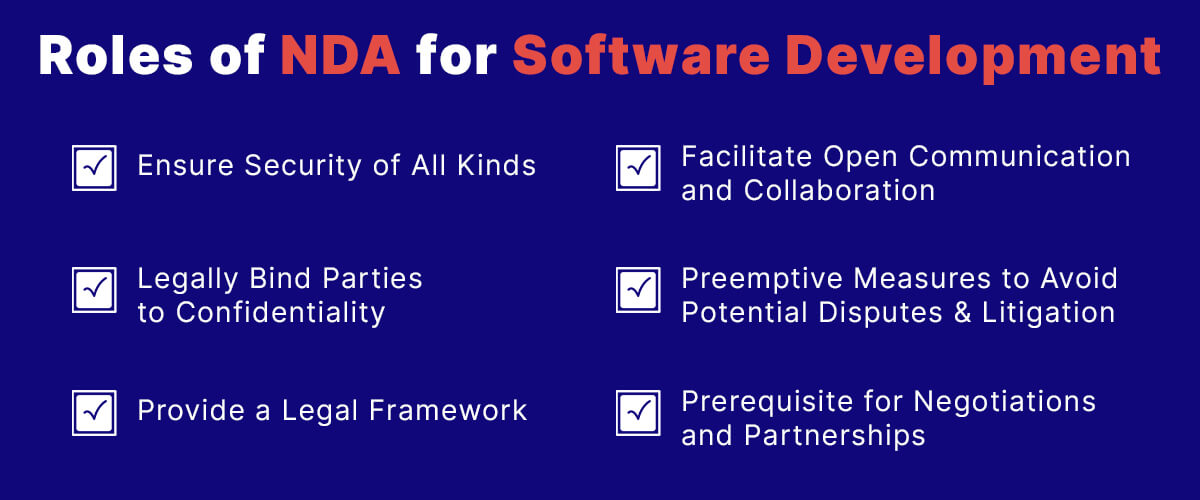
NDAs are the best tools to build trust between entities and to allow open collaboration while keeping data and information away from theft and unauthorized disclosures. Here are their roles in detail:
To ensure security of all kinds
In software building projects, ensuring security includes strict control over access, regular audits, and enhanced encryption. Confidentiality agreements safeguard proprietary data and limit its disclosure. Trade secrets like algorithms are secured through legal and technical NDAs. Primarily, the focus is on three things:
- Proprietary information: Often called the backbone of a company, proprietary information includes valuable data exclusive to companies. It needs stringent measures to keep unauthorized dissemination at bay to preserve the company’s reputation.
- Trade secrets: From recipes to software codes, trade secrets should be protected not just by intrinsic values but also by their nature. Vigilant protection is essential and maintained to keep the company’s business ethics and values.
- Innovative ideas: Innovative ideas help companies not only survive tough markets but also succeed with triumph. Innovative ideas are like catalysts that advance the growth of the company and hence you need to protect it through strict NDAs for software development companies. Through patents and trademarking, such innovations are rewarded for their ingenuity.
To legally bind parties to confidentiality
A non-disclosure agreement is a legal document that ensures that all parties are lawfully bound to confidentiality. This is a legal weapon that protects sensitive information from being leaked to competitors, the public, or even third-party companies. Building a software solution involves software development models and in some cases, even these models are kept confidential and considered a trade secret. NDA promotes such an environment wherein proprietary ideas, tech stacks, and even those models are covered. Thus, developers at the software agency and clients communicate and work on projects without any fear of premature exposure.
To provide a legal framework
Providing a legal framework through a non-disclosure contract creates a clear boundary and expectations for everyone involved. It delineates the aim of what is labeled as confidential, the obligations of the entities, and the consequences of any violation of rules. The software development NDA brings clarity to mitigate risks and safeguard intellectual rights for properties within the software development ecosystem.
To facilitate open communication and collaboration
Collaboration and communication are two essential pillars to secure space for sharing ideas and innovations. Software development non-disclosure agreement covers this and makes sure that the contributions by anyone are not misappropriated and misguided. With an NDA contract, team members feel confident and synergistic because this openness can accelerate their creative processes leading to building the best digital product.
To serve as preemptive measures to avoid potential disputes and litigation
Implementing NDA means securing preemptive measures to bring down potential disputes and litigation that otherwise occur in most non-NDA cases. The document sets the boundaries for sharing information so that ambiguities are reduced and legal conflicts are kept at bay. Both parties are made aware of their roles responsibilities and limitations in dealing with crucial data. The misuse of proprietary data as well as costly court proceedings are avoided.
To serve as a prerequisite for negotiations and partnerships
Non-disclosure agreements often act as a prerequisite for dialogues to negotiate the terms and conditions of software development projects and partnerships. The NDA document establishes a primary framework for communication that signals a serious and professional approach to both parties. With an NDA in place, the partners engage in open discussions about intellectual properties and their rights.
What to do In the event of a NDA breach?
An NDA works as a shield for both parties in software development services by protecting confidential data, ideas, and information from unauthorized disclosure. In the event of a breach, the NDA will provide a clear legal action leading to recourse. The agreement will allow the aggrieved party to demand damages and enforce injunctions to further the use of disputed data.
NDAs also give power to both parties to recover the loss of all kinds and types due to breach or damage. Ideally, NDA means a deterrent against the misapplication of secure information to the public or any third-party company.
Build Secure Software Solutions
While outsourcing software solutions to inferior software companies brings more challenges in terms of safety, you can find the top software development agencies to stay worry-free about losing your project due to a breach of confidentiality. Reputed software development companies practice strict NDA and, therefore, outsourcing projects to them is not just safer but beneficial as well.
NDA for Software Development: People Also Ask
Is an NDA legally binding in software development projects?
Yes, NDAs are legally binding in most countries when they are properly drafted, signed by all parties, and contain reasonable terms. Courts generally enforce NDAs for Software development that clearly define confidential information, obligations, and remedies for breach.
Do startups really need NDAs for software development?
Yes. Startups often rely on innovative ideas, MVPs, and proprietary logic. An Software development NDA helps protect these assets when discussing concepts with developers, investors, freelancers, or outsourcing partners, especially before IP ownership is formally transferred.
Can an NDA protect software ideas or concepts?
An NDA for software development can protect how an idea is shared and used, but not the idea alone. It safeguards confidential details such as workflows, technical execution, and proprietary data, which makes copying or misuse legally actionable.
What is the difference between a one-way NDA and a mutual NDA?
A one-way NDA protects information disclosed by only one party, while a mutual NDA protects confidential information shared by both parties. Mutual NDAs are commonly used in collaborative software development projects where both sides exchange sensitive data.
How long should a software development NDA last?
Most software NDAs last between 2 to 5 years after the project ends. However, trade secrets and core intellectual property may require indefinite confidentiality, depending on the nature of the information.
What happens if an NDA is breached?
If an NDA is breached, the affected party may seek:
- Injunctive relief to stop further disclosure
- Financial damages
- Termination of contracts
- Legal action based on the governing law
The outcome depends on the NDA’s wording and jurisdiction.
Are NDA templates safe to use for software development?
Generic NDA templates can be risky. Software projects often require custom clauses for IP ownership, source code protection, APIs, and data security. It’s best to tailor NDAs to your specific project or have them reviewed by a legal professional.
Are Software Development NDAs Enforceable Globally?
Yes, software development NDAs are generally enforceable worldwide, but their enforceability depends on local laws, how the NDA is drafted, and whether its terms are reasonable. There is no single “global NDA law,” so cross-border software projects require extra care.
What are the rules of NDA in software development in the USA?
In the United States, Non-Disclosure Agreements (NDAs) used in software development are legally enforceable, provided they are drafted fairly and for legitimate business purposes. US courts generally uphold NDAs that protect confidential technical and business information without unreasonably restricting competition or employment.
Key rules governing software development NDAs in the USA include:
- Legitimate business purpose: NDAs in USA must protect valid interests such as source code, proprietary algorithms, trade secrets, customer data, and internal documentation. They cannot be used to block fair competition.
- Clear definition of confidential information: The software development agreement should clearly specify what information is confidential, including software architecture, APIs, databases, workflows, and product roadmaps. Vague or overly broad definitions can weaken enforcement.
- Reasonable scope and duration: NDAs must be reasonable in terms of time and scope. Most software NDAs last 2–5 years, while trade secrets may be protected indefinitely if secrecy is maintained.
- No disguised non-compete clauses: NDAs for software development in USA must not act as indirect non-compete agreements. They cannot prevent developers or employees from using general skills, experience, or knowledge gained during a project.
- Governing law and jurisdiction: A valid NDA clearly states which state’s laws apply and where disputes will be resolved—especially important for remote or offshore software development teams.
- Defined remedies for breach: Enforceable NDAs typically include remedies such as injunctive relief, monetary damages, and recovery of legal fees in case of unauthorized disclosure.
- Legal and whistleblower exceptions: NDAs in the USA cannot prohibit lawful disclosures, including whistleblowing, reporting illegal activities, or compliance with court orders.
In summary, software development NDAs in the United States are enforceable when they are clear, reasonable, and focused on protecting confidential information rather than restricting professional freedom.
What are the rules of NDA in software development in India?
In India, Non-Disclosure Agreements (NDAs) used in software development are legally valid and enforceable, provided they comply with Indian contract law and are drafted with reasonable, clear terms. NDAs in India are widely used in IT services, outsourcing, SaaS development, and startup ecosystems.
However, Indian courts apply strict scrutiny, especially where NDAs appear to restrict employment or competition.
Key rules governing software development NDAs in India include:
- Must qualify as a valid contract: An NDA for software development in India must meet the requirements of the Indian Contract Act, 1872—lawful purpose, free consent, competent parties, and valid consideration.
- Clear definition of confidential information: NDAs in India should precisely define what constitutes confidential information, such as source code, software architecture, algorithms, databases, documentation, client data, and business strategies. Vague or overly broad definitions reduce enforceability.
- Protection of confidentiality is allowed; restraint of trade is not: Indian law permits NDAs that protect confidential information. However, clauses that act as non-compete agreements during or after employment are generally unenforceable under Section 27 of the Indian Contract Act.
- Reasonable scope and duration: Confidentiality obligations must be reasonable in scope and time. NDAs protecting trade secrets may survive contract termination, but excessive or indefinite restrictions may be challenged.
- IP ownership should be clearly stated: Software NDAs often work alongside development contracts. It is critical to clearly specify ownership of source code, derivatives, and work product to avoid disputes.
- Governing law and jurisdiction: The NDA should clearly state Indian law as governing law and specify courts or arbitration venues in India to simplify enforcement.
- Remedies for breach: Indian NDAs for software development commonly allow for injunctive relief (to prevent further disclosure) and monetary damages. Courts focus heavily on proof of actual loss and clarity of breach.
- Subcontractors and third parties must be covered: For outsourcing and offshore development, NDAs should explicitly extend confidentiality obligations to freelancers, consultants, and subcontractors.
In summary, software development NDAs in India are enforceable when they are clearly drafted, reasonable in scope, focused on confidentiality (not non-compete), and aligned with Indian contract law. Careful wording is essential to ensure the NDA protects IP without violating statutory restrictions.
Avantika Shergil
| Jan 7, 2026


Avantika Shergil is a technology enthusiast and thought leader with deep expertise in software development and web technologies. With over 8 years of experience analyzing and evaluating cutting-edge digital solutions, Avantika has a knack for demystifying complex tech trends. Her insights into modern programming frameworks, system architecture, and web innovation have empowered businesses to make informed decisions in the ever-evolving tech landscape. Avantika is passionate about bridging the gap between technology and business strategy, helping businesses build customized software and website, and understand about different tools to leverage effectively for their ventures. Explore her work for a unique perspective on the future of digital innovation.