Software Development Agreement: A Complete Guide
 By
Avantika Shergil
|
May 29, 2026 |
Software Development
By
Avantika Shergil
|
May 29, 2026 |
Software Development

The recent stats by the research giant Statista quote that the revenue from total software development is likely to show an annual growth rate (CAGR 2023-2028) of 5.42% which means it would have a market volume of $858 billion by 2028. There is no company or business that can thrive in the competitive market without automatizing its internal and external operations.
Since so much money and effort are put into finding top software development companies to hire the best resources, it is important for enterprises to make sure that their projects don’t go into the wrong hands; furthermore, it is also suggested that the documentation is in place in order to avoid any hassle or unwanted consequences.
Table of Contents
What is a Software Development Contract?
A software development contract is a legal document that binds a software development company and a client with certain duties about a software project. It can also be extended to dedicated software developers and the client as well. This document mentions what the software will do, the time it’ll take to develop, how much it will cost, and who will own the final product. Furthermore, it may include the hiring models, milestones for software project completion and payments. Such legal binding helps both parties to avoid misunderstandings and disputes about the software project.
Why is a Software Development Agreement important?
As just stated, a software development services agreement builds a legal bond between a software developer and a client with all the details such as the scope, and terms and conditions of the entire project.
It is important to have a software development agreement for several reasons:
- It clarifies the expectations and responsibilities of both parties, such as the deliverables, deadlines, payment methods, ownership rights, warranties, and liabilities.
- It protects the intellectual property rights of the software development company and the client, such as the source code, documentation, trademarks, and patents.
- It reduces the risk of disputes and litigation by providing a clear and enforceable framework for resolving any issues that may arise during or after the software project development.
- It ensures compliance with relevant laws and regulations, such as data protection, privacy, security, and taxation.
Types of Custom Software Development Agreements/Contracts for Hiring
Different software projects require different contractual structures depending on the project scope, engagement model, delivery timeline, and technical complexity. Businesses, startups, and enterprises should choose a software development agreement that aligns with their operational goals and risk management strategy. A well-structured software development contract helps both parties define expectations, responsibilities, ownership rights, and payment terms before development begins. Selecting the right agreement format also improves collaboration between clients, app developers, and software development companies throughout the project lifecycle.
There are different types of agreements for software development that suit the different needs and preferences of both end users. You can hire software developers under three main types of software development contracts:
Fixed price contracts
These software development contracts have a fixed amount of money that has to be paid for the entire project, irrespective of the total time it takes and the effort put in by the developer. The advantage of a fixed-price contract is that it assures certainty and clarity for both end parties. Some software development agreement also mentions an incentive for the developer to finish the project on time and within budget.
However, there is a concern that it requires a clear and detailed specification of the project requirements upfront, and it does not allow for much flexibility or changes in the scope during the software development life cycle process. Any changes or additions will require a new contract or a change order with additional fees.
Time and materials contracts
This type of software development agreement specifies an hourly or daily charge that the client pays for the work of software developers or development teams. This is counted based on the real time & resources utilized for the project. The benefit of this type of agreement is that it offers more flexibility and adaptability to fluctuating demands or unanticipated changes during the software development process.
On the other hand, there is a concern that this type of software agreement does not provide a clear estimate of the total cost or duration of the project; hence, there could be a risk of overcharging or underdelivering by the software development company or developer.
Dedicated team contracts
A dedicated team software development agreement mentions a monthly or annual fee that the client pays to a dedicated team of developers who shall work dedicatedly on their project. The benefit of this type of contract is that it offers an optimum level of collaboration and communication between the client and the dedicated software development team. Also, it is possible to have access to a pool of trained and skilled software developers who can handle multifaceted and long-term projects.
However, this software development agreement could be more expensive than other types of contracts, and it may require a sincere commitment and faith from both parties.
Milestone-based software development services agreement
A milestone-based software development services agreement divides the project into predefined phases, deliverables, or development checkpoints. Payments are usually linked to the successful completion of each milestone, making this agreement suitable for businesses that want better budget control and measurable project progress.
This type of software development contract is commonly used for mobile app development, SaaS platforms, enterprise software solutions, and MVP development projects. Each milestone may include specific deliverables such as UI/UX design completion, backend development, API integration, testing, deployment, or post-launch support.
The agreement should clearly define:
- Milestone objectives
- Deliverables for each phase
- Approval and acceptance process
- Payment schedule
- Revision limits
- Timeline expectations
Milestone-based agreements reduce financial risk because businesses only release payments after verifying completed work. They also help software development companies maintain transparency and accountability during project execution.
However, businesses should ensure that milestone definitions are detailed and realistic. Vague deliverables can create misunderstandings, delays, and disputes regarding project completion and payment approvals.
Agile software development agreement
An agile software development agreement is designed for projects that require flexibility, continuous iteration, and evolving requirements. Unlike traditional fixed-scope contracts, agile agreements support collaborative development cycles where features and priorities may change during the project lifecycle.
This type of software engineering contract is widely used by startups, SaaS businesses, and enterprises developing scalable digital products in rapidly changing markets. Agile contracts allow businesses to adapt development priorities based on customer feedback, market conditions, or technological advancements.
An agile software development agreement generally includes:
- Sprint planning processes
- Product backlog management
- Roles and responsibilities
- Communication workflows
- Iteration timelines
- Testing and deployment cycles
- Change management procedures
Agile agreements encourage ongoing collaboration between clients and development teams. Businesses can review progress regularly, request modifications, and prioritize features according to current business goals.
Since project requirements may evolve continuously, the agreement should also specify how additional costs, extended timelines, and scope changes will be handled. Without proper documentation, agile development projects can experience scope creep and budget overruns.
Maintenance and support agreement
A maintenance and support agreement focuses on post-development services after the software product has been launched. Many businesses assume software development ends after deployment, but applications require continuous monitoring, updates, bug fixes, security patches, and performance optimization.
This software developer agreement ensures that the development company or service provider remains responsible for maintaining the software application’s functionality and stability after release.
Maintenance and support agreements commonly cover:
- Bug fixing and issue resolution
- Security updates and patches
- Performance optimization
- Server monitoring
- Software upgrades
- API maintenance
- Technical support services
- Backup and recovery procedures
Businesses should clearly define the support duration, response times, service-level agreements (SLAs), and maintenance scope within the contract. The agreement should also clarify whether support services are included in the original development cost or billed separately.
For enterprises and high-traffic digital platforms, maintenance agreements are essential for ensuring uninterrupted business operations and protecting customer experience.
Offshore software development agreement
An offshore software development agreement is used when businesses hire software development companies or app developers located in another country. Offshore development helps organizations reduce operational costs, access global talent, and accelerate product development.
This type of custom software development agreement is commonly used by startups, SMEs, and enterprises looking for experienced developers with specialized technical expertise.
An offshore software development contract should address several important areas, including:
- Communication channels and reporting structure
- Time zone coordination
- Intellectual property ownership
- Confidentiality obligations
- Data protection compliance
- Payment terms and currency
- Project delivery timelines
- Jurisdiction and dispute resolution
Since offshore projects involve international collaboration, businesses should ensure the agreement complies with applicable legal and regulatory requirements. Data privacy laws, cybersecurity standards, and IP protection clauses become especially important in cross-border software development engagements.
A detailed offshore agreement minimizes operational risks while establishing a transparent relationship between the client and the remote development team.
Custom software development agreement for enterprises
A custom software development agreement for enterprises is designed for large-scale projects involving advanced technical requirements, multiple stakeholders, complex integrations, and long-term development cycles.
Enterprise software projects often include:
- ERP systems
- CRM platforms
- Cloud-native applications
- AI-powered solutions
- Enterprise mobility systems
- Large-scale SaaS platforms
- Business automation tools
These agreements are typically more detailed than standard software development contracts because enterprise projects involve higher budgets, stricter compliance requirements, and greater operational impact.
An enterprise software development agreement generally includes:
- Detailed scope documentation
- Technical architecture requirements
- Security and compliance obligations
- Scalability expectations
- Multi-phase delivery plans
- Integration requirements
- Governance and reporting procedures
- Risk management clauses
Enterprises also require extensive confidentiality provisions and intellectual property protection to secure sensitive business data and proprietary technologies.
Because enterprise software development projects can continue for several months or years, businesses should work with experienced legal professionals and software development experts while drafting the agreement.
How to Draft a Software Development Agreement?
Drafting a software development agreement requires careful planning, technical clarity, and legal precision. A poorly written software development contract can lead to delays, payment disputes, intellectual property conflicts, and operational risks during the project lifecycle. Businesses should create agreements that clearly define responsibilities, project expectations, timelines, ownership rights, and communication processes before development begins. Working with experienced software development companies, legal professionals, and technical specialists can help organizations develop a contract that protects both parties and supports successful project delivery.
Define project objectives before drafting the contract
Before creating a software development agreement, businesses should clearly identify the purpose and objectives of the project. Defining project goals early helps software developers understand business requirements, technical expectations, and desired outcomes.
Software development project objectives may include:
- Building a mobile application
- Developing enterprise software
- Creating a SaaS platform
- Modernizing legacy systems
- Automating business operations
- Improving customer engagement
The agreement should explain the software product’s intended functionality, target audience, core features, and business goals. Clearly documented objectives reduce misunderstandings and provide a strong foundation for technical planning and project execution.
Without clearly defined objectives, businesses may face scope changes, development delays, and additional costs later in the project.
Identify all stakeholders and responsibilities
A software development services agreement should clearly identify all stakeholders involved in the project and define their responsibilities. This includes clients, project managers, software engineers, designers, QA specialists, third-party vendors, and decision-makers.
The software development agreement should specify:
- Roles and responsibilities
- Reporting structure
- Communication channels
- Approval authority
- Escalation procedures
- Project management responsibilities
Clearly assigning responsibilities improves accountability and prevents confusion during development. Businesses should also identify who will provide feedback, approve deliverables, and manage project-related decisions.
This section becomes especially important for enterprise software development projects involving multiple departments and external service providers.
Include technical specifications and documentation
Technical specifications are one of the most critical components of a software development contract. This section outlines the software architecture, technologies, integrations, functionality requirements, and performance expectations associated with the project.
The agreement of software development may include:
- Technology stack
- Platform compatibility
- Database requirements
- API integrations
- Security standards
- UI/UX requirements
- Hosting environment
- Scalability expectations
Businesses should also specify documentation requirements such as technical manuals, API documentation, deployment instructions, and user guides.
Detailed technical documentation helps developers, project managers, and stakeholders maintain alignment throughout the development process while reducing the risk of disputes caused by unclear requirements.
Set realistic timelines and budgets
Every software development agreement should include realistic project timelines and budget expectations. Businesses should avoid overly aggressive deadlines because unrealistic delivery schedules can negatively impact software quality and team productivity.
The contract of software development should define:
- Project start and end dates
- Milestone deadlines
- Testing schedules
- Deployment timelines
- Payment structure
- Additional cost conditions
Budget planning should also address change requests, feature modifications, third-party licensing costs, infrastructure expenses, and maintenance services.
Transparent timelines and pricing structures help businesses maintain financial control while ensuring software development companies can allocate resources effectively.
Clarify ownership of custom software and third-party tools
Ownership rights are a major component of any custom software development agreement. Businesses must clearly define who owns the source code, intellectual property, databases, designs, documentation, and software assets after project completion.
The agreement for software development should specify:
- Ownership transfer conditions
- Licensing rights
- Use of third-party libraries
- Open-source software policies
- Reusable code ownership
- Restrictions on software reuse
If developers use third-party APIs, frameworks, plugins, or licensed technologies, the agreement should explain how these components are governed and whether additional licensing fees apply.
Clarifying ownership rights early helps businesses avoid legal disputes and protects proprietary software assets.
Review the agreement with legal and technical experts
Before signing a software development agreement, businesses should review the contract with experienced legal professionals and technical experts. Legal review ensures compliance with applicable laws, while technical review validates the accuracy of project requirements and development obligations.
Expert software development agreement review helps businesses identify:
- Ambiguous contract clauses
- Missing technical requirements
- Risk exposure areas
- Intellectual property concerns
- Security and compliance gaps
- Unrealistic project commitments
For enterprise and offshore software development projects, professional contract review becomes even more important due to regulatory, operational, and cybersecurity considerations.
A properly reviewed software development agreement reduces future disputes and establishes a stronger foundation for successful collaboration.
Software Development Agreement Template and Format
Many businesses use software development agreement templates to simplify the contract drafting process and reduce legal preparation time. Templates provide a standardized structure that includes commonly used clauses, responsibilities, payment terms, and intellectual property provisions. However, businesses should understand that every software development project has unique technical, operational, and legal requirements that may require customization. A well-structured software development agreement format helps organizations create professional contracts that support transparency, reduce project risks, and improve collaboration with software development companies and app developers.
What should a software development agreement template include?
A software development agreement template should include all essential legal, technical, and operational components required to manage a software project effectively.
The template of agreement or contract for software development should generally contain:
- Project scope and objectives
- Deliverables and milestones
- Payment terms and pricing structure
- Development timelines
- Roles and responsibilities
- Intellectual property ownership
- Confidentiality clauses
- Change request procedures
- Testing and acceptance criteria
- Maintenance and support terms
- Termination conditions
- Dispute resolution process
Businesses should ensure the template aligns with their project requirements, business model, and compliance obligations before using it for commercial software development projects.
A generic template may provide a starting point, but customization is usually necessary for complex or enterprise-level engagements.
Standard software development agreement format
A standard software development agreement format follows a structured layout that organizes project information in a legally understandable manner. Proper formatting improves readability, contract management, and communication between stakeholders.
Most software development agreements follow this structure:
- Introduction and parties involved
- Definitions and terminology
- Scope of work
- Deliverables and timelines
- Payment terms
- Intellectual property rights
- Confidentiality obligations
- Warranties and liabilities
- Maintenance and support
- Termination clauses
- Dispute resolution
- Signatures and approval
Businesses should maintain consistent formatting, clear section headings, and legally precise language throughout the agreement.
Using a professional agreement format also demonstrates credibility and improves contract administration during long-term development projects.
How to customize a software development contract template?
A software development contract template should always be customized according to the project’s technical requirements, engagement model, and business objectives. Using a generic agreement without modification can expose businesses to operational and legal risks.
Customization of software development agreement may involve:
- Adding project-specific deliverables
- Defining technical architecture requirements
- Adjusting payment structures
- Including compliance obligations
- Modifying intellectual property clauses
- Adding cybersecurity requirements
- Defining agile or milestone-based workflows
For example, enterprise software projects may require stricter data protection clauses, while startup MVP projects may prioritize development flexibility and rapid deployment.
Businesses should avoid copying templates directly without reviewing whether the agreement reflects actual project expectations and responsibilities.
Common mistakes in software development agreement drafts
Many businesses create software development agreement drafts without properly addressing technical and legal details, which can lead to disputes and project failures later.
Common mistakes that occurs during writing the agreement for Software development include:
- Unclear project scope
- Missing ownership clauses
- Undefined payment schedules
- Incomplete acceptance criteria
- Weak confidentiality protections
- No change request process
- Unrealistic timelines
- Ignoring maintenance responsibilities
- Lack of dispute resolution terms
Another common mistake is using overly generic templates that do not address industry-specific risks or business requirements.
Businesses should review software development contracts carefully to ensure all project expectations, obligations, and protections are properly documented.
Where to find a software development agreement PDF
Businesses can find software development agreement PDF documents through legal service platforms, contract management providers, software development consulting firms, and online legal marketplaces.
Common sources include:
- Legal documentation platforms
- Software development company resources
- Startup legal service providers
- Business contract marketplaces
- Professional legal consultants
While downloadable PDF templates can help businesses understand standard agreement structures, organizations should still customize the document according to their project requirements and jurisdiction.
Businesses handling enterprise software, fintech platforms, healthcare applications, or data-sensitive systems should seek professional legal guidance instead of relying solely on free templates.
Should businesses use free agreement templates online?
Free software development agreement templates online can help startups and small businesses understand basic contract structures and common legal clauses. However, relying entirely on free templates may create risks if the agreement does not address project-specific technical, legal, or compliance requirements.
Free templates may lack:
- Strong intellectual property protection
- Industry-specific compliance clauses
- Security obligations
- Data privacy requirements
- Detailed scope definitions
- Proper liability limitations
Businesses working on custom software development projects should treat free templates as educational references rather than final legal documents.
For high-value software projects, enterprises should work with legal professionals and experienced software development specialists to create customized agreements that align with business goals and operational risks.
Key Elements to Include in Your Software Development Agreement Documents
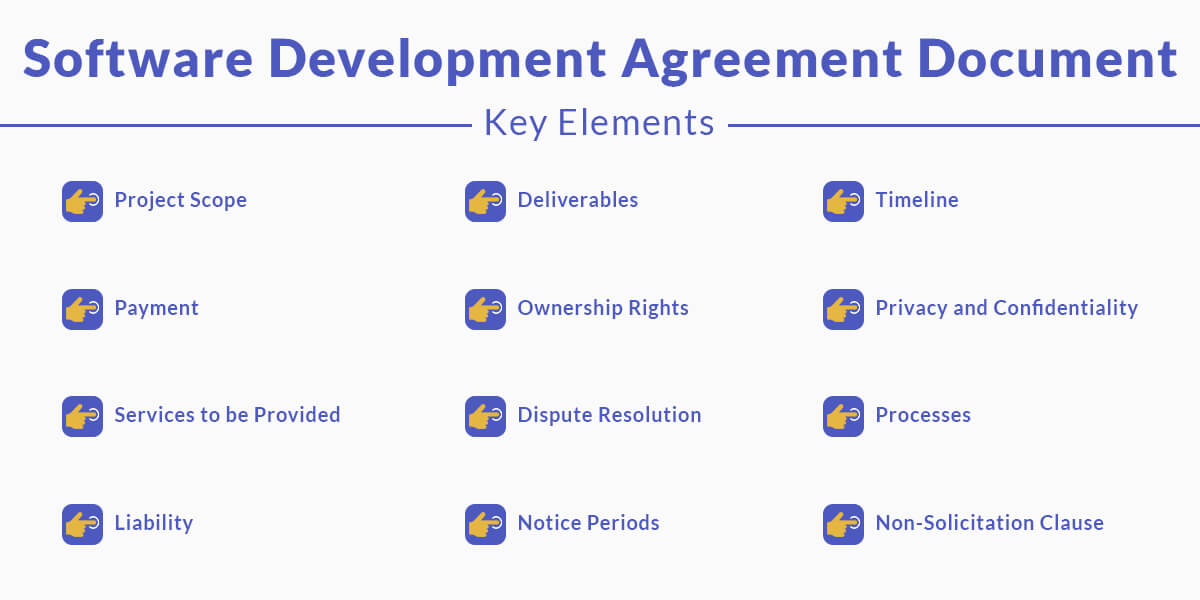
An ideal software development services agreement shall outline the following facets:
- Project Scope
- Deliverables
- Timeline
- Payment
- Ownership Rights
- Privacy and Confidentiality
- Dispute Resolution
- Liability
- Notice Periods
- Non-Solicitation Clause
Project scope and deliverables:
This section of the software development contract mentions what developers shall do for the client, what the anticipated results are, and how they will be gauged. The project scope should be specific, realistic, and measurable. It should include details like the total number of features along with their functions plus design, quality standards, testing, documentation, and support.
The deliverables are the tangible products or services that the software development team will provide to the client at certain milestones or upon completion of the project. The deliverables should be clearly defined and aligned with the project scope and objectives.
How to write Request for Proposal (RFP) for Outsourcing Software Development?
Timeline and schedule:
In this part of the software development agreement, it is mentioned when the project will begin and finish, how long each milestone or task shall take, and what are the deadlines for every deliverable. The timeline should be realistic and achievable, and take into account factors such as complexity, dependencies, risks, and contingencies. The scheduling should also include a communication plan that outlines how often and through what channels the software development team member and the client will communicate.
Payment terms and schedule:
Software development contract’s payment terms determine how much the client shall pay the software development company or remote developers that they have hired for their work and how they will pay them. Plus, it is also important to mention when they will pay them and how. The payment terms are made fair and transparent as they reflect value and professionalism.
The payment schedule should be linked to the delivery of milestones or deliverables, and include provisions for deposits, retainers, invoices, receipts, late fees, penalties, discounts, refunds, and taxes.
Ownership rights and intellectual property agreements:
This part has information about who owns what in relation to the software product. It includes source code, login ids and passwords, designs, databases, trademarks or logos, copyrights, patents, and trademarks.
The ownership rights are made clear and unambiguous to guard the interests and assets of both parties. The intellectual property agreements in software development specify how each party uses and modifies any component and/or licenses. The Intellectual Property (IP) of the other party mentions all types of limitations and obligations as well.
Confidentiality agreements:
This section of the software development agreement obliges both parties to keep certain information confidential during and after the project, such as trade secrets, business plans, customer data, or personal information. The confidentiality agreements should identify what information is confidential, how it will be protected, who can access it, and for how long.
The confidentiality agreements of software development should also include exceptions for disclosure required by law or consent to by both parties.
Dispute resolution policies:
In this policy, the information on how both parties will handle any disputes or conflicts that may arise during or after the software development project, such as disagreements over scope, quality, payment, or ownership. The dispute resolution policies of software contracts mention a clear and efficient process for resolving disputes, such as negotiation, mediation, arbitration, or litigation; additionally, they also specify what law and jurisdiction will apply to the agreement and the dispute.
Liability and Warranties:
This section determines who is responsible for what in relation to the software project, such as errors, defects, delays, damages, or losses. It should define the extent and limitations of each party’s liability and involve sections for amends, restriction of liability, and exclusion of substantial damages.
The warranties section of the software product development agreement should state what guarantees each party makes about their work or products, such as functionality, performance, quality, or compliance; plus, it may state what remedies are available in case of a breach of warranty.
Notice periods:
Here, how much time each party has to give notice to the other party before taking certain actions such as terminating the software development agreement, changing the scope, or requesting a modification is mentioned. The notice periods should be reasonable and sufficient for both parties to prepare and respond to the notice.
Non-solicitation clause:
This software development contract section prohibits both parties from soliciting or hiring the other party’s employees, contractors, or customers during and after the software project development, without the other party’s consent. The non-solicitation clause should protect both parties’ interests and relationships and include details such as duration, scope, and penalties for violation.
Make sure you are not missing anything
Every software product development should have legal agreements as they are essential for ensuring the quality, scope, and ownership of software projects. They protect the rights and interests of both the software development company and the client and help avoid disputes and misunderstandings.
Software development agreements must be clear, comprehensive, and legally enforceable. Plus, they must include all the relevant aspects of the project. By having a well-written software development contract, both parties can benefit from a smooth and successful software development process.
Frequently Ask Questions About Software Development Agreement
What are the main software development agreement types?
Software contracts are agreements between software providers and customers that define the rights and obligations of each party regarding the use of the software. There are different types of software contracts, depending on the nature and scope of the software project. Broadly, you have Time and Materials, Fixed/Bid, and Dedicated agreements.
What should be included in the software development contract?
You must include at least the following clauses and conditions in your software development agreement.
- A description of the software, its features, functions, specifications, and deliverables
- A statement of the rights and obligations of each party regarding the ownership, licensing, use, maintenance, support, warranty, and liability of the software
- A schedule of milestones, deadlines, payments, and penalties for non-performance or breach of contract
- A process for managing changes, disputes, and termination of the contract
Can I make sure that my software development agreement is legally binding?
To make sure that a software development agreement is legally binding, both parties should:
- Review and understand all the terms and conditions of the contract
- Negotiate and agree on any modifications or amendments to the contract
- Sign and date the contract in writing or electronically
- Keep a copy of the software development contract for future reference
Avantika Shergil
| May 29, 2026


Avantika Shergil is a technology enthusiast and thought leader with deep expertise in software development and web technologies. With over 8 years of experience analyzing and evaluating cutting-edge digital solutions, Avantika has a knack for demystifying complex tech trends. Her insights into modern programming frameworks, system architecture, and web innovation have empowered businesses to make informed decisions in the ever-evolving tech landscape. Avantika is passionate about bridging the gap between technology and business strategy, helping businesses build customized software and website, and understand about different tools to leverage effectively for their ventures. Explore her work for a unique perspective on the future of digital innovation.