How to Start Online Food Delivery Business in 2026-2027?
 By
Avantika Shergil
|
Jul 17, 2026 |
Business Strategy Delivery App Startups
By
Avantika Shergil
|
Jul 17, 2026 |
Business Strategy Delivery App Startups
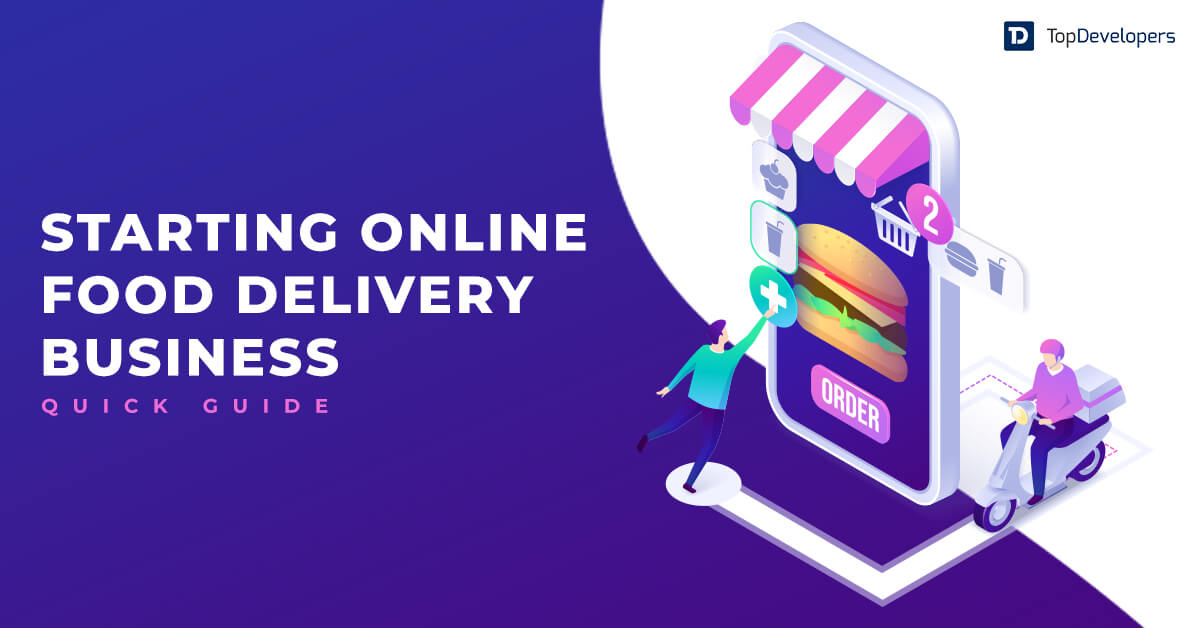
The restaurant business has been doing exceptionally well for ages and there is no doubt about it. Now, whether you are already a restauranteur and your business is doing fine or you are an entrepreneur and thinking of venturing into a restaurant or food business, this guide on how to start an online food delivery business in 2026-2027 shall show you the best possible way to expand your presence in the market. And the best way is to approach your customers through a digital platform. Hence, top mobile app development companies that provide bespoke online food delivery apps are in limelight these days.
Table of Contents
What is the food delivery business and why is it growing at a rapid pace?
A food delivery business is delivering food items to consumers at their doorsteps. Now, these food items may come from hotels, restaurants, cafés, cloud kitchens, or even food trucks. The entire process of ordering and delivery happens through portals or food delivery mobile apps.
Statista’s annual report projects a food-delivery market volume of nearly USD 300 billion by 2027 with the growth of a CAGR of 8.24% which is excellently impressive for farsighted businesspersons. Just in the US, the online food-delivery app market is likely to touch a whopping figure of USD 42.6 billion by 2027 expanding at the rate of CAGR of 10.5% between 2017 and 2027. So, if you are thinking about how to start an online food business, mind it that the entire Gen Z is there to support you!
The time is now. Think of on-demand app development for food delivery whether you already have your restaurant or thinking to have one. Taking your business online comes with ample benefits to your venture.
How does Online Food Delivery work?
As now you know that it is worth investing in the food delivery business, a fair idea of how this business works and how the food delivery business model benefits you becomes important to learn.
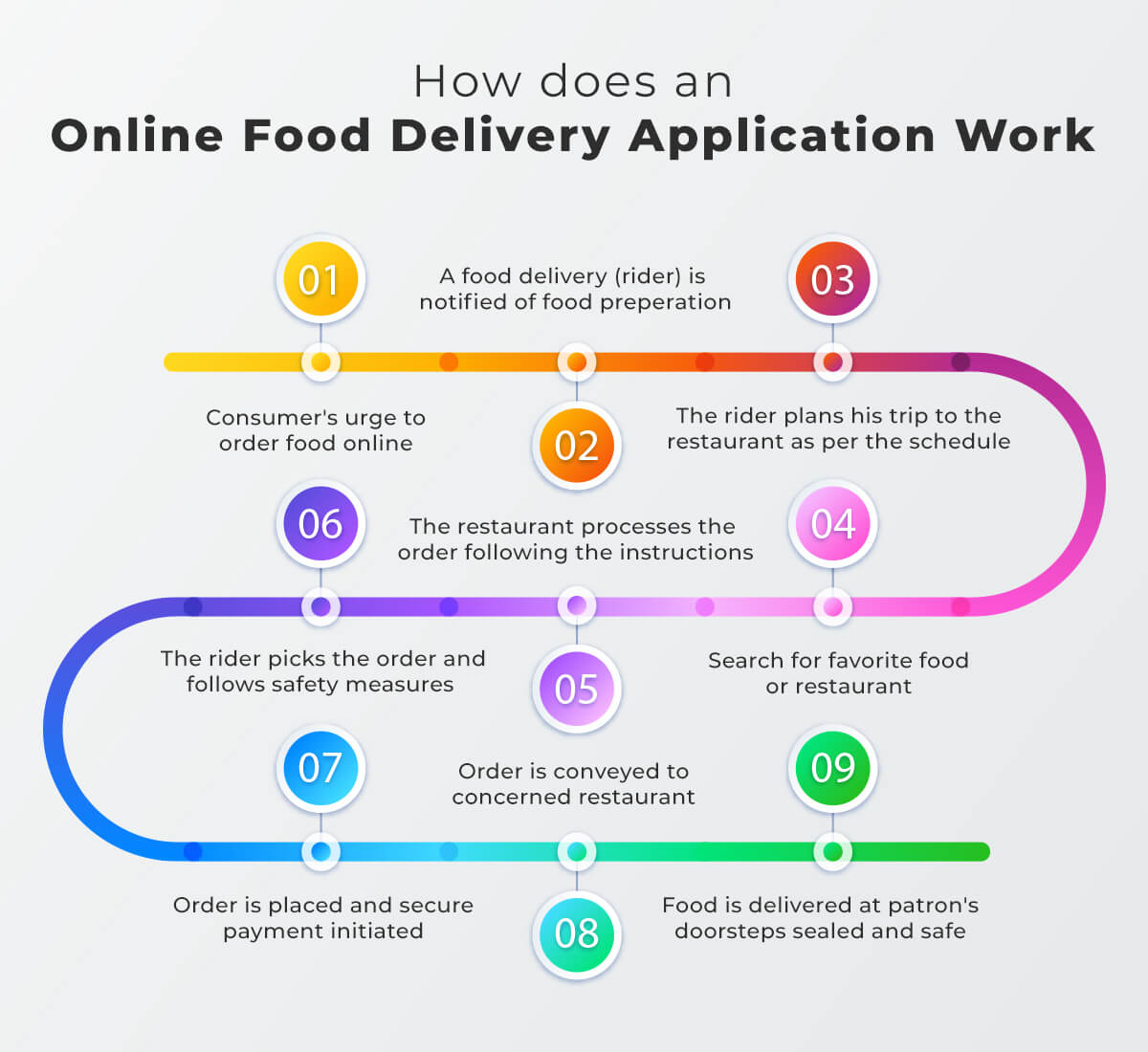
The main stakeholders in the food delivery business are users, restaurants, and delivery persons. They all play their roles on the app.
Users
They are the consumers, customers, or patrons who order food online.
- Chooses a meal from the menus
- Pays online
- Rates and reviews the food and delivery men
- Schedule food orders in advance
- Real-Time Tracking
- In-App Messaging
- Other Features: Promos, Push Notifications, Offers, etc.
Restaurants
These are the food providers who receive orders and prepare them according to the instructions
- Dashboard
- Creates menus
- Maintains good quality to stay in the competitive market
- Order management
- Tracking GPS
- Payment
- In-App Messaging
- Rates and reviews delivery persons and patrons
Delivery persons
Also known as riders or food delivery boys, these are the food carriers
- Receives order details
- Learns locations of restaurants and consumers through GPS-based tracking features
- In-App Messaging
- Goes to restaurants to pick food packets
- Delivers at consumers’ doorsteps
- Rates and reviews
The core business model for online food delivery venture
Not just for the app owners, the food delivery business for restaurants is also lucrative. In other words, whether you are just an investor and want to venture into developing an online food delivery business app or you yourself are a restaurant owner and want to expand your business, it is all a win-win situation. Chiefly, the core business can be divided into three categories –
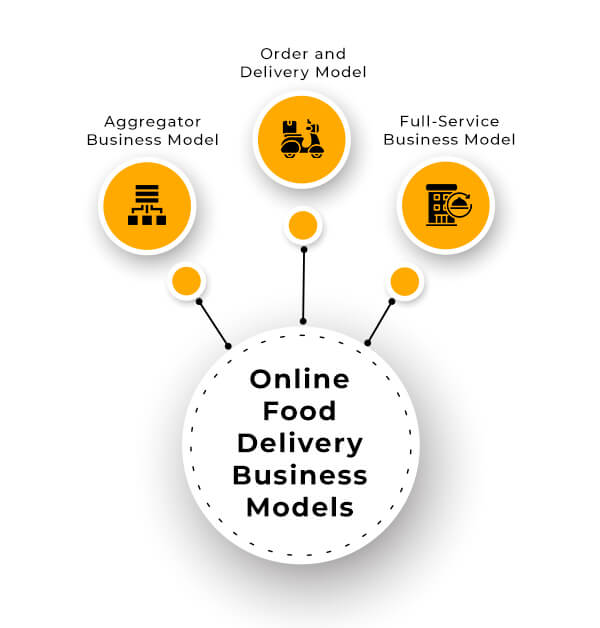
Aggregator business model
The online food-delivery business model offers a powerful digital platform that serves as a bridge between consumers and restaurants. The platform allows all the restaurants in the region to register themselves, and a similar offer goes to consumers or mobile app users. Hence, both service seekers and providers are on the same platform. Generally, this model is applicable to business persons who own a mobile app for online food delivery.
Order and delivery model
In this unique food delivery business model, food business owners hire a delivery service partner for quicker and better food delivery management. The third-party food delivery service providers fix the delivery charges (after discussing with restaurateurs) before offering their services full-fledged. This model gauges success especially for small food business owners who do not want hefty investments in developing digital solutions.
Full-service business model
Suitable for larger food chain businesses, the full-service business model includes everything from cooking to food delivery through an on-demand food delivery app. For instance, McDonald’s, Pizza Hut, and Domino’s Pizza have a full-fledged mobile app for food delivery where everything from orders, delivery men, and logistics (transportation) is managed by the company.
How to Start an Online Food Delivery Business? A step-by-step guide
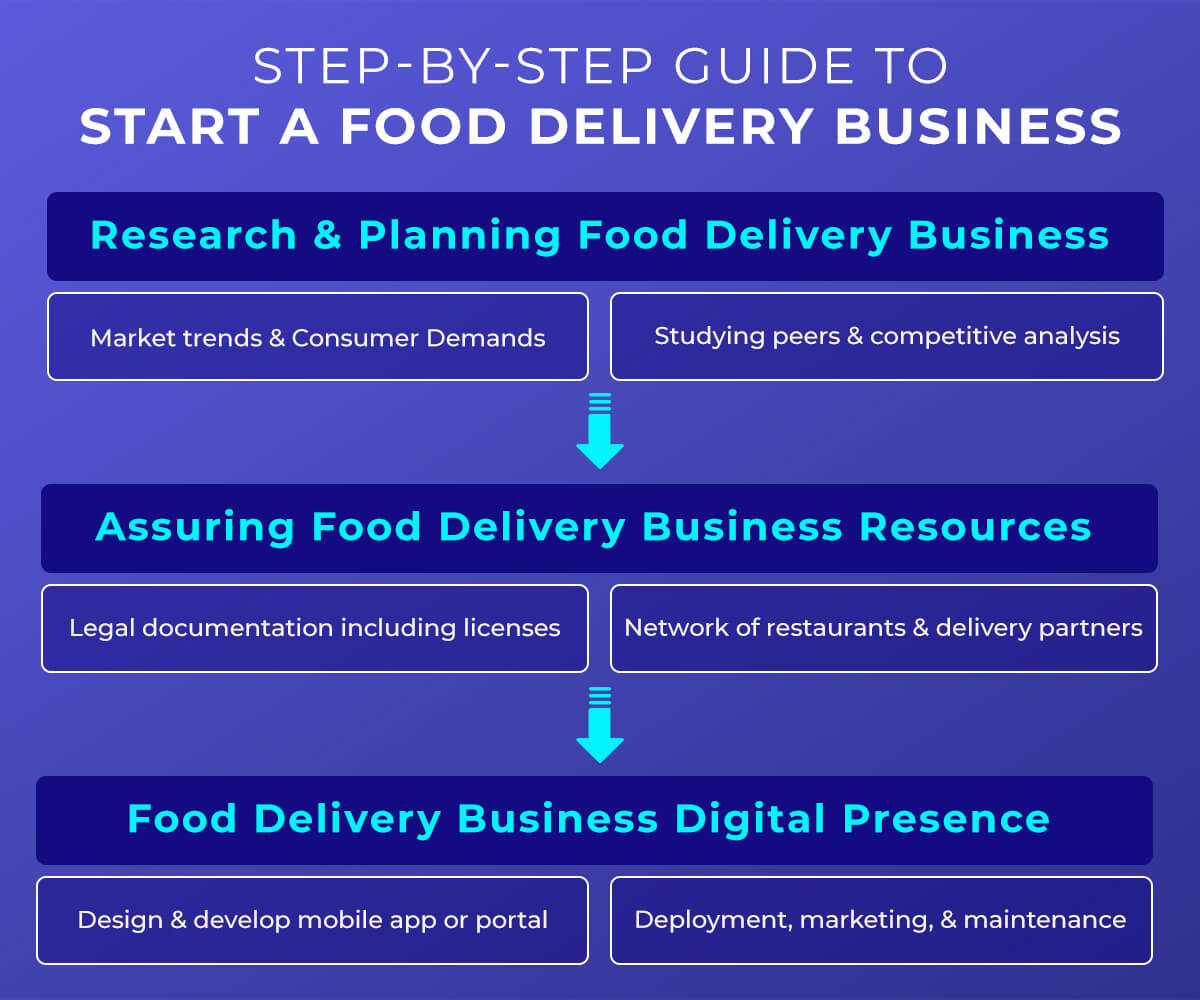
True to every food delivery startup business, you need a foolproof strategy to begin a small step toward a large success. From merely a thought of building a food-delivery business to having a user engaging on-demand food-delivery app as a product requires intense homework. Here are the steps to start a food delivery service –
Research and planning of food delivery business
It all starts with food delivery market research to understand and learn the trends and consumer demands. Studying peers (similar on-demand food delivery apps) would help you construct a better product. You may also research pricing, online menu designs, and the overall presentation of food delivery software. The following factors are important to mind in this phase.
Stats and figures
You may check research firms’ data to understand the demand for food delivery businesses and apps. Such numbers will help you focus on a particular area or type of business with brighter prospects.
Set the target consumers
Based on an on-demand food delivery business needs in specific areas, you can set your target customers. For instance, food delivery service works better where societies with officegoers are found. You may also take the help of data-providing companies and focus on working men and women who are likely to order food online more frequently.
Jotting down the ideas
Once market research and peers are studied thoroughly, you may take the help of food industry experts to outline and draft business strategies. You may also need to frame the budget to start a food delivery business in 2026-2027. In 2026-2027 and beyond, integrating the latest technologies such as Artificial Intelligence and the Internet of Things would be mandatory to stay competitive, and that would cost you a bit more.
Assuring food delivery business resources
On-demand food delivery business requires some crucial paperwork to stay legally clear. Business license and insurance are two major steps you need for your business. Plus, you need to develop a powerful network of restaurants and delivery partners to assure that on-demand food delivery service runs smoothly.
Licenses
The prices to acquire required business licenses and insurance from local authorities would add up to some extra work for your legal teams. Several states mandate worker’s insurance, and food licenses approved by bodies such as FDA that you need to mention and present for your food-delivery app.
Network
The success of an online food ordering business depends on several factors, the major being a good number of registered users and restaurants available on the portal. You can start an online food delivery business only when you have built a powerful network where many restaurateurs have registered their eateries on your app. More options of restaurants, café, and food suppliers would attract more users to the app stores as reviews and word-of-mouth spread.
As a part of the network, you must also find and assure delivery partners of safer and quick food packet delivery to consumers’ doorsteps. The delivery partner and logistic network should have a backup in case the primary way of deliveries fails in unexpected events. Perks, wages, and special on-demand food delivery business models that benefit delivery partners may help you retain the staff (delivery persons or riders) who are the backbone of the business.
Food delivery business’ digital presence
Your online presence can increase your client base manifold, and that is the reason, most companies have their web portals and food delivery mobile applications on which they provide their services and products. You may find startup app developers to discuss your project and develop wireframes and prototypes of your food-delivery apps.
Hire developers
You may find the best mobile app development company as your tech partner and hire remote developers who shall work dedicatedly on your project. Various hiring options are available according to your budget and the complexity or type of your project. You can hire developers on a fixed cost or can build your own team to work on your project dedicatedly for a longer time to assure that you have the best product in the market.
Assure standard development and deployment
Before you hire developers to build an online food-delivery business app, it is advisable to sign legal documents with your tech partners such as NDA to play safe. You need to make sure that the online food delivery app is built using standard tools and that the deployment on predefined platforms goes smoothly. To assure that your product is up and running flawlessly, you may also need to sign a contract for maintenance that would include solving any escalations and regular updates of the food delivery apps to keep up the pace with market trends.
How online food delivery app or portal help you achieve your goal?
So now that you know the prerequisite of having a food-delivery app, it is time to sleeve up your development and marketing teams to focus on the areas that assure you of the app’s success. Here are they –
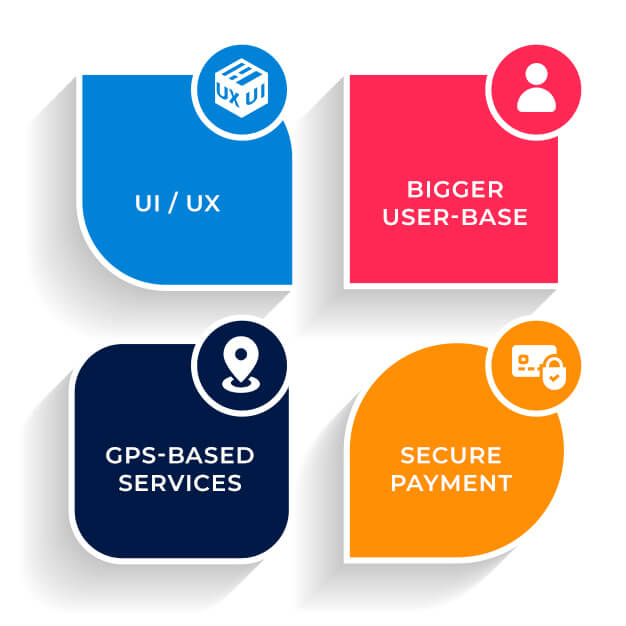
UI/UX
Millions of dollars are spent on a user interface to provide the best possible user experience because today, the digital trend is leaning toward aesthetics of mobile applications. Starting a food delivery business means offering the simplest yet most attractive designs of food dishes with clear texts about the necessary information. Intuitive UI/UX shall help you retain visitors and seek food delivery services.
Bigger user base
While brick-and-mortar restaurants depend on the footfall and visitors passing by, if you have a food delivery business app, the user base increases manifold. You can opt for digital marketing through social media and other online campaigns to reach hundreds of thousands of users beyond geographical boundaries.
GPS-based services
The success of the food-delivery mobile application lies in easy ordering, secure payment, and top of all, accurate tracking of the food parcel. Patrons are desperate to check the status of their food whether it is being prepared or on the way. GPS-based food delivery systems would help users track riders and hence would make them happy customers on your platform.
Secure payment
Security has been one of the biggest concerns for any mobile app. Similarly, for an on-demand food-delivery app, secure payment would give a sense of relief to users (patrons) as they would pay for their food orders without any hesitation. On the other hand, the delivery partners and restauranteurs are also at ease because they have received payment along with orders.
Nail your food delivery business now
It is possible to plan and succeed food delivery business in 2026-2027. Yes, you can nail it better with a customized user-centric mobile application for the same. You can build a brand-new software solution for your food delivery service by hiring the best developers; simply outsource your project and set yourself worry-free from micromanagement.
FAQs regarding food delivery business
How to start an online food delivery business in 2026-2027?
Starting an online food delivery business in 2026-2027 requires more than launching a mobile app. The market is more competitive, customer expectations are higher, and technology has become a major differentiator. Businesses that combine a clear strategy, reliable delivery operations, AI driven features, and strong restaurant partnerships have a much better chance of building a sustainable business.
The process typically involves the following steps:
| Step | What You Need to Do |
|---|---|
| 1 | Research your target market and identify customer demand. |
| 2 | Choose a suitable business model such as a restaurant aggregator, cloud kitchen, or hyperlocal delivery platform. |
| 3 | Create a detailed food delivery business plan with revenue projections and marketing strategies. |
| 4 | Register your business and obtain all required licenses and permits. |
| 5 | Partner with local restaurants or establish your own cloud kitchen network. |
| 6 | Build or purchase a food delivery app with customer, restaurant, driver, and admin panels. |
| 7 | Integrate payment gateways, GPS tracking, restaurant POS systems, and delivery management software. |
| 8 | Hire delivery personnel or work with third party logistics providers. |
| 9 | Launch marketing campaigns to attract restaurants and customers. |
| 10 | Monitor performance metrics and improve your platform using customer feedback and analytics. |
To remain competitive in 2026-2027, many food delivery startups are also adopting AI powered recommendations, delivery route optimization, voice ordering, automated customer support, and predictive demand forecasting. These technologies improve operational efficiency while delivering a better customer experience.
Is an online food delivery business profitable in 2026-2027?
The online food delivery business continues to offer strong growth opportunities as more customers prefer ordering meals through digital platforms. However, profitability depends on selecting the right business model, controlling operational costs, and maintaining a loyal customer base. Businesses that diversify their revenue streams generally perform better than those relying only on delivery charges.
Several factors contribute to a profitable food delivery business:
- Earn revenue through restaurant commissions, delivery fees, subscriptions, advertisements, and premium listings.
- Increase repeat orders with loyalty programs and personalized customer offers.
- Reduce delivery costs using route optimization and efficient driver management.
- Build long term partnerships with restaurants to generate consistent order volumes.
- Use AI driven analytics to improve demand forecasting and operational planning.
- Scale your platform gradually without significantly increasing operating expenses.
Although food delivery startup costs for technology, marketing, and customer acquisition can be significant, businesses usually become more profitable as repeat customers increase and delivery operations become more efficient. A well planned strategy combined with excellent customer service can create a sustainable and scalable business in the long term.
How much does it cost to start an online food delivery business?
The cost of starting an online food delivery business varies depending on your business model, technology requirements, service area, and overall business scale. A local delivery platform serving one city requires far less investment than a multi city marketplace supporting thousands of restaurants and delivery partners. Careful planning helps allocate your budget effectively while avoiding unnecessary expenses.
Below is a general cost estimate for launching a food delivery startup:
| Expense Category | Estimated Cost |
|---|---|
| Business registration and licenses | $500 to $5,000 |
| Food delivery app development | $20,000 to $150,000+ |
| Website development | $2,000 to $15,000 |
| Restaurant and admin dashboard | $5,000 to $30,000 |
| Payment gateway integration | $500 to $5,000 |
| Cloud hosting and infrastructure | $200 to $2,000 per month |
| Marketing and customer acquisition | $5,000 to $50,000+ |
| Driver onboarding and training | Varies by region |
| Customer support setup | Depends on team size |
| Software maintenance and updates | 15% to 20% of annual development cost |
The total investment is influenced by several factors, including whether you choose custom development or a white label solution, the number of supported platforms, advanced features like AI and real time tracking, geographic expansion plans, and ongoing marketing efforts.
Top food delivery startups begin with a minimum viable product (MVP) to validate their business idea before investing in advanced functionality. This approach helps reduce initial costs while providing valuable customer feedback for future growth.
Which food delivery business model is the most profitable?
There is no single food delivery business model that is the most profitable for every entrepreneur. The right choice depends on your investment budget, target audience, local market demand, and long term business goals. Understanding the strengths and limitations of each model helps you select one that delivers sustainable growth and higher returns.
Below is a comparison of the most popular food delivery business models:
| Business Model | How It Works | Profit Potential | Best For |
|---|---|---|---|
| Restaurant Aggregator | Connects customers with multiple restaurants and earns commissions. | High | Marketplaces similar to Uber Eats or DoorDash. |
| Order Only Platform | Restaurants manage deliveries while the platform handles online ordering. | Medium | Businesses with limited logistics resources. |
| Full Stack Delivery | Manages ordering, deliveries, and customer support. | Very High | Businesses seeking complete operational control. |
| Cloud Kitchen | Prepares food without a dine in facility and delivers directly to customers. | Very High | Restaurant brands focused on delivery. |
| Hyperlocal Delivery | Delivers food from nearby restaurants within a limited radius. | High | Urban and quick commerce markets. |
Many successful food delivery startups combine multiple business models instead of relying on just one. For example, a restaurant aggregator can also operate cloud kitchens, offer subscription plans, and provide advertising opportunities for restaurant partners. This diversified approach creates multiple revenue streams while reducing business risk.
What licenses are required to start a food delivery business?
Before launching your online food delivery business, you must ensure that your operations comply with local business and food safety regulations. The required licenses vary by country, state, and city, but obtaining the appropriate approvals helps build customer trust and prevents legal issues. It is also important to verify that your restaurant partners meet all food safety requirements.
Common licenses and registrations to start a food delivery business require:
- Business Registration: Register your company according to local business laws.
- Food Business License: Required if you prepare, store, or handle food directly.
- Restaurant Partner Compliance: Ensure partner restaurants have valid food safety certifications.
- Tax Registration: Obtain applicable tax identification numbers and sales tax registrations.
- Trade License: Required in many cities for operating a commercial business.
- Employment Registration: Needed if you hire delivery personnel or office staff.
- Vehicle and Delivery Permits: May be required for commercial delivery vehicles in certain regions.
- Data Privacy Compliance: Follow regulations governing customer data and online payments.
If you plan to expand internationally, review the licensing requirements for each country before entering the market. Working with legal and tax professionals can help ensure your food delivery business remains compliant while avoiding costly penalties.
How do make money?
Modern food delivery businesses generate revenue through multiple income streams rather than relying on delivery fees alone. This diversified approach improves profitability and reduces dependence on any single source of income. As the business grows, additional services and premium offerings can further increase revenue.
The most successful revenue models of food delivery businesses:
- Restaurant Commissions: Charge partner restaurants a percentage of every successful order placed through the platform.
- Delivery Charges: Collect delivery fees from customers based on distance, order value, or delivery speed.
- Subscription Plans: Offer premium memberships that provide benefits such as free deliveries, exclusive discounts, and faster service.
- Advertising and Sponsored Listings: Allow restaurants to promote their menus or appear at the top of search results for additional fees.
- Convenience and Service Fees: Apply small platform or service charges to each completed transaction.
- Value Added Services: Provide analytics, marketing tools, customer insights, or restaurant management solutions through paid subscriptions.
The most successful food delivery platforms combine several of these revenue streams while continuously improving customer retention. Higher repeat orders, efficient delivery operations, and strong restaurant partnerships contribute significantly to long term profitability.
How to partner with restaurants for a food delivery platform?
Restaurant partnerships are the foundation of every successful online food delivery business. Without a diverse selection of reliable restaurant partners, attracting and retaining customers becomes much more difficult. Building strong relationships with restaurants requires offering clear business value, an easy onboarding process, and continuous support after they join your platform.
Follow these steps to build a strong restaurant network:
| Step | Action | Purpose |
|---|---|---|
| 1 | Identify popular local restaurants | Increase customer demand from launch. |
| 2 | Present your business proposal | Explain revenue opportunities and platform benefits. |
| 3 | Offer competitive commission rates | Encourage restaurants to join your platform. |
| 4 | Provide an easy onboarding process | Reduce setup time and simplify menu management. |
| 5 | Integrate with restaurant POS systems | Improve order accuracy and operational efficiency. |
| 6 | Support restaurant marketing | Increase visibility through promotions and featured listings. |
| 7 | Share business insights | Help restaurants improve sales using order analytics. |
Restaurants are more likely to partner with a platform that offers transparent pricing, timely payments, reliable delivery operations, and dedicated account support. As your platform grows, maintaining regular communication and introducing promotional opportunities can strengthen long term partnerships.
How can AI improve an online food delivery business?
Artificial intelligence has become one of the biggest competitive advantages for food delivery businesses in 2026-2027. Instead of simply automating routine tasks, AI helps improve customer experiences, optimize delivery operations, and support better business decisions. Businesses that integrate AI into their platforms can increase efficiency while reducing operational costs.
AI can improve different areas of a food delivery business in several ways:
- Personalized Recommendations: Suggest meals based on customer preferences, order history, and browsing behavior.
- Delivery Route Optimization: Select faster delivery routes using real time traffic and driver locations.
- Demand Forecasting: Predict busy hours to prepare restaurants and delivery partners in advance.
- Dynamic Pricing: Adjust delivery charges according to demand, distance, or weather conditions.
- AI Chatbots: Handle customer inquiries, order updates, and refund requests around the clock.
- Fraud Detection: Identify suspicious transactions and reduce payment related risks.
- Restaurant Analytics: Provide insights into customer preferences, menu performance, and sales trends.
- Inventory Predictions: Help restaurants estimate ingredient requirements more accurately.
As AI technology continues to evolve, many food delivery startups are also introducing voice ordering, predictive delivery estimates, automated customer engagement, and intelligent loyalty programs. These innovations improve customer satisfaction while helping businesses scale more efficiently.
What is the difference between a food delivery marketplace and a cloud kitchen business?
A food delivery marketplace and a cloud kitchen business both serve customers through online ordering, but they operate using entirely different business models. One focuses on connecting customers with multiple restaurants, while the other prepares and delivers food from its own kitchen facilities. Understanding these differences helps entrepreneurs choose the model that best matches their investment capacity and business objectives.
| Feature | Food Delivery Marketplace | Cloud Kitchen Business |
|---|---|---|
| Business Role | Connects customers with multiple restaurants. | Owns and operates food preparation facilities. |
| Food Preparation | Handled by partner restaurants. | Prepared by the business itself. |
| Main Revenue Source | Commissions, delivery fees, subscriptions, and advertising. | Food sales and delivery charges. |
| Inventory Management | Not required. | Required for daily operations. |
| Operational Complexity | Focuses on technology and logistics. | Focuses on food production and kitchen management. |
| Investment Level | Moderate to High. | High due to kitchen infrastructure. |
| Scalability | Expand by onboarding more restaurants. | Expand by opening additional cloud kitchens. |
Some food businesses successfully combine both models by operating their own cloud kitchens while also partnering with independent restaurants through a marketplace platform. This hybrid approach creates multiple revenue opportunities and provides greater control over customer experience and food quality.
How can a new food delivery startup compete with Uber Eats, DoorDash, Swiggy, or Zomato?
Competing with established food delivery platforms may seem challenging, but it is far from impossible. Instead of trying to replicate everything these companies offer, successful food delivery startups focus on solving specific customer problems or serving underserved markets. A niche strategy combined with better customer experience and innovative technology can help new businesses establish a strong market presence.
Consider the following strategies to differentiate your food delivery startup:
Focus on a Specific Market: Target a particular city, neighborhood, cuisine, dietary preference, or customer segment instead of launching nationwide from the beginning.
Build Strong Restaurant Relationships: Offer fair commission rates, faster onboarding, marketing support, and transparent pricing to attract restaurant partners.
Deliver a Better Customer Experience: Provide faster deliveries, accurate order tracking, responsive customer support, and personalized recommendations to encourage repeat orders.
Use AI and Automation: Implement AI powered recommendations, smart delivery routing, automated customer support, and demand forecasting to improve operational efficiency.
Create Customer Loyalty: Launch reward programs, referral incentives, exclusive memberships, and personalized offers to improve customer retention.
Invest in Local Marketing: Partner with local businesses, collaborate with influencers, optimize for local SEO, and run targeted digital advertising campaigns.
Large food delivery platforms often focus on scale, while food delivery startups can compete by offering localized services, faster support, and stronger community engagement. Building trust with both customers and restaurant partners can become a significant competitive advantage over time.
How long does it take to launch a food delivery app?
The time required to launch a food delivery app depends on the project’s complexity, development approach, and feature requirements. A basic application can be released much faster than a fully customized platform with AI capabilities, advanced integrations, and multiple user panels. Planning the project carefully before development begins can significantly reduce delays.
The following timeline provides a general estimate:
| Project Type | Estimated Timeline |
|---|---|
| Ready made or White Label Solution | 2 to 6 weeks |
| Minimum Viable Product (MVP) | 2 to 4 months |
| Custom Food Delivery App | 4 to 8 months |
| Enterprise Scale Platform | 8 to 12 months or longer |
Several factors influence the overall development timeline, including:
- Number of features and user roles.
- Android, iOS, and web platform support.
- Third party integrations such as payment gateways and POS systems.
- AI powered functionality and analytics.
- Quality assurance testing and security validation.
- App store approval processes.
Best food delivery startups choose to launch an MVP first to validate the business idea and gather customer feedback. Additional features can then be introduced through regular updates, allowing the platform to grow based on actual user needs.
What are the ongoing operational costs of a food delivery business?
Launching a food delivery business is only the beginning. To maintain reliable service and support business growth, owners must budget for recurring operational expenses. Understanding these ongoing costs helps improve financial planning and ensures the business remains profitable over the long term.
The table below outlines the major operational expenses:
| Cost Category | Purpose |
|---|---|
| Technology Maintenance | App updates, bug fixes, feature enhancements, and security improvements. |
| Cloud Hosting | Servers, databases, storage, and infrastructure services. |
| Payment Processing Fees | Transaction charges collected by payment providers. |
| Driver Payments | Salaries, incentives, bonuses, or delivery commissions. |
| Customer Support | Support staff, AI chatbots, and customer service software. |
| Marketing | Digital advertising, referral programs, promotions, and loyalty campaigns. |
| Software Subscriptions | Analytics tools, CRM platforms, communication software, and business applications. |
| Business Compliance | License renewals, insurance, legal services, and accounting. |
As the food delivery business expands into new cities or serves more customers, these operational expenses typically increase. However, investing in delivery automation, AI powered analytics, efficient fleet management, and customer retention programs can help control costs while improving overall profitability.
Avantika Shergil
| Jul 17, 2026


Avantika Shergil is a technology enthusiast and thought leader with deep expertise in software development and web technologies. With over 8 years of experience analyzing and evaluating cutting-edge digital solutions, Avantika has a knack for demystifying complex tech trends. Her insights into modern programming frameworks, system architecture, and web innovation have empowered businesses to make informed decisions in the ever-evolving tech landscape. Avantika is passionate about bridging the gap between technology and business strategy, helping businesses build customized software and website, and understand about different tools to leverage effectively for their ventures. Explore her work for a unique perspective on the future of digital innovation.