Top App Development Methodologies: An In-Depth Guide
 By
Avantika Shergil
|
Apr 9, 2026 |
App Development
By
Avantika Shergil
|
Apr 9, 2026 |
App Development
“Build less, start sooner.” – Jim Highsmith in Adaptive Leadership
It perfectly aligns with full-fledged mobile app development backed by a lot of hard work, planning, resource investment, and documentation, which is started before the app goes on the development floor.
Similarly, the project management team cannot handle app development, design, and deployment unless a process or standard methodology is finalized. Leading mobile app development companies use methodologies to ensure the best mobile apps are developed.
The app development methodology resembles the software development life cycle that includes planning, design, implementation, and support. As an entrepreneur, building a brilliant mobile app requires using a development methodology that determines rules to follow at all stages of mobile app development.
However, the various mobile app development methodologies confuse business stakeholders in choosing the one. The detailed overview of different application development methodologies and tips for selecting the right methodology help businesses choose what matters and leave the development tasks to mobile app developers. Take a deeper dive into the blog to keep the roadmap simple and focus on goals.
Table of Contents
What is App Management Methodology?
App management methodology provides a set of techniques, tools, practices, and procedures that illustrates the roadmap with all the steps required for successful project delivery. There are various app management methodologies available that assist the project manager with all the steps taken to complete the project before the deadline.
Many times, project management methodology is confused with project management framework, which is wrong. The frameworks are neither as detailed nor rigid as the project management methodology. They just provide an overview of how to implement the guidelines and leave no room for tools and practices. We can say traditional project management is a framework. Conclusively both of them are inherently different.
Types of Application Development Methodologies
Application development methodologies define the structured approaches teams use to plan, design, build, test, and deploy applications efficiently. Each methodology offers a distinct framework that aligns with varying project requirements, timelines, team sizes, and levels of complexity. Choosing the right approach can significantly impact development speed, product quality, collaboration, and overall business outcomes. From traditional linear models to flexible, iterative frameworks, these methodologies cater to diverse business and technical needs across industries.
Here, we explore the most widely adopted application development methodologies that help business organizations streamline workflows and deliver scalable, high-performance applications.
Dynamic Systems Development Method (DSDM) for App Development
Dynamic Systems Development Method (DSDM) is an Agile-based framework that focuses on delivering business value quickly through iterative and incremental development. It emphasizes active user involvement, continuous feedback, and strict time and budget constraints to ensure efficient delivery. DSDM ensures that app development remains aligned with business goals while maintaining high-quality standards.
The methodology prioritizes delivering functional components early and refining them based on stakeholder feedback. It follows a structured yet flexible approach, making it suitable for projects requiring rapid deployment with controlled governance.
When DSDM methodology is a good fit for App Development:
- User involvement: DSDM requires consistent collaboration with stakeholders throughout the development lifecycle, ensuring that the final product meets business expectations and user needs.
- Faster delivery: By focusing on incremental delivery, the methodology ensures that critical features are developed and deployed quickly.
- Strong governance: It maintains a balance between flexibility and control with clearly defined roles, responsibilities, and processes.
When DSDM methodology becomes a challenge for App Development:
- Requires active participation: Continuous user involvement may not always be feasible, especially for businesses with limited availability.
- Complex implementation: The structured framework can be difficult to implement without experienced teams.
- Higher initial effort: Setting up DSDM processes and roles may require more time compared to simpler methodologies.
Lean Development for App Development
Lean development methodology focuses on maximizing value while minimizing waste in the app development process. Inspired by lean manufacturing principles, it emphasizes efficiency, continuous improvement, and delivering only what is necessary. The approach helps teams optimize resources and accelerate time-to-market.
Lean development encourages building simple solutions first and improving them based on user feedback. It ensures that unnecessary features, processes, or efforts are eliminated, resulting in cost-effective and streamlined app development.
When Lean methodology is a good fit for App Development:
- Waste reduction: Eliminates unnecessary processes, features, and delays, ensuring efficient use of resources.
- Faster time-to-market: Focuses on delivering a minimum viable product (MVP) quickly and iterating based on feedback.
- Continuous improvement: Encourages teams to refine processes and enhance product quality over time.
When Lean methodology becomes a challenge for App Development:
- Requires disciplined teams: Success depends on team expertise and commitment to lean principles.
- Limited documentation: Minimal documentation can create challenges in long-term maintenance.
- Risk of oversimplification: Excessive focus on minimalism may lead to missing important features.
DevOps Methodology for App Development
DevOps methodology bridges the gap between development and operations by promoting collaboration, automation, and continuous delivery. It focuses on integrating coding, testing, deployment, and monitoring into a unified workflow. This approach enhances the speed, reliability, and scalability of app development.
DevOps enables continuous integration and continuous deployment (CI/CD), allowing teams to release updates frequently and efficiently. It ensures that applications remain stable and responsive to user needs in dynamic environments.
When DevOps methodology is a good fit for Application Development:
- Continuous delivery: Enables frequent updates and faster release cycles through automation.
- Improved collaboration: Aligns development and operations teams for better efficiency and communication.
- Enhanced reliability: Automated testing and monitoring reduce errors and improve application performance.
When DevOps methodology becomes a challenge for Application Development:
- Cultural shift required: Organizations may struggle to adopt the collaborative DevOps culture.
- Toolchain complexity: Managing multiple tools for automation and monitoring can be challenging.
- Initial setup cost: Implementing DevOps infrastructure requires investment in tools and training.
Crystal Methodology for App Development
Crystal methodology is a lightweight Agile framework that prioritizes people, communication, and adaptability over rigid processes. It is highly flexible and can be tailored based on team size, project complexity, and system criticality. The methodology focuses on improving team collaboration and delivering high-quality applications efficiently.
Crystal encourages frequent communication, regular feedback, and minimal documentation to ensure faster development cycles. It adapts to the unique requirements of each project, making it suitable for dynamic environments.
When Crystal methodology is a good fit for Application Development:
- Flexibility: Adapts to different project sizes and team structures with ease.
- Strong collaboration: Encourages open communication and teamwork for better outcomes.
- Faster development: Minimal processes and documentation speed up delivery timelines.
When Crystal methodology becomes a challenge for App Development:
- Lack of structure: Minimal guidelines can lead to inconsistencies in software application development.
- Dependency on team skills: Success heavily relies on the expertise and collaboration of team members.
- Scalability issues: May not be suitable for large, complex enterprise-level projects.
Component-Based Development (CBD) for App Development
Component-Based Development (CBD) focuses on building applications by assembling reusable components rather than developing everything from scratch. This methodology promotes modular design, enabling faster development and easier maintenance. It enhances productivity by leveraging pre-built and tested components.
CBD allows developers to reuse existing components across multiple projects, reducing development time and ensuring consistency. It is particularly useful for large-scale applications requiring scalability and flexibility.
When CBD methodology is a good fit for App Development:
- Reusability: Encourages the use of pre-built components, reducing application development effort and time.
- Scalability: Modular architecture makes it easier to scale and update applications.
- Improved quality: Reusable components are often pre-tested, ensuring reliability.
When CBD methodology becomes a challenge for App Development:
- Integration complexity: Combining multiple components can lead to compatibility issues.
- Dependency risks: Reliance on third-party or existing components may create limitations.
- Initial setup effort: Designing a modular architecture requires careful planning and expertise.
Waterfall Methodology for App Development
The mobile app development methodology as its name always works in a sequential form from top to down with no chance of going back. This methodology requires solid planning as everything is mapped out by the project manager ahead of development and if anything goes wrong, then the team needs to repeat everything from design to implementation.
Waterfall projects are long-term projects that are completed in a single go. It requires the businesses to specify the project scope to the development team as the team moves to the next task when the previous task is completed with no overlapping involved.
When waterfall methodology is a good fit for App development:
- Clear structure: The methodology vividly outlines the development process in a set of steps including- data collection, design, development, implementation, testing, deployment, and maintenance. The team needs to finish the step before moving to the next step, which highlights the issues or bugs so that they are fixed instantly.
- Commitment to deliverables: With a clear view of the project development goal, the team won’t accommodate the changes in between. The team stays laser-focused on the goal with no deviation or distraction possible.
- Transparent information sharing: The methodical approach of waterfall ensures a clear transfer of information at every step, which is well-documented. When the team members are added to the project, it becomes easier to cope with the project, that’s halfway.
When waterfall methodology becomes a challenge for App Development:
- Changes are difficult: Waterfall mobile app development methodology leaves no room for changes or revisions. When the team working under rigid scope encounters an unplanned roadblock that’s essential to remove or fix, then the team needs to make efforts from top to bottom. It makes the entire work done till that point useless and extends the timeline as well.
- No client involvement: It prevents client involvement with clear and unchangeable goal projection from the beginning. As the development move from one phase to another, the internal teams are involved with no update/approval taken from the client.
- No testing until development: It’s a major drawback of waterfall methodology that inhibits the required testing till the app is developed. When an issue is found, it takes a huge amount of time to complete the revisions or make the changes.
Agile Methodology for App Development
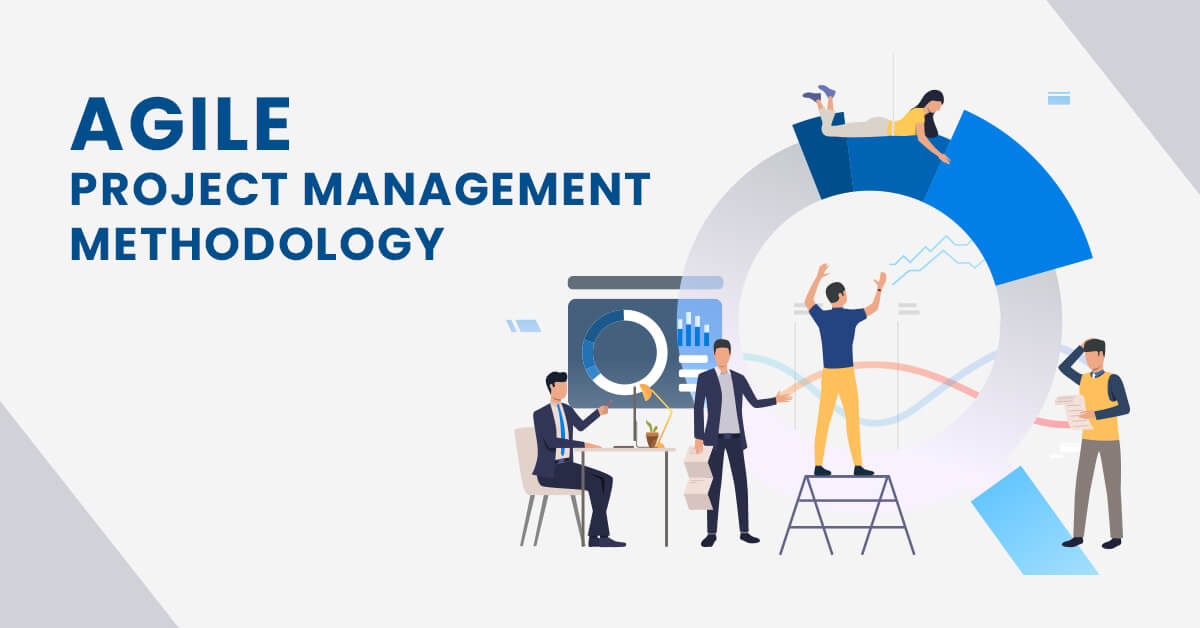
An agile mobile app development methodology is an iterative approach for mobile app development that comprises short development cycles as opposed to the waterfall methodology. In agile methodology, the entire project is divided into multiple sprints where each sprint consists of a few tasks that are assigned to the development team. Each sprint is sent to the client after its completion for client approval or feedback.
Based on the client review, the functionality or app design aspects are changed as required in every sprint to build a full-fledged solution. The methodology accommodates all the steps of SDLC in every sprint development. The team sticks to the schedule, but changes or additions elongate the timeline.
71% of US companies using agile methodology have experienced a 64% success rate in their projects.
When the agile methodology is a good fit for App Development:
- Better control: The project manager would have more control over the project due to sheer transparency in project progress facilitated by agile methodology. The feedback integration makes it easier to control project quality. The continuous tracking and advanced reporting tools enable the manager to keep the project goes on as expected.
- Enhance predictability: The improved visibility into the project progress helps in identifying the risks ahead of time. It allows the team to be ready with risk mitigation plans so that project runs smoothly and is completed before the deadline.
- Enable flexibility: The unparalleled flexibility enables the team to incorporate the changes in the project for the better. Also, when the team fixes the issues in one sprint, they ensure it will not be repeated in the next sprint.
- Get relevant metrics: The agile methodology makes it easier for the team to estimate the app development time and budget. It produces metrics such as cycle time, lead time, and more that help in analyzing team performance and making data-driven decisions.
When agile methodology becomes a challenge for App Development:
- Documentation gets sidetracked: The series of changes made to the app development using agile methodology makes the app up-to-date, but the documentation that’s created at the beginning of the project is not followed accurately.
- Scope creep: The frequent changes in the middle of development make it difficult to see the end of the project, thus scope creep issues pop up.
- Lacks design thinking: Agile methodology involves short cycles that won’t give enough time to the team for the design thinking process. That’s why several iterations to engineer the best experiences are a part and parcel of the app.
Scrum Methodology for App Development
Scrum methodology brings most of the work on the shoulders of the scrum master who is solely responsible to create a list of tasks along with prioritization order. The scrum team comes to the fore divides the whole project into small, manageable chunks, and plans the sprints according to their priorities. The timeline is set for every sprint by the team members in a scrum meeting.
The role of a scrum master is to guide the team and make them perform to their peak efficiency in a focused way.
When scrum methodology is a good fit for App Development:
- Eliminate interpretation: The scrum master clearly defines the roles, rules, events, and more, which simplifies the app development. The semi-prescriptive approach enables removing ambiguities and provides enough space for every member of the team.
- Transparency improves control: With division of complex projects into small tasks makes it easy to manage the project. The 360-degree view of responsibilities and task allocation brings transparency into the projects as everyone knows who is working on which aspect of the app development.
When scrum methodology becomes a challenge for App Development:
- Steep learning curve: When moving from conventional project management to scrum development methodology, it’s difficult to adopt the new approach because the team members need to micromanage the task as the scrum master oversee trivial aspects. The training is a must to make the team avoid project hindrance.
- Large team involvement: Communication stays at the heart of the scrum methodology. When the team is small, documenting every step becomes easy. However, it frustrates the users when the team size gets too large.
Kanban Methodology for App Development
The idea of the Kanban board emerged at Toyota when workers started using inventory cards to ensure the required parts are available when needed. Later, it transformed into a poster and whiteboard to improve control over project progress. Kanban board improves the workflow, operational efficiency, and results by allowing the team and manager to visualize the progress and process from start to end.
The improved visualization makes it easy to identify and fix the issues during the app development. In this methodology, the work moves ahead from one state to another with the feasibility of task reprioritization.
When Kanban methodology is a good fit for App Development:
- Omnipresence: The cloud-based Kanban board is accessible by the employees every time, everywhere. In the age of remote workstyle, the Kanban board keeps the employees connected and allows them to share great ideas on the board whenever required.
- Enable flexibility: The team is focused on the work as they pick up the task from the backlog when they are done with the previous task. The client can change the task priority in the backlog without interrupting the latest task that the team is working on.
- Increase efficiency: The improved visualization of the development process highlights the inefficiencies or bottlenecks that the team can fix quickly.
When Kanban methodology becomes a challenge for App Development:
- Excessive changes: The digital boards facilitate clients to change their priorities and add their ideas limitlessly. It becomes a curse for development as the project leads to an idea dump.
- Desk lock: The digital Kanban boards prevent the desk lock by allowing the team members to collaborate on the project with meetings or daily huddles. However, when there is complex information or a critical issue pops up, in-person interaction becomes essential.
Rapid App Development for App Development
Developers very well know how to create an app, but when it comes to building and launching an app swiftly, they need a development methodology that makes it done.
Rapid application development methodology aims to increase the project turnaround time and release iterations which makes it an attractive choice for businesses. It’s excels at accommodating changes easily and refining the application after every iteration.
When RAD methodology is a good fit for App Development:
- Task management: RAD divides the project into manageable, smaller tasks that are structured in a task-oriented way. It makes task allocation to the different team members on the board based on their experience and expertise becomes effortless.
- Release efficient design: RAD involves taking user feedback into account regularly. Continuous interaction with users and considering their feedback help in improving the build and design process.
When RAD methodology becomes a challenge for App Development:
- Extend development time: The unexpected changes when introduced by the team in the app development based on customer feedback frequently, the scope creeps, and thus, the development time gets extended by an indefinite time. The methodology is not a good fit for fixed-time and budget projects.
Extreme Programming Project Management Methodology for App Development
As the name suggests, the agile framework goes to an extreme level to ensure quality results as promised. The extreme programming lifecycle moves in five phases- planning, managing, designing, coding, and testing to guarantee app success.
At the planning stage, the client requirements for the project are gathered with a clear estimation, then the project is divided into multiple sprints, where each includes a list of tasks, that are managed by the project manager according to priorities. As the project moves into the designing and coding phase, the actual work of developers starts and they keep testing and iterating unless it’s liked/approved by the client or customers. Finally, the product is released on the market.
How do you Choose the right Project Management Methodology?

Now, you have limited choice to narrow down the choice to one methodology, but, still, that’s not an easy task. Theirs is no one-size-fits-all solution. you need to select the methodology that effectively matches the business project needs and maximizes the time and resources usage. Here are a couple of considerations that help in making the right selection.
Flexibility
Trying a hands-on project management tool is essential to know if the nature of the project requires changes in the processes, then it will be facilitated by the methodology or not. Checking Project Management Processes whether facilitating the shift during, after or before project development or not is necessary.
Risk Score
The project that includes experimentation with the latest technology or tool, or adding a unique feature, then it’s necessary to check if the methodology allows businesses to take this calculated risk. For instance, the agile methodology enables making changes at any stage and then testing the users’ response for the same.
Timeline
The time-critical projects that need to be delivered at a pre-defined schedule need to select the methodology that fixes the project scope and timeline in stone. The waterfall methodology fits best for the project with a quick turnaround time.
Stakeholder Involvement
The projects that require consistent approval from the client or key stakeholders, then their involvement is essential. The Project Management Application allows stakeholders to track the project progress, but the selected methodology should include the practice of getting approval or sprint retrospection as it’s facilitated by scrum or agile.
Budget
Knowing the budget set aside for app development is essential before the project planning begins. The methodology selection relies on if the businesses allow changes in budget or want to keep it within predetermined limits. For instance, scope changes increase the efforts, time, and resource consumption, which ultimately surge the budget.
Adopt the right app development methodology
“Once you eliminate your number one problem, number two gets a promotion.” – Gerald M. Weinberg in The Secrets of Consulting
Popular app development methodologies are revealed, but you are expecting the best for your business app. Right? There’s no winner, as the best methodology for mobile app development depends on the project size, project needs, and target audience expectations.
For instance, the waterfall methodology would be the best pick when the long-term project with requirements is set in stone. When the app requires changes to incorporate between the projects, agile methodology adoption for mobile app development works excellently. RAD methodology stands out when it comes to building an app rapidly. The Kanban board is the topmost choice for the remote development team.
List down your mobile app development project needs to select the best methodology for your next project. If you are still trying to figure it out, talk with experienced mobile app consultants, and they will help you to know which one is better and more suitable for your project requirements.
Avantika Shergil
| Apr 9, 2026


Avantika Shergil is a technology enthusiast and thought leader with deep expertise in software development and web technologies. With over 8 years of experience analyzing and evaluating cutting-edge digital solutions, Avantika has a knack for demystifying complex tech trends. Her insights into modern programming frameworks, system architecture, and web innovation have empowered businesses to make informed decisions in the ever-evolving tech landscape. Avantika is passionate about bridging the gap between technology and business strategy, helping businesses build customized software and website, and understand about different tools to leverage effectively for their ventures. Explore her work for a unique perspective on the future of digital innovation.
Popular Blogs
-
How to Choose the right Mobile App Development Company?

-
Questions to Ask Yourself Before Creating an App
-
How To Create A Business Plan For A Mobile App?
-
Guide to Outsource App Development
-
Mobile App Development Cost
-
List of Mobile App Development Frameworks
-
Top Mobile App Development Trends
-
Development of Clone App For your Business