Micro-Investment App Development: Features, Cost & Guide
 By
Avantika Shergil
|
Oct 19, 2026 |
App Development

Micro-investment apps have created new ways for people to participate in financial markets by investing small amounts of money. These applications simplify investment activities through automated contributions, recurring deposits, portfolio tracking, and access to selected financial products. According to The Business Research Company’s micro-investing application market report, the global market is estimated to grow from $1.77 billion in 2025 to $2.08 billion in 2026. This growth outlook highlights the business opportunity for companies developing digital investment platforms, although actual demand depends on the target market, product model, and regulatory environment.
Micro-investing apps in Australia witnessed a marked increase in the number of users (almost doubled) in the last year, according to an article in Financial Review. Micro-investment applications or small investment apps allow users to access and invest in the financial market with as little as a few cents. While these figures are from Australia, the numbers of micro-investment app users are much higher than the world statistics.
For businesses planning to enter this segment, micro-investment app development involves more than creating a mobile interface for buying investments. It requires a suitable investment model, secure financial integrations, transaction processing, portfolio management, and compliance with applicable financial regulations. Understanding these requirements helps businesses define the product scope, estimate development costs, and plan a viable launch.
Table of Contents
What Is a Micro-Investment App?
A micro-investment app is a digital platform that allows users to invest small amounts of money in eligible financial products, such as stocks, exchange-traded funds (ETFs), or mutual funds, depending on the market and the services supported. Instead of requiring a large initial contribution, these apps can let users start with smaller amounts or automate investments based on their budgets and preferences.
For example, an app may allow users to invest spare change from eligible purchases, schedule weekly contributions, or purchase fractional shares where supported by the brokerage and applicable regulations. Some platforms also offer portfolio tracking, educational resources, and automated investment features to simplify account management.
From a business perspective, a micro-investment app can operate as a standalone investment platform or as part of a broader fintech product. Its functionality depends on the target audience, investment products, partnerships, and the regulatory permissions required to offer the service.
Unlike major investments by the rich, micro-investing facilitates everyone to have simple investments or low-cost investments. Micro-investment is also known as low-barrier investment or no-hassle investment where there is potential growth even with little money.
A micro-investment app is a user-friendly software using which individuals can have a hassle-free investment in various schemes and financial projects such as trade, stock, cryptocurrency exchange, and the like.
How Does a Micro-Investment App Work?
A micro-investment app connects users with an investment service through a digital interface. The precise workflow depends on whether the platform supports automated investing, recurring contributions, fractional investing, or professionally managed portfolios. Most platforms follow a series of steps to register users, fund accounts, process investment instructions, and display portfolio information.
Round-Up Investing
Round-up investing allows users to invest the difference between a purchase amount and the next whole currency unit. For example, if a user spends $4.35, the app can calculate a $0.65 round-up. Depending on the provider’s rules, the amount may be accumulated until it reaches a threshold before being transferred for investment.
To implement this feature, the app needs access to eligible transaction data, a reliable round-up calculation mechanism, clear user authorization, and a process for transferring funds. Businesses must also account for transaction delays, reversals, insufficient balances, and failed transfers.
Recurring and Scheduled Investments
Recurring investments allow users to schedule contributions at regular intervals, such as weekly or monthly. The app records the user’s instructions and initiates the applicable funding and investment workflow according to the selected schedule.
The development requirements include scheduling logic, payment or bank integrations, balance checks, transaction status updates, and notifications. Users should also be able to review, modify, pause, or cancel recurring instructions under the platform’s terms and applicable rules.
Fractional Investing
Fractional investing allows users to purchase a portion of an eligible share or other investment instead of buying a complete unit. For instance, a platform may support an investment of $10 in an eligible asset even when its full share price is higher.
This functionality depends on the brokerage or investment provider’s capabilities and the rules governing the relevant market. The app must accurately display order values, execution status, ownership records, fees, and portfolio balances. Fractional investing should not be advertised as available for every asset or through every brokerage integration.
Automated Portfolio Management
Some micro-investment apps offer automated portfolio allocation based on a user’s stated objectives, time horizon, risk preferences, and other permitted inputs. Depending on the product, this may involve model portfolios, automated rebalancing, or recommendations generated through an investment service.
Businesses must distinguish basic portfolio tools from personalized investment advice or discretionary portfolio management. The latter may trigger additional licensing, supervision, disclosure, and compliance requirements. Product design should make the scope of automation clear and avoid suggesting that automated investing guarantees returns.
Micro-investment apps are built to invest a routine in every user’s life because they can put little money into various schemes on the go. The apps take a tiny share out of each transaction and that’s how it starts making revenue. Largely, the app functions in three ways –
- The app may round off the figure spent by each user. For instance, if the amount transacted is $17.80 then the app rounds it off to $18.00 and the remaining $0.20 shall be invested in your selected source.
- Another functionality of the micro-investment app is a bit more uniform where the app or platform shall deduct a specific amount (decided by you) from your account daily, weekly, monthly, quarterly, or even yearly. This amount shall be put into selected micro-investing schemes.
- The last function of the micro-investment app is a trigger-based investment. The app shall trigger a certain amount if it exceeds or touches a specific number. For instance, if you have put a threshold of $100 for spending, $10 shall be deducted and invested automatically. This way, savings shall happen as you touch or exceed certain spending on the app.
What Are the Benefits of Micro-Investment Apps?
Micro-investment apps can create value for both end users and businesses when the product is designed around clear financial needs, transparent fees, and responsible investing practices.
Lower Entry Barriers for Investors
Smaller investment amounts can make eligible financial products accessible to people who do not want to begin with a large contribution. This can help users develop regular investing habits while choosing amounts that fit their financial circumstances. However, minimum investment requirements still depend on the product, brokerage, and market.
Convenient and Automated Investing
Features such as recurring contributions and round-up investing reduce the need for users to initiate every investment manually. Automated workflows can improve convenience, provided the app clearly communicates when funds will be collected, how investment instructions will be processed, and what happens when a transaction fails.
Portfolio Visibility and Account Management
A centralized dashboard can help users review their holdings, contributions, transaction history, and portfolio performance. Clear reporting allows users to understand their investment activity without having to navigate multiple screens or external services.
Opportunities for Fintech Businesses
For businesses, micro-investment platforms can support several product models, including brokerage-linked apps, investment features within digital banking products, and subscription-based financial tools. The appropriate model depends on customer demand, partner availability, regulatory requirements, and the cost of maintaining financial integrations.
Personalized User Experiences
Goal tracking, configurable investment schedules, educational content, and relevant notifications can make the experience more useful for different user groups. Personalization should rely on appropriate data permissions and be designed carefully when it influences investment decisions or falls within regulated advisory activities.
Promotes investment
Micro-investment apps promote investment through their ease of use and guaranteed secure transactions. Earlier, any investment and trading used to involve a lot of paperwork and hassle which micro-investment platforms have successfully overcome. Also, since such apps offer little amount investment plans, people from low- and mid-income groups can easily invest. Overall, such apps have promoted investment throughout all income classes.
Trading on the go
Mobile apps for financial investments have made it a cakewalk for all types of investors as all trading and financial transactions are done through handheld devices, within a few taps. From searching for the best investment plan to stock trading, payday loans, and one-day investment plans, everything is on the go.
Affordable and quick
Micro-investment plans are affordable because they require quite a little funding which almost everyone can afford. For instance, a few micro-investing plans ask for investments of as little as $10. Hence, it is affordable. Another aspect of micro-investment mobile apps is all the transactions done on the platform are quite quick because there is less paperwork and everything is digitally approved and verified.
Less tedious task
Many people, in the past, avoided investments due to tedious paperwork and lengthy procedures for transactions and trading. Removing all such hassles, micro-investment apps offer less tedious procedures and make all business on the app easier than ever before. Due to this very reason, more and more people now approve micro-investment plans via mobile apps.
Minimal fees
Since the workforce or manpower is reduced drastically on all digital platforms, the cost per transaction or trading has been markedly brought down. In other words, there are minimal fees for micro-investments; thus, people save a large chunk of money over time.
What are the well-known business models of a Micro-investment app?
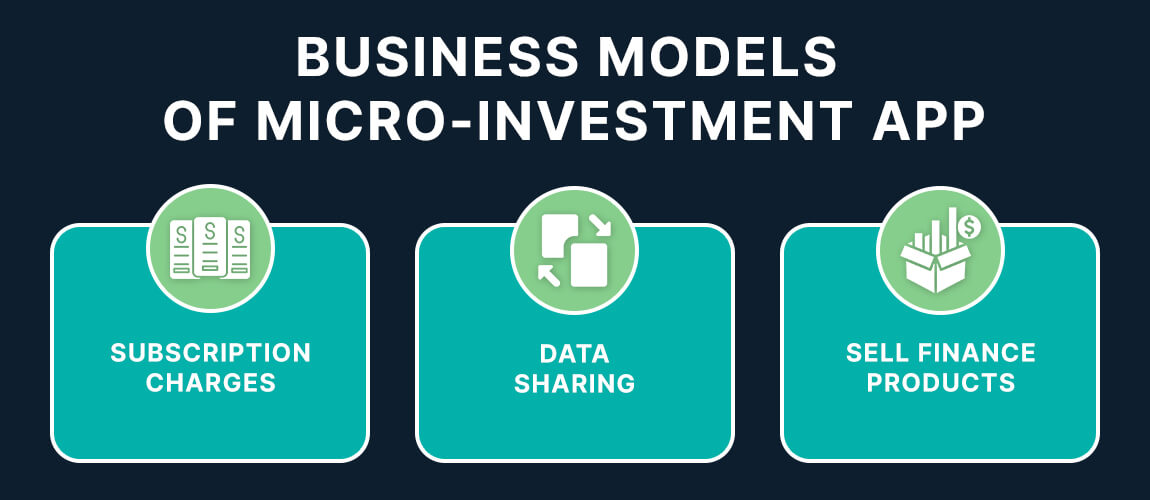
Micro-investment apps can mint money for a businessperson through various models. To keep a micro-investment business up and running, the apps can adapt several ways to generate steady revenues. Here are a few to describe –
Subscription Charges
Opposite to a freemium model, where users are offered some basic features of micro-investment software applications, subscription-based premium models offer more. Users can fully utilize the app’s features with no restrictions. Investment is a long-term process and, therefore, the subscription-based micro-investment apps would have monthly and yearly options which can generate steady income for business owners.
Data Sharing
Not crucial or personal data, but general user data can be shared. Most micro-investing apps gather enormous data from hundreds of thousands of investors from all over the world. Such data can be shared with authentic third-party apps or companies who shall pay commissions for such services to the micro-investment app owners.
Sell Finance Products
Micro-investment applications shall have great investment potential through their services and products. While you can offer various investment options to users, financial firms would also wholeheartedly pay you for their highlighted posts that are featured on your micro-investment platform app.
Fintech apps are built to offer smooth operations and ease of transactions for every trade or business that happens on the platform. There are many micro-investment fintech apps on the market; nevertheless, there are a few features commonly found on each of them. Here are they –
What Are the Essential Features of a Micro-Investment App?
A micro-investment app needs features that help users manage their accounts, fund investments, track portfolios, and monitor transactions. The feature set depends on the business model, target market, investment products, and integrations available through financial service providers. Businesses should prioritize the capabilities required for a reliable minimum viable product (MVP) before introducing advanced automation and personalization features.
User Registration and Identity Verification
User registration allows customers to create accounts using their email addresses, phone numbers, or supported authentication methods. The onboarding process may also collect personal information, verify contact details, and establish secure account access.
Identity verification helps financial service providers meet applicable Know Your Customer (KYC) and anti-money laundering (AML) requirements. Depending on the target market and investment products, the app may need identity document checks, address verification, sanctions screening, and additional eligibility assessments. Integrating a suitable verification provider can simplify these workflows while protecting sensitive customer information.
User Profile and Account Management
A user profile allows customers to manage their personal details, linked accounts, investment preferences, notification settings, and security options. The app should provide clear access to account statements, consent settings, privacy information, and available account management actions.
For investment products that require suitability assessments or risk disclosures, the onboarding workflow should collect the necessary information before enabling relevant features. Businesses should also establish procedures for updating customer information and handling account restrictions or closure requests.
Bank Account Linking and Investment Funding
Bank account linking enables users to connect an eligible funding source to their investment account. Depending on the market and provider, this may involve open banking integrations, bank transfers, direct debit arrangements, or other supported payment methods.
The app should display funding instructions, transaction status, processing times, and applicable fees. It must also handle failed transfers, duplicate requests, reversed transactions, and insufficient balances. Secure authorization and reconciliation processes help ensure that displayed balances match the underlying financial records.
Automated Investments and Round-Ups
Automated investment features allow users to schedule contributions or invest eligible spare change from purchases. These features can reduce manual effort and encourage consistent participation, provided users understand the funding rules and potential investment risks.
The development team needs to implement scheduling logic, user-configurable limits, authorization controls, transaction tracking, and exception handling. Users should be able to modify or stop recurring instructions, while the system should prevent duplicate processing and notify users when an investment cannot be completed.
Investment Options and Portfolio Tracking
A micro-investment app may offer access to eligible stocks, exchange-traded funds (ETFs), mutual funds, or other investment products, depending on its business model and regulatory permissions. Users should be able to review available investments, relevant disclosures, applicable fees, and the risks associated with each product.
Portfolio tracking provides an overview of holdings, invested amounts, cash balances, transaction history, and performance over time. Accurate reporting depends on reliable market data, transaction records, and reconciliation with the relevant brokerage or investment provider. The interface should distinguish realized and unrealized gains where applicable and explain how performance figures are calculated.
Transaction History and Reconciliation
A transaction history helps users review deposits, withdrawals, purchases, sales, fees, and other account activities. Each record should display relevant details, such as the transaction date, amount, status, and reference number when available.
Behind the interface, reconciliation processes compare the app’s records with those maintained by banks, payment providers, and brokerage partners. These processes help identify discrepancies, delayed settlements, duplicate transactions, and failed operations. Maintaining an auditable record of financial activity is essential for resolving disputes and supporting operational controls.
Risk Information and Investment Calculators
Investment calculators can help users estimate how regular contributions might accumulate over a selected period under different assumed rates of return. Risk information can explain market volatility, potential losses, fees, and the characteristics of available investment products.
Calculators should clearly state their assumptions and avoid presenting hypothetical projections as guaranteed outcomes. If the app offers personalized recommendations or advice, businesses must assess the additional regulatory and suitability requirements that may apply.
Notifications and Customer Support
Notifications keep users informed about deposits, investment execution, failed transactions, account verification, scheduled contributions, and important account activity. Email, push notifications, and SMS can be used according to the event, user preferences, and applicable communication rules.
Customer support features may include help articles, contact forms, chat, and ticket tracking. Since investment-related issues can involve financial discrepancies or account access, support teams need procedures for verifying users, escalating sensitive cases, and protecting confidential information.
Admin Dashboard and Reporting
An admin dashboard gives authorized staff an overview of platform activity, user accounts, verification status, transactions, integration health, and support requests. Role-based access controls should limit the information and actions available to each employee.
Reporting tools can help businesses monitor onboarding completion, transaction failures, user engagement, operating costs, and system performance. Administrative actions should be logged, sensitive data should be protected, and financial records should remain traceable for auditing and dispute resolution.
Which Features Should Be Included in the MVP?
The MVP should include the capabilities required to onboard eligible users, accept authorized funding, execute supported investment instructions, display account information, and provide basic customer support. The precise scope depends on the investment provider, operating market, and applicable regulations.
- Account access: Registration, secure authentication, and profile management.
- Compliance: Required identity verification, eligibility checks, and disclosures.
- Funding: Supported bank account linking and deposit workflows.
- Investment execution: Integration with an authorized brokerage or investment provider.
- Portfolio visibility: Holdings, transaction history, balances, and basic performance reporting.
- Security and operations: Access controls, audit logs, error handling, reconciliation, and customer support.
Features such as advanced portfolio analytics, personalized recommendations, extensive financial education, and additional investment products can be introduced in later releases if they align with user needs and the business strategy. However, essential security, compliance, and financial control requirements should not be deferred simply to reduce the initial development budget.
How to Develop a Micro-Investment App?
Building a micro-investment app requires coordinated planning across product strategy, financial integrations, software architecture, security, and regulatory compliance. The development process should account for how users fund accounts, how investment orders are processed, and how financial records remain accurate across connected systems. A structured approach helps businesses prioritize essential functionality, manage development costs, and prepare the platform for long-term operation.
Define the Business Model and Target Market
The first step is to identify the intended users, investment products, and business model. A platform designed for first-time investors may prioritize small recurring contributions and educational resources, while an app serving experienced investors may require more detailed portfolio analytics and investment controls.
Businesses should also decide whether the product will operate through a brokerage partner, integrate investment services into an existing fintech platform, or provide another permitted financial service. These decisions influence the required licenses, third-party partnerships, revenue model, feature scope, and operating costs.
Research Competitors and Validate the Idea
Competitor research helps businesses understand the features, pricing structures, onboarding processes, and investment options available in the target market. Reviewing existing products can reveal unmet user needs, such as clearer fee disclosures, simpler recurring investment controls, or improved portfolio reporting.
Customer interviews, surveys, prototype testing, and market research can help validate these opportunities before substantial development begins. The findings should inform the product requirements, MVP scope, and success metrics, such as onboarding completion, successful funding, transaction reliability, and user retention.
Determine the MVP Features
The minimum viable product should focus on the smallest set of features needed to deliver the intended investment service safely and reliably. Typical requirements include user registration, identity verification, funding, investment execution through an appropriate provider, portfolio tracking, transaction history, and customer support.
Advanced features should be prioritized according to user demand, technical complexity, regulatory implications, and available budget. Essential security controls, financial reconciliation, audit logging, and required compliance workflows must be included from the beginning rather than treated as optional enhancements.
Select the Technology Stack and Architecture
The technology stack should support secure account management, financial transactions, reliable API communication, and accurate portfolio reporting. The choice of mobile development framework, backend language, database, cloud infrastructure, and monitoring tools depends on the product requirements, team expertise, integration constraints, and expected scale.
A typical architecture includes a mobile application, backend services, a database, authentication and authorization components, financial integrations, and administrative tools. Sensitive financial operations should be handled through controlled backend workflows rather than relying on the mobile client to enforce transaction rules.
Businesses should also plan for encryption, secure key management, backup and recovery, system monitoring, and controlled software releases. These decisions form part of the broader mobile app development life cycle, from requirements and design through development, testing, deployment, and ongoing improvements.
Design the UI/UX
The user interface should make account balances, available funds, investment instructions, fees, and transaction statuses easy to understand. Since users may be unfamiliar with financial terminology, onboarding screens and investment workflows should explain important actions without overwhelming them with unnecessary information.
Designers should create wireframes and interactive prototypes for account registration, identity verification, bank linking, investment selection, transaction confirmation, and portfolio management. Usability testing can help identify confusing steps before development is completed. Accessibility, error messages, consent screens, and confirmation prompts should also be included in the design process.
Integrate Financial APIs and Investment Services
Financial APIs connect the app to the external services needed to verify identities, link bank accounts, obtain market data, transfer funds, and execute investment orders. The integrations required depend on the product model and the responsibilities handled by each financial partner.
Before choosing a provider, businesses should assess supported markets, licensing arrangements, available financial products, API documentation, security controls, transaction fees, service availability, and support policies. The development team must also implement authorization, input validation, error handling, retry controls, and reconciliation procedures.
Integration testing should cover delayed responses, service outages, duplicate requests, rejected orders, failed transfers, and inconsistent transaction statuses. These scenarios are particularly important because a technical failure in a financial workflow can affect account balances and user confidence.
Implement Security and Compliance Controls
Security and compliance requirements should be defined before the app handles real customer information or investment transactions. Depending on the jurisdiction and services offered, the platform may need identity verification, anti-money laundering controls, transaction monitoring, customer disclosures, data retention policies, and procedures for handling complaints.
Technical safeguards may include multifactor authentication, encryption in transit and at rest, role-based access control, secure session management, rate limiting, audit logs, vulnerability testing, and continuous monitoring. The business should also establish an incident response process and define responsibilities among the app operator, brokerage, banking partners, and other service providers.
Legal and compliance specialists should review the business model and integrations before launch. Using a third-party provider does not automatically transfer every regulatory obligation away from the company operating the app.
Test the App and Validate Transactions
Testing should cover both the user interface and the financial operations performed by the backend. Functional testing verifies registration, funding, investment instructions, account updates, notifications, and transaction history, while integration testing checks communication with external providers.
Performance, security, usability, and recovery testing are also necessary. The team should verify that duplicate requests do not create duplicate transactions, failed operations are recorded correctly, balances reconcile with source records, and users receive accurate status updates.
Before launch, the business should complete user acceptance testing, resolve high-priority defects, review compliance requirements, and confirm that support and incident management procedures are operational.
Launch, Monitor, and Maintain the App
After testing and required approvals, the app can be released to the intended market. A controlled rollout can help the team monitor onboarding completion, transaction success rates, API reliability, application performance, and user feedback before expanding availability.
Post-launch work includes fixing defects, updating dependencies, adapting to financial provider changes, monitoring security risks, and improving features based on usage data. Businesses should also budget for cloud infrastructure, third-party services, compliance activities, customer support, and regular software updates.
Ongoing mobile app maintenance helps keep the application compatible with evolving operating systems, financial integrations, security requirements, and user expectations. Maintenance planning should therefore be included in the operating budget rather than considered only after launch.
What APIs Are Needed for Micro-Investment App Development?
APIs connect a micro-investment app with external financial services, allowing it to retrieve account information, verify users, process funding requests, access market data, and submit investment instructions. The required integrations depend on the app’s business model, target market, financial products, and the services provided by banking or brokerage partners.
Choosing the right APIs requires evaluating supported features, security controls, transaction limits, documentation, pricing, service reliability, and regulatory responsibilities. Businesses should also confirm which operations the provider performs directly and which remain the responsibility of the app operator.
Banking and Account Aggregation APIs
Banking and account aggregation APIs allow users to connect eligible financial accounts and authorize access to supported account information. Depending on the provider and jurisdiction, these integrations may support balance checks, transaction retrieval, account ownership verification, and payment initiation.
These capabilities can support round-up investing, recurring contributions, and funding workflows. For example, an app may retrieve eligible purchase transactions to calculate round-ups or check an available balance before initiating an authorized transfer. Developers must account for delayed transaction updates, revoked permissions, duplicate records, and failed connections.
Businesses should evaluate the provider’s geographic coverage, supported financial institutions, consent management, data retention practices, and transaction availability before selecting an integration.
Brokerage and Trading APIs
Brokerage and trading APIs connect the application with an investment service that supports eligible financial products and order execution. Depending on the integration, these APIs may provide account information, investment orders, order status, holdings, transaction records, and fractional share functionality.
The development team must understand how the provider handles order submission, execution, settlement, rejected orders, cancellations, and account restrictions. The app should clearly distinguish an order that has been submitted from one that has been executed or settled. Portfolio values and available balances should reflect the appropriate source records and processing status.
Before integrating a brokerage API, businesses should verify the provider’s authorization to offer the relevant services, supported investment products, eligible customer markets, fees, and contractual responsibilities. Access to an API does not automatically authorize a business to provide brokerage or investment advisory services independently.
Market Data APIs
Market data APIs provide information about financial instruments, such as prices, historical values, and other available market indicators. A micro-investment app may use this information to display portfolio valuations, investment details, and performance charts.
Businesses should check whether a provider offers real-time or delayed prices, which exchanges and instruments are covered, and whether commercial display or redistribution is permitted under its licensing terms. The application should also handle unavailable data, market closures, stale prices, and discrepancies between displayed valuations and actual execution prices.
Identity Verification and Compliance APIs
Identity verification APIs help validate customer information during onboarding. Depending on the provider and target market, they may support identity document checks, facial verification, address validation, sanctions screening, and other customer due diligence workflows.
These integrations can reduce manual verification work and help standardize onboarding. However, businesses must define how verification failures, suspicious activity, incomplete applications, and requests for additional documentation are handled. The app should also protect identity records and restrict access to sensitive customer information.
The Financial Action Task Force guidance on digital identity explains how digital identity systems can support customer due diligence and ongoing monitoring. Businesses should use the guidance alongside the applicable requirements in their operating jurisdictions.
Payment and Notification APIs
Payment APIs can support authorized deposits, withdrawals, and other permitted funding operations, depending on the payment provider and financial arrangement. The integration should handle payment authorization, transaction status, failed transfers, refunds where applicable, and reconciliation with the relevant financial records.
Notification APIs allow the app to send transaction updates, verification messages, security alerts, and reminders through supported channels such as email, SMS, or push notifications. Notifications should avoid exposing unnecessary financial or personal information and should follow user preferences and applicable communication requirements.
Businesses should confirm that payment services are suitable for the intended investment use case. A general-purpose payment gateway does not necessarily support securities transactions, brokerage funding, or the regulatory requirements associated with investment services.
How to Choose APIs for a Micro-Investment App?
API selection should be based on the app’s functional requirements, regulatory responsibilities, operating costs, and expected transaction volume. Before committing to a provider, businesses should evaluate the following factors:
- Functional coverage: Confirm that the API supports the required accounts, transactions, financial products, and geographic markets.
- Security and authorization: Review authentication methods, access permissions, encryption, credential handling, and available audit capabilities.
- Pricing: Assess setup charges, subscription fees, per-request pricing, transaction charges, and any additional licensing costs.
- Reliability: Review service availability, rate limits, response times, incident communication, and support arrangements.
- Documentation and testing: Check the quality of technical documentation, sandbox access, sample workflows, and testing support.
- Compliance responsibilities: Establish which obligations are handled by the provider and which remain with the business operating the app.
- Scalability: Determine whether the integration can support projected user growth, transaction volume, and future product requirements.
The development team should test each integration in a sandbox environment before connecting it to live financial services. Testing should include authorization failures, duplicate requests, rate limits, delayed responses, provider outages, and transaction reconciliation. Financial operations should also use appropriate idempotency controls and audit records to reduce the risk of duplicate processing and unexplained discrepancies.
How to Secure a Micro-Investment App and Meet Regulatory Requirements?
A micro-investment app processes sensitive personal and financial information, making security and compliance essential parts of product development. The requirements depend on the countries served, the investment products offered, the app’s role in financial transactions, and the responsibilities assigned to its partners.
Businesses should identify applicable obligations during product planning and translate them into technical controls, operational procedures, and testing requirements. Compliance should be reviewed by qualified professionals rather than treated as a checklist that applies identically to every investment app.
Protect Financial and Personal Data
Encryption should protect sensitive information during transmission and storage. Access to customer records, financial data, identity documents, and system credentials should be restricted according to role and business need.
Developers should also use secure credential storage, appropriate key management, data minimization, controlled logging, and documented data retention policies. Sensitive information should not be included unnecessarily in application logs, analytics events, or notification messages.
Implement Strong Authentication and Access Controls
Secure authentication helps prevent unauthorized access to customer accounts and administrative systems. Depending on the risk profile, the app may use multifactor authentication, biometric authentication supported by the device, secure session management, and additional verification for sensitive actions.
Authorization controls should determine which operations a user or employee can perform. For example, customer support personnel may need to review a transaction status without receiving permission to initiate withdrawals or change financial account details. Privileged administrative actions should be logged and reviewed.
Support KYC, AML, and Customer Due Diligence
Know Your Customer (KYC), anti-money laundering (AML), and customer due diligence requirements vary by jurisdiction and business model. Depending on the applicable rules, a platform may need identity verification, sanctions screening, transaction monitoring, recordkeeping, suspicious activity escalation, and ongoing customer reviews.
The app should support the required workflows and maintain appropriate records of verification results, customer consent, and relevant account activity. Where a regulated partner performs some checks, the business should document the allocation of responsibilities and verify that the arrangement meets applicable legal requirements.
Follow Applicable Financial Regulations
Regulatory requirements depend on whether the app provides access to brokerage services, executes investment orders, offers personalized investment advice, manages portfolios, holds customer funds, or performs other regulated activities. Different services may trigger different licensing, registration, disclosure, custody, and reporting obligations.
For example, the U.S. Securities and Exchange Commission’s investor bulletin on robo-advisers explains that automated investment advisory services remain subject to applicable investment adviser laws. Businesses operating in other markets must identify the corresponding local requirements before launching their products.
Legal and compliance specialists should review the proposed business model, investment products, customer onboarding, disclosures, partner agreements, and operational processes. Using a licensed third-party provider does not automatically remove every regulatory responsibility from the company operating the app.
Conduct Security Testing and Continuous Monitoring
Security testing should cover the mobile application, backend services, API integrations, authentication mechanisms, and administrative interfaces. Testing should identify weaknesses such as insecure data storage, insufficient authorization, exposed credentials, and unsafe network communication.
The OWASP Mobile Application Security Verification Standard provides a framework for assessing mobile application security and privacy controls. Its guidance can help development teams structure security requirements and testing across areas such as data storage, cryptography, authentication, network communication, and privacy.
After launch, businesses should monitor suspicious account activity, failed authentication attempts, unusual transaction patterns, API errors, and system availability. An incident response plan should define how security events are investigated, escalated, communicated, and resolved. Regular security reviews and software updates help the platform respond to changing threats and integration requirements.
Which Micro-investment apps are currently popular?
Several renowned micro-investment apps and small investment apps are available in the finance market. For instance, UNest, EarlyBird, Stash Invest, Fidelity Spire, SoFi, Binance, Betterment, Gemini, MoneyLion, StockPile, and so on. Nevertheless, the three investment apps have made their way to the top of the list;
Acorns
As they claim, Acorns helps users save and invest both on the same platform. Users can support spare change and invest while they bank. Through each transaction, users can earn bonus investments. The app also provides a sound knowledge of micro-investment and finance growth in the safest possible way.
Robinhood
Robinhood’s strategy is to help you run your money your way. Robinhood is a super investment app that offers trade stocks, options, ETFs, and other cryptos (Robinhood Crypto) services on a single platform. The best part of why the Robinhood investment app is popular among millions is its zero-commission policy.
eToro
eToro is a social investment and multi-asset brokerage company spread across the world. The platform offers manual and social investment from various options such as stocks, crypto assets, multiple currencies, ETFs, indices, and commodities.
What APIs shall help your Micro-investing app lead the market?
APIs are like power boosters that can help your app for micro-investment perform better than other investment apps. Here are a few APIs you can ask your tech partners when you hire developers to build a customized micro-investment app.
- Plaid API: connects with several banks
- Alpaca Stock Trading API: helps handle regulatory compliances
- Alpha Vantage, Bloomberg Market, Yahoo! Finance API: provides real-time quotes
- ETrade: helps manage user accounts, orders, and search for exchanges
- Finbox & Tradier: gets stock metrics and helps research the finance sector
How Much Does Micro-Investment App Development Cost?
The cost of micro-investment app development depends on the feature set, investment products, financial integrations, security requirements, and regulatory obligations. A basic application with limited investment functionality requires a different budget from a platform that supports automated investing, brokerage integrations, portfolio management, and advanced reporting.
As an initial planning benchmark, a focused fintech MVP built by an experienced offshore development team may cost approximately $20,000 to $60,000, while a production-grade investment platform can require $60,000 to $250,000 or more. These are indicative estimates rather than verified quotes for every micro-investment app. The actual cost depends on the product scope, operating market, provider fees, and compliance requirements.
Depending on the number of features you want, the location you are hiring developers for, and the time taken to develop micro-investment apps (small investment apps) will affect the overall development prices. Nevertheless, according to tech experts, somewhere between $30000 to $50000 you may have to keep your finance ready to get started.
Ultimately, it is the mobile app development company you hire that shall get you the closest estimation or cost breakdown to develop a micro-investment app. Most app development service providers, depending on your business objectives, can get you a free consultation when you contact them.
MVP Development Cost
A micro-investment app MVP focuses on the core functionality needed to validate the business model and deliver the intended investment service. It may include user registration, identity verification, account funding, integration with an investment provider, basic portfolio tracking, transaction history, and an administrative dashboard.
For preliminary budgeting, businesses can consider a range of $20,000 to $60,000 for a focused MVP developed by an experienced offshore team. This estimate assumes a limited feature scope and access to suitable third-party financial services. It may not cover licensing expenses, extensive legal reviews, proprietary trading infrastructure, or every ongoing provider charge.
Cost of Developing a Feature-Rich App
A more advanced micro-investment app may include automated round-ups, recurring investment schedules, fractional investing where supported, advanced portfolio analytics, additional investment products, and more extensive administrative controls. Multiple financial integrations and more complex transaction workflows can increase development effort substantially.
For preliminary planning, a feature-rich investment platform may require $60,000 to $250,000 or more. Platforms that operate across multiple jurisdictions, manage complex financial workflows, or require extensive proprietary infrastructure may exceed this range. Businesses should obtain a scope-based estimate after defining their investment model, regulatory responsibilities, and integration requirements.
Key Factors Affecting Development Cost
Several technical and business decisions influence the final development budget. Evaluating these factors early helps businesses allocate resources and reduce the risk of unexpected expenses.
- Feature complexity: Automated investing, advanced analytics, multiple investment products, and complex administrative workflows require additional design, development, and testing.
- Platform selection: Developing separate native applications for iOS and Android may require more resources than a suitable cross-platform approach.
- Financial integrations: Banking, brokerage, market data, identity verification, and payment services can involve implementation fees and recurring usage charges.
- Security and compliance: Authentication, audit trails, transaction monitoring, security assessments, legal reviews, and regulatory requirements affect both implementation and ongoing costs.
- Development team: Team location, experience, project management, and specialist fintech expertise influence hourly rates and delivery costs.
- Scalability requirements: Infrastructure, monitoring, data processing, reliability, and recovery requirements become more demanding as transaction volumes and user numbers increase.
- Third-party licensing: Market data, brokerage services, and other financial integrations may have separate licensing or commercial terms.
Ongoing Maintenance and Third-Party Costs
The initial development budget is only one component of the total cost of operating a micro-investment app. Businesses must also account for infrastructure, financial service providers, security reviews, customer support, compliance activities, and regular software updates.
As a preliminary planning allowance, annual maintenance may account for approximately 15% to 25% of the initial development cost. The actual amount depends on the application architecture, release frequency, support arrangements, security needs, and complexity of financial integrations.
Other recurring expenses may include cloud hosting, identity verification checks, market data subscriptions, brokerage fees, transaction processing, monitoring tools, and customer service. These costs should be estimated separately because they may increase with user growth and transaction volume.
Businesses should also budget for ongoing mobile app maintenance to address compatibility issues, security vulnerabilities, operating system changes, and updates to financial service integrations. A realistic operating budget should account for these expenses alongside the initial development investment.
How Do Micro-Investment Apps Make Money?
Micro-investment apps can generate revenue through several business models, depending on their target audience, financial products, partner arrangements, and applicable regulations. The right approach should balance commercial viability with transparent pricing and the financial interests of users.
Many monetization models can generate revenue. The Top mobile app development company can help you integrate such models right from the development stage of your micro-investment app. Here are a few to check out –
Subscription Fees
A subscription model charges users a recurring fee for access to selected features or services. Depending on the product, paid plans may include advanced portfolio reporting, additional account management tools, goal tracking, or educational resources.
Businesses should ensure that subscription charges are clearly disclosed and that the available benefits justify the recurring cost. Pricing must also be appropriate for the target audience, particularly when the app is designed for users who make relatively small investments.
Transaction or Service Fees
Some platforms charge fees for specific transactions or services, subject to the commercial arrangements and regulations governing their operations. Depending on the investment model, these may include disclosed service charges or other permitted account-related fees.
Fees should be communicated before users authorize a transaction. Businesses should also evaluate how charges affect small contributions, since fixed fees can represent a significant proportion of a low-value investment.
Assets Under Management Fees
Platforms offering eligible portfolio management services may generate revenue through fees calculated as a percentage of assets under management. The revenue depends on the value of managed assets and the applicable fee structure.
This model may require additional regulatory permissions and operational controls, particularly when the platform provides personalized investment advice or discretionary portfolio management. Businesses must verify the requirements that apply to their service and clearly explain the fees to customers.
Referral and Partner Revenue
A micro-investment app may earn referral or partnership revenue from eligible financial service providers when permitted under the applicable commercial and regulatory arrangements. Potential partnerships may involve investment services, financial education products, or other relevant offerings.
Businesses should disclose material commercial relationships where required and manage potential conflicts of interest. Partner compensation should not lead to misleading recommendations or obscure the costs and risks associated with financial products.
Premium Financial Tools
Some apps offer optional paid tools such as detailed portfolio analysis, expanded reporting, investment tracking, and personalized account insights. These services can create additional revenue opportunities without requiring every user to pay for advanced functionality.
Businesses should distinguish educational tools and general account analytics from regulated investment advice. Features that provide personalized recommendations or manage investment decisions may create additional compliance obligations, depending on the jurisdiction and service model.
The most suitable monetization strategy depends on the app’s operating costs, user activity, target audience, and regulatory permissions. Businesses should assess the expected revenue per user alongside customer acquisition costs, financial partner fees, ongoing maintenance, and compliance expenses before selecting a model.
How to Choose a Micro-Investment App Development Company?
Choosing a development company for a micro-investment app requires more than comparing development rates or reviewing app portfolios. The right partner should understand financial technology, investment workflows, third-party integrations, data protection, and the operational requirements of handling financial transactions.
Evaluate Fintech and Investment App Experience
Review the company’s experience developing fintech applications, digital investment platforms, brokerage products, or personal finance apps. Examine relevant case studies to understand how the team has handled account funding, portfolio tracking, investment transactions, and financial data.
Check API Integration Capabilities
Micro-investment apps often depend on brokerage APIs, banking integrations, payment gateways, identity verification services, and market data providers. Confirm that the development team can integrate these services, manage API failures, handle webhooks, and maintain consistent transaction records.
Assess Security and Compliance Knowledge
Financial applications process sensitive identity, account, and transaction information. Ask how the company implements encryption, authentication, access controls, secure data storage, audit logs, and security testing. Regulatory requirements should be reviewed with qualified legal and compliance professionals for the target markets.
Review Testing and Transaction Reconciliation
Testing should cover more than app navigation and interface performance. The team should validate payment failures, duplicate requests, partial transactions, investment order status, account balance updates, and reconciliation between internal records and financial service providers.
Compare Project Scope, Pricing, and Communication
Request a proposal that separates design, mobile app development, backend engineering, API integration, testing, deployment, and ongoing support. Compare the proposed deliverables, milestone payments, ownership of source code, third-party fees, and assumptions behind the estimate rather than choosing a company solely on its initial quote.
Confirm Post-Launch Support
A micro-investment app requires continued monitoring, dependency updates, security patches, bug fixes, and compatibility updates. Establish who will handle production incidents, API changes, performance monitoring, and future feature releases after launch.
When comparing mobile app development companies, consider their technical expertise, relevant project experience, client feedback, pricing transparency, and ability to support the product beyond its initial release.
Conclusion
Building a micro-investment app involves defining an investment model, selecting the right technology stack, integrating financial APIs, protecting user data, and meeting applicable regulatory requirements. Development costs depend on the app’s features, integrations, target markets, and operational complexity.
A phased approach can help businesses validate their investment concept before expanding into more advanced features. A well-defined MVP, reliable transaction processing, transparent fees, and a long-term maintenance strategy provide a practical foundation for developing and scaling a micro-investment platform.
So now that you have gone through various aspects of micro-investment business planning and app development, you can submit your project and contact professionals to build a bespoke solution to your business needs.
What People want to Know About Micro-Investment App Development?
How much does it cost to build a micro-investment app?
A focused micro-investment app MVP may cost approximately $20,000 to $60,000 when developed by an offshore team. A more advanced, production-grade investment platform may cost $60,000 to $250,000 or more. These are indicative estimates, not fixed market prices. Brokerage integrations, regulatory requirements, security controls, supported markets, and ongoing third-party fees can significantly affect the total cost.
How long does it take to develop a micro-investment app?
A focused MVP may take around four to nine months to develop, depending on the feature set, team size, integration complexity, and testing requirements. A more comprehensive platform may take longer. Financial service provider onboarding, compliance reviews, licensing requirements, and external approvals can also extend the launch timeline.
What features should a micro-investment app have?
Core features typically include user registration, identity verification, bank account linking or funding, investment selection, automated contributions, portfolio tracking, transaction history, fee disclosures, notifications, and customer support. An administrative dashboard should support user management, transaction monitoring, reporting, and operational reviews. The exact feature set depends on the app’s investment model and target users.
Which APIs are required to build a micro-investment app?
The required APIs depend on how the app handles funding and investments. Common integrations include banking or account aggregation APIs, brokerage and trading APIs, market data APIs, identity verification services, payment processing, and notification services. Some products may also need tax reporting, analytics, or customer support integrations. Each provider should be evaluated for supported markets, security, pricing, reliability, and regulatory responsibilities.
How do micro-investment apps make money?
Micro-investment apps may generate revenue through subscriptions, disclosed service or transaction fees, asset-based management fees, premium financial tools, and referral partnerships. The available models depend on the product’s structure, customer segment, and applicable regulations. Businesses should assess how fees affect small account balances and clearly explain charges to users before they invest.
What regulations apply to micro-investment apps?
Regulatory requirements depend on the countries where the app operates, the assets offered, and whether the business provides investment advice, executes transactions, holds customer funds, or acts as an intermediary. Requirements may involve investment services licensing, know-your-customer (KYC) checks, anti-money laundering (AML) controls, consumer disclosures, data privacy, cybersecurity, and recordkeeping. Businesses should obtain jurisdiction-specific legal and compliance advice before launching.
Is fractional investing necessary for a micro-investment app?
Fractional investing is not mandatory, but it can help users invest small amounts when the full price of a share or other eligible asset is higher than their available budget. The feature depends on brokerage support, asset eligibility, order handling, and the applicable market rules. An app can also support small recurring contributions through other investment structures where permitted.
Does a micro-investment app need ongoing maintenance?
Yes. Ongoing maintenance helps keep the app secure, compatible with current operating systems, and reliable as external APIs and financial service providers change. It also includes monitoring transactions, resolving defects, updating dependencies, reviewing security controls, and improving performance. Maintenance costs should be included in the product’s operating budget from the beginning.
Frequently Asked Questions Micro-investment App
I want to create a micro-investment app but don’t know where to start. What to do?
This guide to how to start a micro-investment business app shall take you through the A to Z stages of the business and app development. You need market research and a foolproof plan to develop an app. It’s all mentioned here.
How does a micro-investment app differ from a traditional investment app?
The micro-investment apps or small-investment apps, as the term suggests, attract everyone as they have financial investment options with a micro (small) amount of money. For instance, just a $10 investment. Hence, here, the number of users could be from low to medium-income groups which is quite higher than traditional investment app users.
What types of investments can be made through an app for micro-investment?
Micro-investment apps don’t restrict themselves to a type or two finance plans. You can invest in a stock, cryptocurrency exchange, digital assets, and other such finance sectors.
How can I ensure the security and compliance of my micro-investment app?
Any investing app shall have certificates and compliances set by local and international authorities. You can take the help of a legal finance attorney or can simply ask mobile app development companies that master in building finance apps.
What are the costs associated with developing a micro-investment app?
Costs to develop a micro-investment app include developing a blueprint, wireframe, and prototype of the digital product. Also, the UI/UX of micro-investment apps and development with several tier-security, API integrations, and payment gateways shall have their own costs.
Avantika Shergil
| Oct 19, 2026


Avantika Shergil is a technology enthusiast and thought leader with deep expertise in software development and web technologies. With over 8 years of experience analyzing and evaluating cutting-edge digital solutions, Avantika has a knack for demystifying complex tech trends. Her insights into modern programming frameworks, system architecture, and web innovation have empowered businesses to make informed decisions in the ever-evolving tech landscape. Avantika is passionate about bridging the gap between technology and business strategy, helping businesses build customized software and website, and understand about different tools to leverage effectively for their ventures. Explore her work for a unique perspective on the future of digital innovation.