Engagement Models to Hire Developers: A Comprehensive Guide
 By
Avantika Shergil
|
Jan 21, 2026 |
Hire Developers
By
Avantika Shergil
|
Jan 21, 2026 |
Hire Developers

Hiring models, also known as engagement models, are various ways of cooperation and business deals that you need for a healthy and professional working on your web and software application development project. Most IT outsourcing companies would offer you various ways of costing or quotes through which you can engage required resources for a short or long-term project.
Table of Contents
Why Businesses Should Choose the Right Engagement Model?
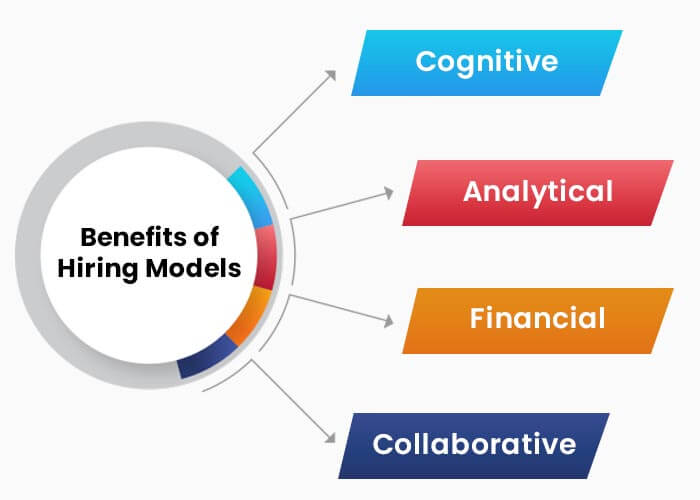
It is of paramount importance that each buyer should know these hiring models in order to save time and money. There are various benefits to learning how one can sign a deal with development companies.
A Better Understanding of the Company
Various models for hiring developers showcase the business models of the IT outsourcing service-providing companies because such offers reflect how much they care about their clients. For any company, clients may range from small to mid-sized to large enterprises and if the IT company does not have a suitable model for all the client segments, they are likely to fail in providing the required services. As a business owner, you would have cognitive input to judge your tech partner.
Sensible Discussion on the Feasibility
If businesses know about the hiring models and how the project is likely to undergo development, they can discuss their business ideas with service providers in a better and more sensible way. By knowing the pros or benefits and limitations of each hiring model, business persons can have the analytical power to plan their project and discuss all the technicalities practically.
A Better Insight into Budget Planning
The development of digital projects comes with various plans and stages wherein entrepreneurs need to think from scratch to the post-production phase of the product. Various hiring or engagement models offered by offshore companies would help outsourcing enterprises have better insight and financial cognizance into budget planning. Businesses with estimated budgets for their projects can be altered depending on the business models offshore companies can offer for hiring their developers.
Fruitful Project Outcomes
By knowing the pros and cons or restrictions of each hiring model, businesses would be able to understand what comes and what does not come under each model and, therefore, they would know the limitations of their expectations. They would avoid skirmishes and conflicts but rather be collaborative with remote developers about including the number of features and facilities in their project; additionally, they would also know the timeline their projects are going to take depending on the engagement model.
Popular Engagement Models to Hire Web, App, and Software Developers
Choosing the right engagement model directly influences how efficiently your product is built, how much control you retain, and how predictable your investment remains. As digital products become more complex and timelines more competitive, modern businesses need engagement models that balance flexibility, accountability, and long term value. The following models are widely used by startups, growth stage companies, and enterprises to hire web, app, and software developers based on specific business goals.
Here are some of the most popular hiring models most development companies offer:
Staff Augmentation and Outstaffing Model
The staff augmentation and outstaffing model allows you to extend your existing team by adding skilled developers from an external partner. Instead of outsourcing the entire project, you integrate dedicated professionals who work as part of your internal team and follow your processes, tools, and direction. This model is often chosen by product owners who want full control over development while scaling quickly.
What You Should Know About the Staff Augmentation and Outstaffing Model as a Product Owner?
In the staff augmentation and outstaffing model, development companies provide skilled web, app, or software developers who work as an extension of your in house team. Instead of outsourcing the entire project, you retain ownership of execution while leveraging external expertise. This model primarily operates on resource based engagement and is structured around how developers are integrated and billed.
The model generally works on the following structures:
- Resource based augmentation: Developers are added to your existing team and work under your direct supervision while following your internal processes and tools.
- Skill specific augmentation: Specialists such as frontend developers, backend engineers, QA experts, or DevOps professionals are hired to address specific gaps in your team.
- Team extension approach: A small group of dedicated developers is assigned to your product for a defined period while remaining operationally supported by the vendor.
- From a product owner’s perspective, success in this model depends on clarity of requirements, strong communication, and the ability to manage distributed teams efficiently.
The Benefits of the Staff Augmentation and Outstaffing Model
- High flexibility: You can scale the team up or down quickly based on project requirements without long term hiring commitments.
- Faster onboarding: Experienced developers can join your project almost immediately, reducing time to market.
- Cost efficiency: You save on recruitment, infrastructure, and employee benefits while paying only for productive hours.
- Full control: You maintain authority over task prioritization, architecture decisions, and delivery timelines.
- Access to global talent: You can hire developers with niche skills that may not be available locally.
The Limitations of the Staff Augmentation and Outstaffing Model for Hiring
- Management responsibility: The client is responsible for task allocation, performance tracking, and delivery oversight.
- Dependency on internal processes: Weak documentation or unclear workflows can reduce productivity.
- Communication challenges: Time zone differences and cultural gaps may impact collaboration if not managed properly.
- Not ideal for non technical teams: Businesses without technical leadership may struggle to extract full value from this model.
When to Choose the Staff Augmentation and Outstaffing Model?
- When you already have a core development team but need additional expertise.
- When project requirements are evolving and demand flexibility.
- When speed is critical and traditional hiring would slow delivery.
- When you want full transparency and control over development activities.
- When you want to test collaboration with developers before committing long term.
Experts’ Take on This Model: Industry experts recommend the staff augmentation and outstaffing model for product driven companies that value agility and control. It is particularly effective for scaling teams quickly without increasing operational burden. When managed well, this model delivers strong productivity and cost advantages while allowing businesses to retain ownership of both technology and outcomes.
Outcome Based Engagement Model
The outcome based engagement model shifts focus from effort to results. Instead of paying for hours or headcount, you invest in clearly defined business outcomes tied to measurable success criteria. This model aligns vendor incentives with your product goals, making accountability a core part of the partnership rather than an afterthought.
What You Should Know About the Outcome Based Engagement Model as a Product Owner?
In the outcome based engagement model, development companies are paid based on predefined results rather than hours worked or resources deployed. As a product owner, this model requires you to clearly define business outcomes, success metrics, and acceptance criteria before development begins. The vendor takes responsibility for execution strategy while being accountable for delivering measurable value.
This model is commonly structured around the following approaches:
- Milestone driven outcomes: Payments are linked to the successful completion of predefined milestones aligned with business objectives.
- Performance based outcomes: Compensation is tied to performance indicators such as speed, quality, user adoption, or system stability.
- Value driven outcomes: The vendor is rewarded based on tangible business impact such as feature delivery, efficiency improvement, or cost reduction.
- For product owners, the effectiveness of this model depends on clarity, trust, and a shared understanding of what success truly means.
The Benefits of the Outcome Based Engagement Model
- Strong accountability: Vendors are motivated to deliver results rather than billable effort.
- Predictable investment: Costs are directly tied to outcomes, reducing budget uncertainty.
- Business alignment: Development efforts stay focused on objectives that matter to stakeholders.
- Reduced management effort: Less need for daily task monitoring since success is outcome driven.
- Encourages innovation: Vendors often optimize processes to achieve results faster and more efficiently.
The Limitations of the Outcome Based Engagement Model for Hiring
- Requires clear definition: Poorly defined outcomes can lead to misunderstandings and disputes.
- Limited flexibility: Frequent scope changes can weaken the effectiveness of this model.
- Higher upfront planning: Time and effort are needed to define metrics and success benchmarks.
- Not ideal for early stage products: Experimental or exploratory projects may lack measurable outcomes.
When to Choose the Outcome Based Engagement Model?
- When project goals and success metrics are clearly measurable.
- When leadership prefers results over activity tracking.
- When working with an experienced and trusted development partner.
- When minimizing delivery risk and cost overruns is a priority.
- When the product has moved beyond experimentation into execution.
Experts’ Take on This Model: Experts consider the outcome based engagement model a strong choice for organizations focused on ROI and accountability. It is best suited for mature products and transformation initiatives where outcomes can be clearly defined. When executed correctly, this model creates a balanced partnership where both client and vendor are aligned toward shared success rather than transactional delivery.
Build Operate Transfer (BOT) Model
The build operate transfer model is designed for companies that want to establish a long term offshore or nearshore development capability without the initial operational burden. In this model, a vendor builds the team and infrastructure, operates it on your behalf, and later transfers full ownership to you once the setup is stable.
What You Should Know About the Build Operate Transfer Model as a Product Owner?
The build operate transfer model is designed for companies that want to establish a long term dedicated development center without managing initial setup and operational complexities. In this model, a development partner builds the team and infrastructure, operates it on your behalf, and later transfers full ownership to your organization once the operation becomes stable.
This model generally unfolds across three structured phases:
- Build phase: The vendor hires developers, sets up infrastructure, ensures legal compliance, and aligns the team with your product vision and processes.
- Operate phase: The vendor manages daily operations, performance, and delivery while the team works exclusively on your product under shared governance.
- Transfer phase: Full control, ownership, and operational responsibility are transferred to your organization, including team members, processes, and assets.
- For a product owner, this model provides a controlled path to building a captive development team while minimizing early stage risk.
The Benefits of the Build Operate Transfer (BOT) Model
- Reduced setup risk: You avoid challenges related to hiring, compliance, and infrastructure in new regions.
- Faster market entry: Teams are built and operational much faster than setting up an in house center from scratch.
- Long term cost efficiency: Operational costs decrease once ownership is transferred.
- Knowledge continuity: Teams gain deep product understanding before transition.
- Strategic control: You eventually own the team, processes, and intellectual property.
The Limitations of the Build Operate Transfer Model for Hiring
- Long term commitment: This model requires a clear long term vision and investment.
- Complex governance: Legal, operational, and financial alignment must be planned carefully.
- Vendor dependency in early stages: Initial success depends heavily on partner capability.
- Not suitable for short projects: Small or temporary initiatives may not justify this model.
When to Choose the Build Operate Transfer Model?
- When you plan to scale product development long term.
- When expanding into a new geography without local operational expertise.
- When building an offshore or nearshore captive development center.
- When you want ownership without early operational burden.
- When stability, retention, and long term control are strategic priorities.
Experts’ Take on This Model: Experts recommend the build operate transfer model for enterprises and scaling companies that want sustainable global development capabilities. It bridges the gap between outsourcing and in house teams by reducing early risk while ensuring future ownership. When executed with the right partner, this model delivers long term stability, cost efficiency, and strategic independence.
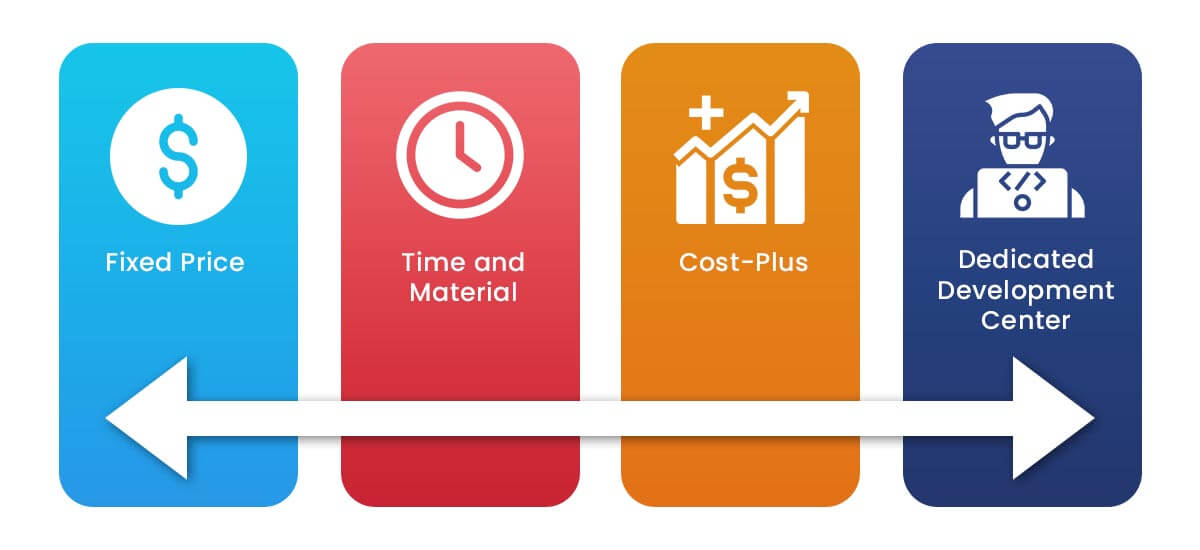
Fixed Price Engagement Model
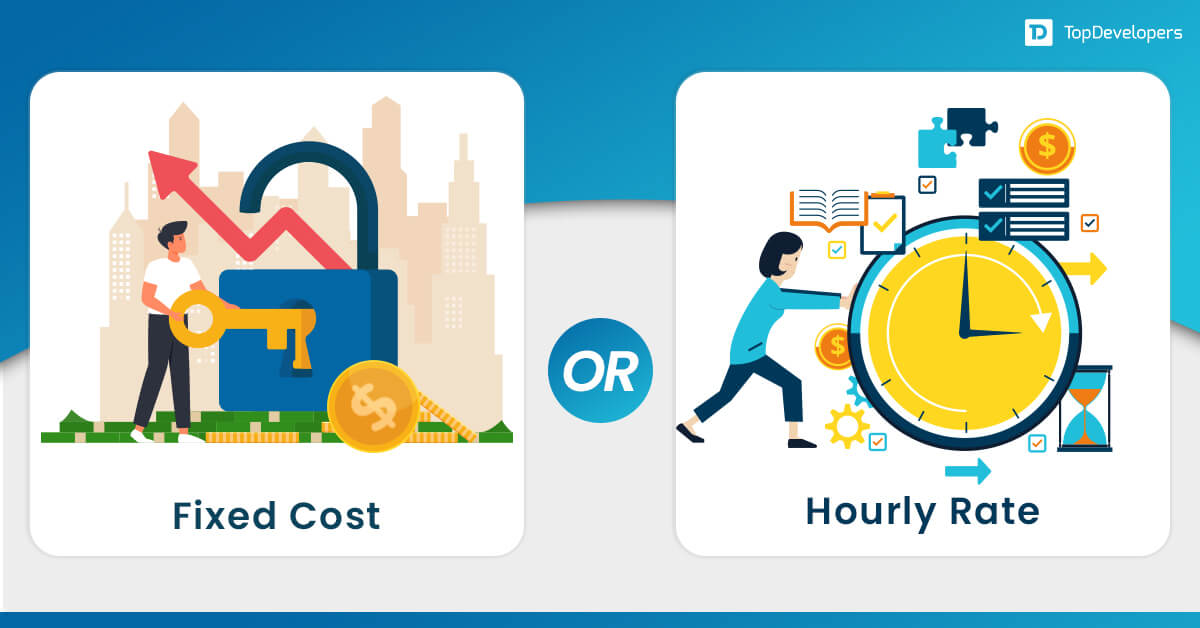
Also known as a lump sum contract or fixed bid, the fixed price engagement model is quite straightforward as its name. This model is all about agreeing on a price that is fixed to build a specific software product, tool, or solution with specific needs or features. Business owners need to document all the project scopes meticulously and draw out detailed requirements with sharply defined milestones and deliverables.
Simply put, the fixed model is a perfectly defined requirement, project scope, and a clear picture of your final product. There are little to no chances to change, amend, or alter anything from the defined scope of the project.
What you Should know about the Fixed Price Model as a Product Owner?
Before the development hits kickstart, the development service providers would vigorously check your business idea and may ask you a series of extensive questions during interviews or writing emails. Every little detail is carried out along with user stories and the product’s goal to understand the number of features and facilities required. While carrying out the pricing of this model, business and technology consultants at IT outsourcing companies would jot down the technical specifications, tech stacks, development schedules, methodology, and other protocols, if any.
Benefits of the Fixed Price Engagement Model
- Precise price and time: The fixed price model gets you the firmest idea about the budget you require for the project. From the very beginning, you are quite clear about how much money you are going spend on software product development.
- Transparency and accuracy: With the fixed price engagement model in place, you have transparency and accuracy throughout your product development life cycle. There is nothing ambiguous or gloomy about the project.
- Minimal management and supervision: Clients are at ease when they adopt a fixed-price hiring model because it is like fixing up the price and then kickstarting the project. After the said time, you receive a product exactly the way you have defined it. There is no intervention required in between.
Limitations of the Fixed Price Engagement Model
- Little or no flexibility: Since the fixed pricing model suits projects with clear scope and calculated objectives, the flexibility to change or alter anything are little. Any shortcomings at the end of the project would come with a cost to change. If the development period of the product is longer, then there are chances that the features and facilities in the product get outdated and you will be stuck with old ones with the same product with no change.
- Bigger homework: The fixed rate model will require you to have clarity on your project and firm documentation of business objectives and clear project scopes. This takes a lot of time because you will not be relying on any change during the project development.
- A costly affair: The fixed price engagement model for hiring developers has a comparatively higher cost than other models. The costs calculated are advanced and inclusive because the development companies would not take any chance of missing out on anything.
When to Choose the Fixed Price Engagement Model?
- When the project scope is clear.
- When you have clarity on the number of features and facilities to be included.
- When you have short to medium-term projects.
- When you want to build MVP (Minimum Viable Project) for a larger project.
- When you have a fixed amount of budget.
Experts’ take on this model: Don’t go for this hiring model if this is your company’s first project and your business is likely to vary in its features and scopes while in the development phase.
Time and Material Engagement Model
Abbreviated as the T&M hiring model, the time and material model offers more flexibility as compared to the fixed price engagement model. Here, you don’t have a clear vision of the product and there are chances of changes in the market and user demand, you cannot have a list of fixed features and facilities. In such a case, you can divide the creation of a product or project either into a smaller portion and go with the fixed model, or use the time and material engagement model and get the product developed as it goes.
What you Should know about the Time and material Model as a Product Owner?
Unlike the fixed price model to hire developers, the business and technology consultants don’t require to dig in deeper to understand the requirements of the project. The Time and Material model is the easiest way to get on board and start the project. The dedicated development team members would simply listen to the client and keep working unless the product is developed. Both parties are clear that the invoice would be made as the human hours are spent.
The T&M engagement model needs more involvement of a client but at the same time offers greater project control. The time and material model allows flexibility to change the size and composition of the product.
Benefits of the Time and Material Engagement Model
- Better control over the project: Compared to the fixed budget model, the time and material model offers more control over the project.
- Low risk: The T&M model offers the lowest possible risks to clients and developers while developing the project.
- Quick kickstart of the project: Since the project does not ask a solid homework on clarifying the project scope, developers can quickly get on to the project in the shortest time.
- Ideal for agile method: Many enterprises prefer adopting the agile method for their product development process. The time and material engagement model is a perfect fit for the agile approach.
- Sheer flexibility: When it comes to the budget and scope of the project, the time and material model is unbeatable. It offers immense flexibility to everyone to change or add objectives.
Limitations of the Time and Material Engagement Model
- More client involvement: As compared to the fixed price model to hire developers, the time and material one asks for more client engagement.
- Unsure development time: There is no confirmation or guarantee on the timeline provided or estimated for software project development. The timeline is also flexible.
- Chances of development cost discrepancy: There are chances of a discrepancy between the estimation and the real cost of the software development.
When to Choose the Time and Material Engagement Model?
- If the project scope and objectives are not clear or precise.
- When it is not possible to dedicate specific time and resources to the project.
- When there are chances of change in the scope and objectives of the project during development.
- If the project is large in size and more complex.
- After MVP is built and now the product is to be completed with full-fledged features.
Experts’ take on this model: Choose this model if you need long-term cooperation from developers and there are all chances to add features as your market, user, or industry research progresses.
Non-Fixed Price: Cost Plus Engagement Model
Used for outstaffing or personal leasing, the cost-plus engagement model for hiring developers is a practice wherein IT companies lend some of their resources to other companies that are outsourcing their mobile app development for a certain period. It is like acquiring the entire team of developers or QA engineers etcetera until they complete the project.
In this model, the client bears all wages and expenses that incur during the project development plus the contractor’s fees. In other words, at the end of the month, the contractor will have an invoice with a comprehensive breakdown of all deliverables and expenses involved. Often known as the Open Book Model, this model exhibits fair price transparency, and the invoice may range from electricity expenses to the costs of entire team management.
What you Should know about the Cost-Plus Engagement Model as a Product Owner?
The development companies would calculate the profit margin of the product and therefore, the model is calculated on three criteria:
- Cost plus fixed fees: Here, the fees of contractors or remote resources working onsite are frozen with a fixed-cost contract.
- Cost plus percent fees: The dedicated remote developers’ fees are proportional to the total project expenses [Expert’s advice: avoiding this is beneficial because there are chances that contractors may spend more to increase their profits or shares]
- Cost plus incentive fees: In this sub-model, the profit of the contractor is carried out by calculating the ratio of target cost to actual cost. In other words, remote developers would get more for spending fewer hours i.e., if they work faster, they earn more.
The Benefits of the Cost-Plus Engagement Model
- Faster: If the cost-plus incentive fees model is implemented, the project finishes much faster.
- Affordable: The overall cost would be lesser and thus enterprises can save money.
- Less risky: The cost-plus hiring model is said to involve fewer risks as compared to the fixed-price model and therefore, clients can be at ease adapting to this.
The Limitations of the Cost-Plus Engagement Model for Hiring
- The contract, when signed for the cost-plus model, clearly mentions that the buyers or clients need to inform developers a couple of months in advance when they want to terminate or cancel the services. This makes this model quite gloomy.
- The client needs to pay more attention to every bit of progress to avoid padding the bill.
When to Choose the Cost-Plus Engagement Model?
- When you don’t want any headaches managing the team.
- When you want complete transparency in billing and project development.
- When there are fewer chances of change in the objectives of the project during development.
- If the project is medium-sized and include not much complexity.
- After MVP is built and now the product is to be completed with full-fledged features.
Experts’ take on this model: Go for this model if you need an affordable model yet fast delivery with fewer risks. A small to medium-sized project with somewhat defined scopes is a good fit for this model.
Dedicated Team Model or Dedicated Development Center Model
The DDC (Dedicated Development Center) or dedicated team model is a non-fixed pricing model wherein software development companies offer their teams of experts and other domain experts to create a fully-fledged offshore development center. The offshore company provides all the resources who would dedicatedly work for the clients’ projects and nothing else. They are never asked to get involved in other projects of the company.
The cost of the dedicated model includes the combined salary of all the resources (generally billed monthly) and the fees of the IT Company for management and infrastructure. The best part of this model is that the dedicated team can integrate with the client’s in-house teams, if any. The existing team could adopt all the corporate culture, etiquette, methodologies, and industry-standard practices you want. This is an awesome option for those who want to leave no stone unturned to make their product feature-rich and competitive.
What you should know about the Dedicated Team Model as a Hire?
The development service providers would carefully check your business objectives and project scopes. If they feel that the project has great potential and requires utterly dedicated attention, they would suggest the dedicated team model. Large enterprises, for whom budget is not an issue, would be advised to go for this DDC model because the end product would be much superior and aligned with the business goal.
The Benefits of the Dedicated Development Center Model
- Super control: Exceptional control is on the buyer’s hand. The control includes every aspect of software project development and team management. The clients can handpick the top developers and make their own team from the bulk.
- Guaranteed security: The DDC model is the offshore company’s flagship model and, therefore, they have immense measures to keep it secure and safe.
- Estimated budget: In most cases, the dedicated team engagement model has a predictable budget despite varying work and flexible scopes.
- Immense flexibility: As compared to other engagement or hiring models, the dedicated development team model would offer great flexibility and compatibility with agile methodology.
- Scaling the teams: Scalability i.e., cutting the team size or expanding is possible at no extra costs.
When and How to Change Development Team in the Middle of a Project?
Limitations of the Dedicated Development Center Model
- Costlier as compared to others: Since the project would have an entire dedicated team, the cost would go higher compared to other engagement models.
- Active participation of clients: Since the team is dedicatedly working on a single project, active participation of clients is required in order to receive regular updates and work with the team as a supervisor; nevertheless, a development company can provide a manager on request to take care of all the progresses
- Knowledge transfer: Scaling the teams up and down would require knowledge transfer among the developers and stakeholders. This may consume time and delay the project.
When to Choose the DDC Model?
- If you want to expand your existing team with global talent.
- When the project is big and complex.
- When you don’t want any hassle of team management.
- If the goal is to get the best product with high scalability, UI/UX, and a feature-rich approach.
- When you want highly customized software tools or solutions for your big business operations.
Experts’ take on this model: Choose this model if you need the best product that is feature-rich, customized, and terrifically user-oriented. Larger enterprises must adopt this model to have their end-product stand out in the market.
A 2-MINUTE DECISION-MAKING TABULAR GUIDE TO BUYERS
| Suitable model if… | Fixed Price | Time and Material | Cost – Plus | Dedicated Team |
|---|---|---|---|---|
| Your project size is… | Small | Small to Medium | Small to Medium | Medium to large |
| You want control over the project… | Less | Less to medium | Less to medium | Total |
| You want to scale the team size up and down… | Not possible | Not possible | Not possible | possible |
| You want to change scope… | Not possible | Possible | possible | possible |
| You want to have a budget idea… | Clear | Not Clear | Not Clear | Somewhat clear |
| You want to spend… | Low to Medium | Medium to high | Medium to high | High |
| You have your project objectives… | Clear | Somewhat clear | Somewhat clear | Somewhat clear |
| Your project has complexity… | Minimal | Somewhat complex | Somewhat complex | Complex |
Start Hiring Developers Now
Engagement models are designed to fit projects of different sizes and complexities. Depending on your business requirements and project scope, you may choose the one that suits your budget. Alternatively, you can also ask IT outsourcing companies you shortlist about the engagement models they practice and the ones that they recommend for your project.
Avantika Shergil
| Jan 21, 2026


Avantika Shergil is a technology enthusiast and thought leader with deep expertise in software development and web technologies. With over 8 years of experience analyzing and evaluating cutting-edge digital solutions, Avantika has a knack for demystifying complex tech trends. Her insights into modern programming frameworks, system architecture, and web innovation have empowered businesses to make informed decisions in the ever-evolving tech landscape. Avantika is passionate about bridging the gap between technology and business strategy, helping businesses build customized software and website, and understand about different tools to leverage effectively for their ventures. Explore her work for a unique perspective on the future of digital innovation.